Language
Language
- involves
- recognition of speech
- comprehenshion of speech
- motor production of speech
- cognitive production of speech
- reading
- writing
Brain Regions
Motor Regions
- primary motor cortex: motor neurons control muscles involved in speech production
- jaw
- lips
- tongue
- vocal cords
- basal ganglia: facilitates automatic sequences of behaviors needed for speech
Perception
- Auditory Cortex
Broca’s Area
- involved in language production
- location: left frontal lobe
- function: language production
- prosody: rhythmic emphatic melodic aspects oof speech
- word choice
- grammar
- articulation
- broca’s aphasia: difficulty producing language especially speech
- neural mechanism:
- motor memories about sequences of muscular movements needed for speech
- motor neurons control motor cortex outputs to the mouth tongue etc
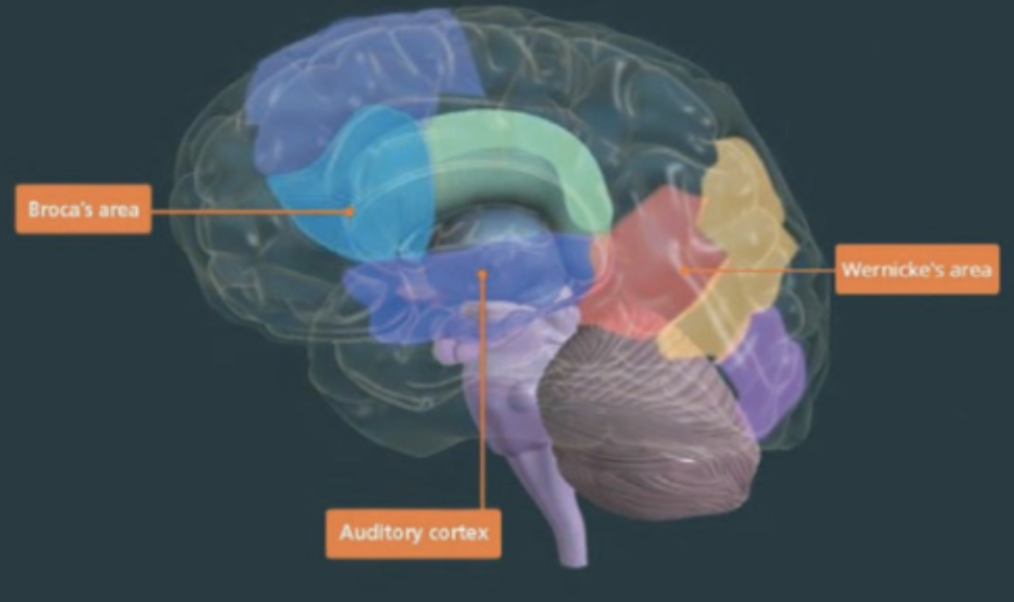
Wernicke’s Area
- involved in meaningful language production and comprehension
- location: superior left temporal gyrus near the auditory cortex
- wenicke’s aphasia: difficulty comprehending or producing logical language
- Neural mechanism: contains memories of sequences of sounds that constitute words
- comprises the dictionary of the brain along with the posterior language area
- posterior language area: regions surrounding wernickes area
- integrates the sensations and memories to form definitions or meanings of words
Lateralization
- left hemisphere: dominant for speech and language production in 90% of people
- wernickes and brocas area in the left hemisphere
- right hemisphere:
- language abour spatial relationships
- abstract language compression
- prosody: rhythmic emphatic melodic aspects of speech
- the man walked to the grocery store
- split brain operation: surgical severing of the corpus collosum isolating the left and right hemispheres
- most abilities remain
- showinf image to one visual field allows scientists to derermine the roles of the oopposite hemisphere
- show apple to left
- right recieves
- cannot name but can draw stimulus w left hand
Broca’s Aphasia
- difficulty producinglanguage especially speech
- slow labored articulation the lacks prosody
- 3 deficits
- agrammatism: difficulty using grammatical constructions
- Difficulty using function words (i.e. a, the, about) →speech mainly composed of content words (i.e. nouns, verbs)
- Grammatical markers (-ed)
- Comprehending grammatical aspects of language produced by others
- anomia: word finding difficulty
- articulation difficulties: impaired pronunciation
Wernicke’s Aphasia
- difficulty comprehending language and producing meaningful speech
- Little distress or awareness of own aphasia
- Speech is meaningless & illogical
- Few content words, and those that are used to not makes sense
- Impaired comprehension of others’ speech
- patients cannot correctly name common objects
- 3 major deficits
- spoken word recognition: WA symptomology consist of some components of pure word deafness
- pure word deafness: left damage to temporal. lobe impairs analysis of sounds of words
- Auditory perception of timing of complex sounds to produce speech
- Can speak but may “forget” pronunciation over time
- language comprehension: requires linguistic information from memory
- WA symptomology consists of some components of transcortical sensory aphasia
- Transcortical sensory aphasia: Damage to auditory regions surrounding Wernicke’s area (posterior language area)
- Word repetition intact, but cannot comprehend meaning of others’ or own speech
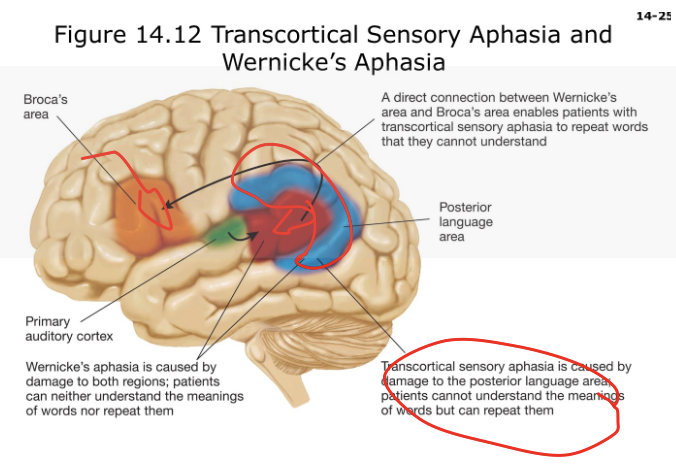
- Word repetition intact, but cannot comprehend meaning of others’ or own speech
- converting thoughts into words:
- WA symptomology consists of some components of anomic aphasia
- Anomic aphasia: partial amnesia for words →difficulty finding the appropriate words
- Patients with anomic aphasia can comprehend other’s speech
- those with WA cant \n
Conduction Aphasia
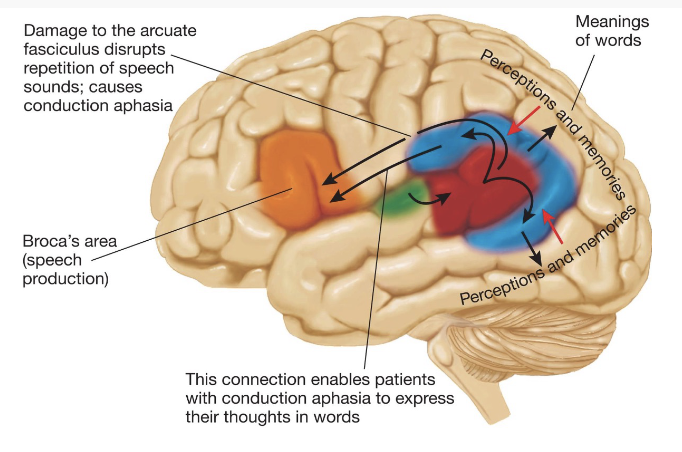
- Arcuate Fasciculus: bundle of axons connecting Wernicke’s and Broca’s area, conveys speech sounds from auditory cortex to frontal lobe
- Conduction Aphasia: damage to arcuate fasciculus
- Symptoms: fluent & meaningful speech, \n but poor repetition of non-words
- Evidence for two pathways
- Direct pathway: Arcuate fasciculus
1. Auditory information 2. Function: repetition
- Indirect pathway: Wernicke’s Area →Parietal Cortex→ Broca’s Area
1. Information about meaning
2. Function: comprehension