Ch 2 with Mr. Sinn
(2.1) Population Distribution
The four major regions (2/3 of population live in these regions)
south asia
east asia
southeast asia
In these three, there are people primarily located in rivers and oceans
Europe
People located next to natural resources instead of only around rivers and oceans
Physical factors:
climate
weather patterns
landforms
bodies of water
natural resources
Human factors:
economic aspects
People are attracted to places where they can work and get paid well
cultural aspects
People are attracted to places where they can feel accepted and feel community
historical aspects
History influences where population patterns are based on migration patterns
political aspects
People gravitate to places where they can feel a sense of safety in a cohesive society
Population density/distribution
Population distribution: spread of people in an area
Population density: number of people in an area
Arithmetic density: how crowded a particular area is (total population / total amount of land). Assumes that everyone is evenly spread out. Does not account for agriculture or uninhabited land
Physiological density: measures the pressure that a population exerts on the environment to feed the population. population / total amount of arable land.
Agricultural density: shows the level of efficiency of agricultural production in an area and the degree of reliance on human labor vs technology. Amount of farmers / amount of arable land
(2.2) Consequences of population distribution
Higher population = more political representation and power
Lower population = less political representation and power
Population pattern effects drawing districts, which affects voting
Division between urban and rural areas
Higher population = wider range of goods and services
Higher population = higher taxes and prices
Higher population = better education and healthcare
Higher population = more economic and social activities
Higher population = more urban sprawl
(2.3) Population composition
demographic characteristics:
age
gendar
ethnicity
educational attainment
income
occupation
These help us to understand the social, economic, and cultural factors of the society
Population pyramid:
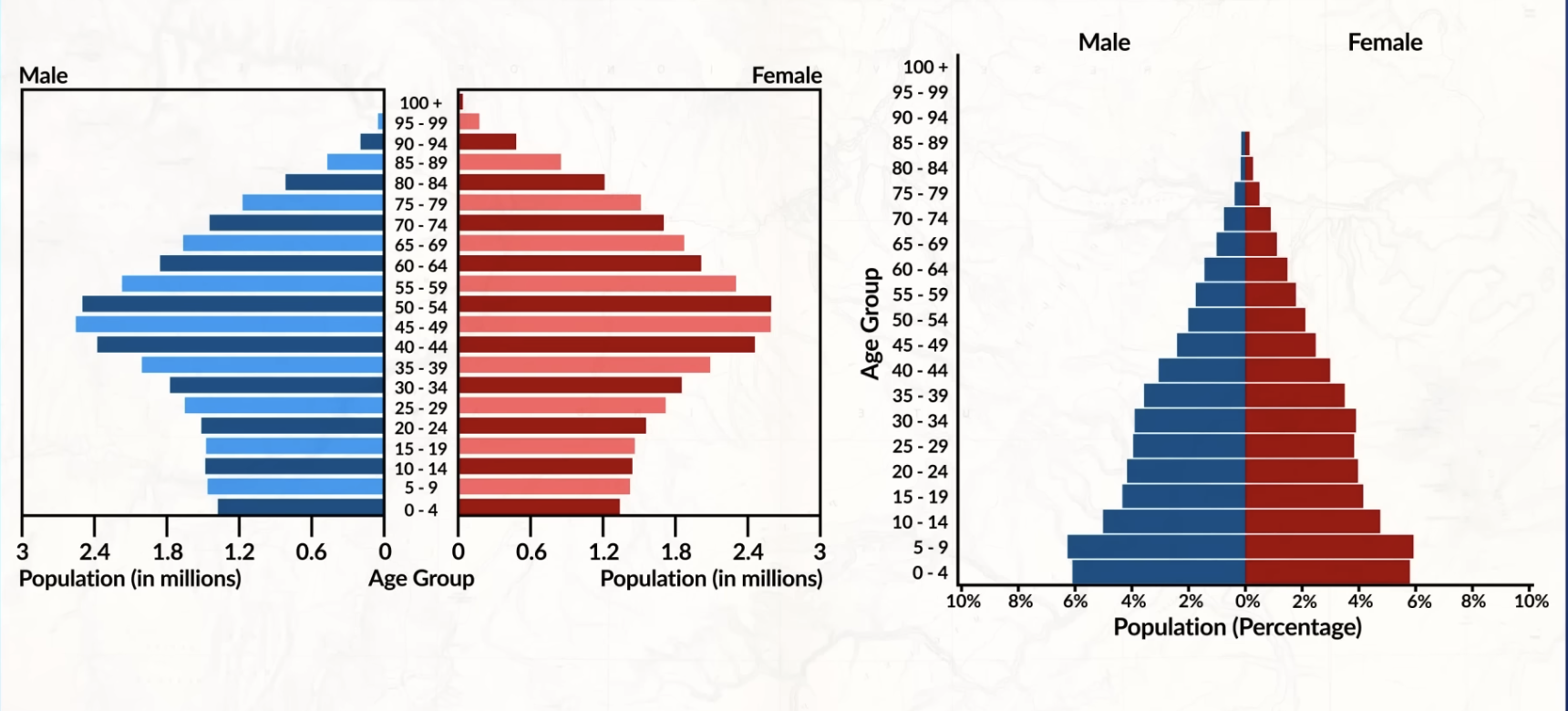
Top-heavy pyramid: aging population (more healthcare and a decrease in population)
Bottom-heavy pyramid: Younger population (growing population, more spent on education)
Ratios:
Dependancy ratio: how many people a society needs to support. higher number = greater burden on working population. (children ages 0-14) + (people 65+) / (Working age population)x 100
Child dependancy ratio: (children ages 0-14) / (working age population) x 100
Elderly dependancy ratio: (People 65+) / (working age population) x 100
(2.4) Population Dynamics:
Crude birth rate: the number of births in a year for every 1,000 people alive
Crude death rate: the number of deaths in a year for every 1,000 people alive
Natural increase rate: The percent a population grows in a year (NIR = CBR - CDR)
Doubling time: how long it takes for pop to doubbe. Helps countries understand how to utelize there resources, set policys and predict future problems
Total fertility rate: average amount of children a woman will have.
replacemnt rate: 2.1 (how many people it takes to replace a population
Infant morality rate: the total number of deaths under one year of age in a year for every 1,000 live births
Sectors of the econemy:
primary sector: extracting natural resources = more of these jobs is less developed countries
Secondary sector: take raw resources and produce/manufacure products of greater value = more of these jobs in less developed countries
tertiary sector: provide service for individuals = more of these jobs in more developed countries
(2.5) Demographic transition model
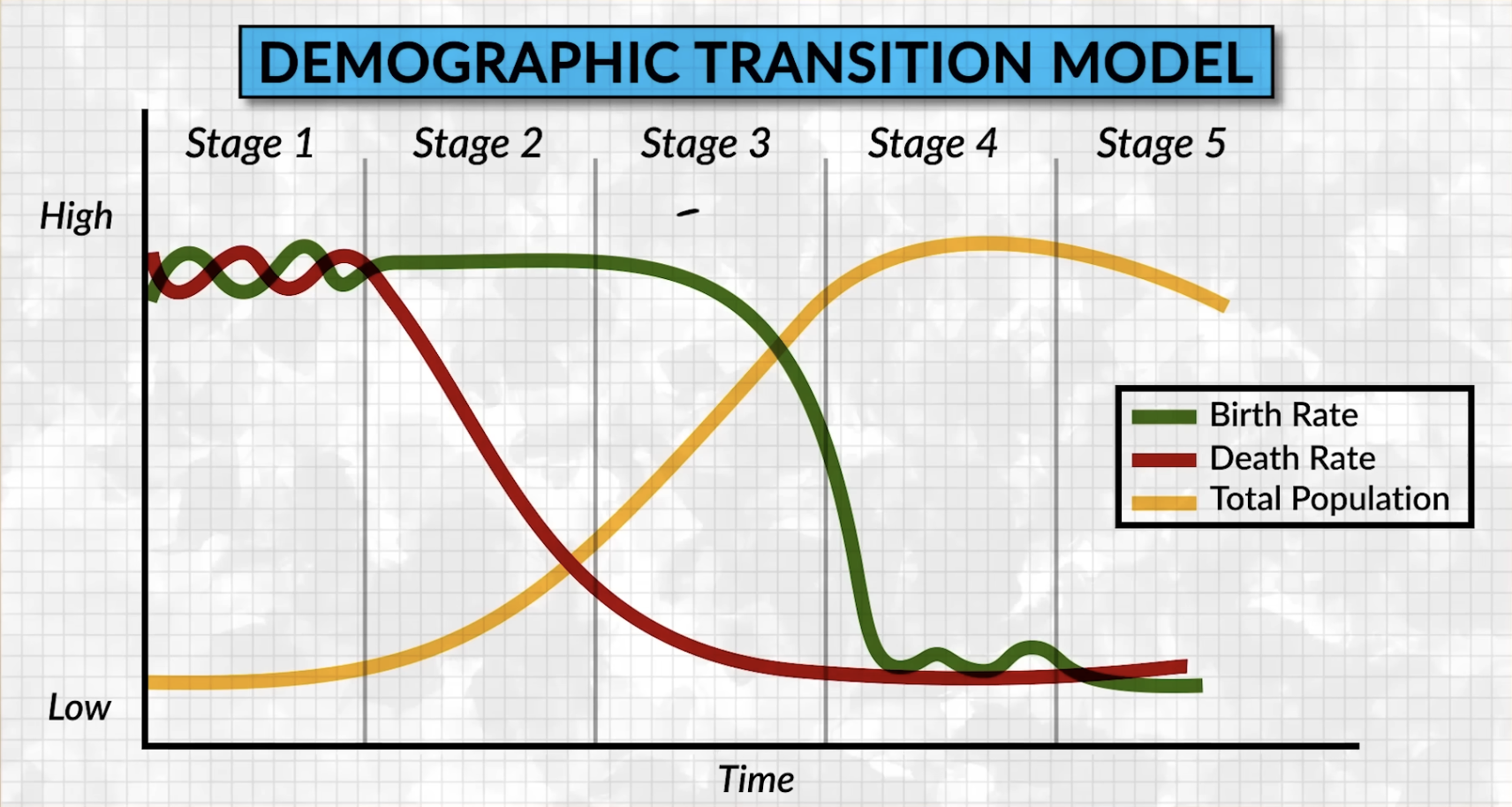
Stage one (pestilence, famine, deaths):
most people working subsistance agriculture
women have limited opertunitys
women dont have much education
seasonal migration
not much medication
high mortality rate
not many countries in stage one after industriul revolution
deaths due to animal attacks, pandemics, food shortages, and diseases. contaminated water sources, etc
Step two (fewer deaths, receading pandemics):
advacements in technology
increase agriculture production
better sanitation
increased knowlege in medicen
women have slight expantions in there roles
limited women acces to education
women are primary caregivers in there homes
improved living standards
better and more food
+ sanitation
Step three (increased degenerative diseases):
increased life expecdancy
better medication
smaller family sizes
jobs focusing in manufacturing
rural —> urban migration
rise of job opertunitys
Step four (fighting degenerative diseases):
Zero population growth is common
Women play an active role on society and the economy
specialized medicen / doctors
more people start to move into suburbs
longer life expectancy
medical advances
improved diets
avioding drug use
more junk
Step five (resurgence of infectious diseases):
Overall, the population is decreasing
evolution of different diseases
antibiotic resistance
increased poverty and urbanization
globalization
(2.6) Malthusian theory:
Malthus was a British guy who thought that eventually, because the population would increase exponentially, the food would increase at an arithmetic rate, where the population would pass the carrying capacity.
He thought the government should try to intervene and get the population to start implementing more policies to have the population have fewer kids.
Malthus was wrong.
Food production ended up increasing, and population ended up decreasing throughout the transition model.
(2.7) Population Policys:
Pro-Natalist Policies: policies that are created to help increase a society’s birth rate
Propaganda, tax insentives, family plnning resources, removal of economic and political barriers
Ex: France
Anti-Natalist Policies: Policies that are created to held decrease a societys birth rate
Like china’s one child policy
Can create higher male population then woman population
Governments will bace there immigration policies on:
economic needs
national security policies
cultural values
(2.8) Women and demographic change:
More opertunitys for women = lower fertility rate
More control over contreseption
more control over education and work
more education = more info on how to keep children safe heathy and happy
economic development = more opertunitys for women
Ravenstines rules of migration:
most migration is due to economic reasons
young adults
migrants often travel short distances
travel in step migration
rural —> urban is most likely
farther migrating —> more likely they are migrating to larger urban area
larger urban areas tend to have increase in population due to migration rather then natural births
women more likely to migrate within a countrie
men are more likely to migrate to different countrie
because men had acces to more wealth
!REMEMBER! This may no longer be acurate because these rules were made a long time ago
(2.9) Ageing populations:
developing countrie = growing older population
more dependancy ratio
more money being taken out of the system because more are accessing there retirment funds then those puting money away into there retirment funds
decrease in growth rate = shortage of workers to support econemy
this may make pronatalist policies or pro immigrant policies
(2.10) Cause of migration:
Pull facotors: the good that atracts people to come to geographic location
Economic: more job opertunities, less taxes, greater variety of goods and services
Political: better access to governemnet services, protection of individual rights, political freedom or political stability
Social: Acess to quality healthcare, increased acccess to education, acceptance of different cultures, desire to be closer to family
Enviornmental: climates, living conditions (pollution), arable land resources
Push factors: the negative aspects that force people to leave a geographic location
Economic: lack of job opertunities, economic instability, high taxes, higher cost of living
Political: political persecution, discrimination, lack of political freedom, unstable political enviornment
Social: religious persecution, discrimination, lack of social services (healthcare education)
Enviornmental: natural desasters, enviornmental degrigation, increased air and water pollution, undesirable climate
Emigration: moving out of a place (E for Exit)
Immigration: moving into a place (I for In)
Intervining obsticals: negative situations of obsticals that hinder migration and end up preventing migrants from reaching there final destination
Runnign out of money, not being granted acces to place
Intervining opertunities: posative situations or events that hinder migration and end up preventing migrants from reaching there final destination
Like going somewhere and finding a job opertunity there instead
(2.11) forced or voluentary migration:
Forced:
Human trafficing
Forced child labor
child soldiers
slavery
War, political opression, enviornment disasters
These people are considered refugees
May seek asylum
Internally dispaced person is a refugee who has not passes any national boarder and are still in the countrie they started in
Voluentary:
people are choosing to leave the spot they were in
transnational migration: when people choose to leave there current countrie
traditionally these people will settle in areas similar to the ones they were in before
Chain migration: a legal immigrent has become a citizen and sponcers a family member to come to that countrie with them
Step migration: Migration which occurs in stages. migrants make stops at locations allong the way before reaching their final destination
more often impaccted by intervining obsticles and opertunites
Guest workers: when migrants go to new countrie for work or education opertunities and send money back to families in other countrie
This action of sening money is knows as remittance
Trannshuman migration: migration that is seasonal and revlves around seasonal move of livestock
Rural to Urban migration: most often happens for people seekeing more economic opertunities
Intraregional migration: movement of people withing a particular region
Interregional migration: Movement of people between different regions
(2.12) Effects of migration:
citizenship policies
immigration limits
family reunification
higher economic output
brain drain: skilled labor leaves because there aren’t many opertunities for them there
Aculturation: culture one adopts aspects of culture two (aspects fo culture one are not lost)
Asymalation: Culture one is thrown away in favor of culture two
Syncretism: two cultures evolve and change over time but stay distinctly different
Vocab:
Desertification: when arable land loses its fertility and becomes a desert
Urban sprawl: unrestricted growth and expansion of an urban or suburban area to the surrounding countryside
carrying capacity: the maximum number of people who can be supported by the environment without damaging it
dependancy ratio: how many people a society needs to support. higher number = greater burden on working population. (children ages 0-14) + (people 65+) / (Working age population)x 100
Child dependancy ratio: (children ages 0-14) / (working age population) x 100
Elderly dependancy ratio: (People 65+) / (working age population) x 100
Crude birth rate: the number of births in a year for every 1,000 people alive
Crude death rate: the number of deaths in a year for every 1,000 people alive
Natural increase rate: The percent a population grows in a year (NIR = CBR - CDR)
Doubling time: how long it takes for pop to doubbe. Helps countries understand how to utelize there resources, set policys and predict future problems
Replacement rate: 2.1 (how many people it takes to replace a population
emigration: an individual leaves a country or political boundary
maternal mortality rate: the number of maternal deaths per 100,000 live births that occur due to pregnancy or childbirth related complications