Lecture 2 - Scruton
On the Impossibility of Pornographic Art
There is (or can be) no such thing as pornographic art according to Scruton.
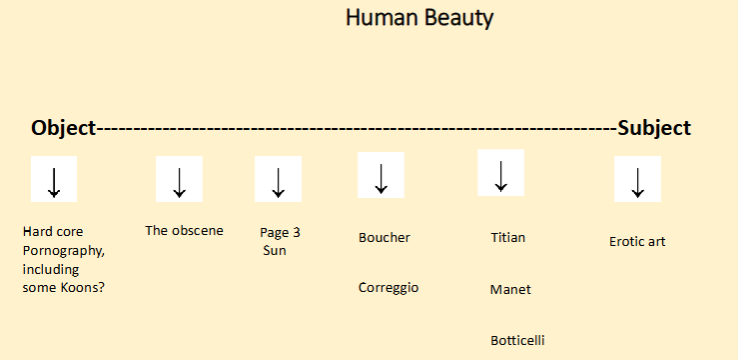
Pornography lies outside the realm of art because it is incapable of beauty. This is because it cannot depict a person.
It is incapable of beauty because its purpose is to arouse vicarious desire, whereas the purpose of art that deals with sexual desire is to portray sexual desire without arousing it.
“Art can be erotic and also beautiful, like a Titian Venus. But it cannot be beautiful and also pornographic” (p.133)
On why Photography cannot be erotic art
“And surely is it this too which makes photography incapable of being an erotic art, in that it presents us with the object of lust rather than a symbol of it: it therefore gratifies the fantasy of desire long before it has succeeded in understanding or expressing the fact of it. The medium of photography, one might say, is inherently pornographic” (Scruton, ‘Photography and Representation’, 1981)
Erotic Art
Erotic art for Scruton is the meeting of human beauty with artistic beauty. He discusses Titian’s Venus of Urbino and Boucher’s nudes.
NOTE: Scruton only gives examples of female nudes, not male nudes, he only speaks of heterosexual erotic art (he is Christian), and that he only provides paintings and sculptures as examples, not anything photographic (unlike Nancy and Agamben)
Scruton maintains that Titian glorifies eros as something that singles out an embodied person, an individuality.
The main way that Titian does this is by how he paints the face - he individualises his nudes by their faces.
If you think the face is not a crucial part of how we should think about the nude, consider deepfake pornography - when someone’s face is digitally imposed over sexually explicit images. This has led university and school students, especially female ones, to commit suicide in certain countries in recent years.
“In the Venus of Urbino - that most provocative of Titian’s female nudes - the lady draws our eyes to her face, which tells us that this body is on offer only in the way that the woman herself is on offer, to the lover who can honestly meet her gaze. To all others the body is out of bounds, being the intimate property of the gaze that looks out from it: not a body but an embodiment, to use the language of Chapter 2.”
“The face individualises the body, and possesses it in the name of freedom, and condemns every covetous glance as a violation. The Titian nude neither provokes nor excites, but retains a detached serenity - the serenity of a person, whose thoughts and desires are not ours but hers.”
“Boucher’s nudes are not individualised by their faces. As a matter of face, they all have the same face, which is not a face at all, but an assemblage of parts. The lips just slightly apart as though in anticipation of a kiss; the clear eyes under lowered lashes; the oval contours filled with flushing cheeks that swell like sails in a summer breeze - all such features, brilliantly displayed from every angle and in every light, carry a single meaning, which is that of sexual appetite.”
“The eyes [in Boucher’s paintings] look at things - but only inconsequential things in the picture. No soul shoots out from them, no gaze questions or troubles or enraptures: all is fixed in its stillness - the stillness of creatures too abstract to take ownership of life.”
“In Boucher the face is a pointer to the body, which is its raison detre. In Titian it is not exactly the other way round: for certainly the emotion of the painting resides in the flesh-tints, the light, softness and promise of the full female form. But in Titian the face keeps vigil over this form, quietly asserting ownership and removing it from our reach.
This is erotic art, but in no way concupiscent art: Venus is not being shown to us as a possible object of our own desire, She is withheld from us, integrated into the personality that quietly looks from those eyes and which is busy with thoughts and desires of its own.” (p.130)
Manet’s Olympia, 1863
Problem 1: Scruton’s comments on homosexuality
He previously and ineptly condemned homosexuality - though he apparently changed his mind about this, though his comments on homosexuality still seem very crass and problematic (Spiked)
His argument against homosexuality is extraordinarily weak, namely, that homosexuals lack courage (because one needs courage to tackle the body and mind of a different sex, according to him).
Scruton, anti-LGBT Law and Hungary
“Since 2021, Mathias Corvinus Collegium, a private university has organised student trips to the UK for so-called Scruton lectures, also named after the philosopher, whose views are so revered in Orban’s Hungary that a series of cafes in Budapest are named after him”. (Guardian article, 28/08/23)
Moreover, in 2021, a law came into being that said that any products intended for children that display or promote deviation from one’s birth gender identity, gender reassignment or homosexuality must be sold separately from other products and in closed packaging and must not be placed in a store’s window.
Problem 2: ‘Who says Pornography can’t be art?’ in Art and Pornography: Philosophical Essays (2012)
“Sexual experiences involve the deepest corners of ourselves and are among the most intense, powerful, emotional, and profound experiences we have. If pornography, which offers the most direct representa