Language of Argument
Language of Argument
Persuasive Techniques
PERSUADE
Power of 3
include three similar words or reasons
Emotive language
words or phrases that create imagery to provoke an emotional response
Rhetorical question
Questions that make the audience think Often implies the answer or writers contention
Say again
Repeat the same word, phrase or idea more than once to emphasise it
Undermine opposing views
criticise opposing view or argument
Anecdote
Small personal stories that illustrate the point
Direct adress
involve audience by speaking to them directly or use pronouns like ‘we’ to involve them and share experiences
Exaggeration
Going over the top and making the issue seem worse than it might actually be
The idea of persuading someone is to get them to agree with your point on an issue. To change their way of thinking. This means you need to be aware of your audience. Try to create links and establish a common goal. Do not annoy them by ignoring their needs, as then they will not listen.
The 3 Areas to Appeal to
Logos: logic
Appeals to reason. Builds up logical arguments to persuade
Gets audience to think
Ethos: Ethics
Establish personal credibility
Get audience to trust you
Using a respected person, such as a celebrity, to support your view
Pathos: pity
Appeal to emotions
Inspires an emotional response
Gets audience to feel
Emotions need to be carefully considered in an argument, as without realizing it, many people act on emotion.
Tone
Tone
Indicates a feeling
The feeling can be any emotion, like joy, seriousness, urgency, formality, hopefulness, or pessimism. nearly anything.
it will be reflective of the mood of the writer
Tone is as diverse as our emotions. It can convey the positive, neutral, negative, and everything in between. E.g., you have been invited to a birthday party. some tones you could respond to could be… Joy at getting to go annoyance (at a waste of time) digust (at the person who invited), hopefulness (that you can go), and many more.
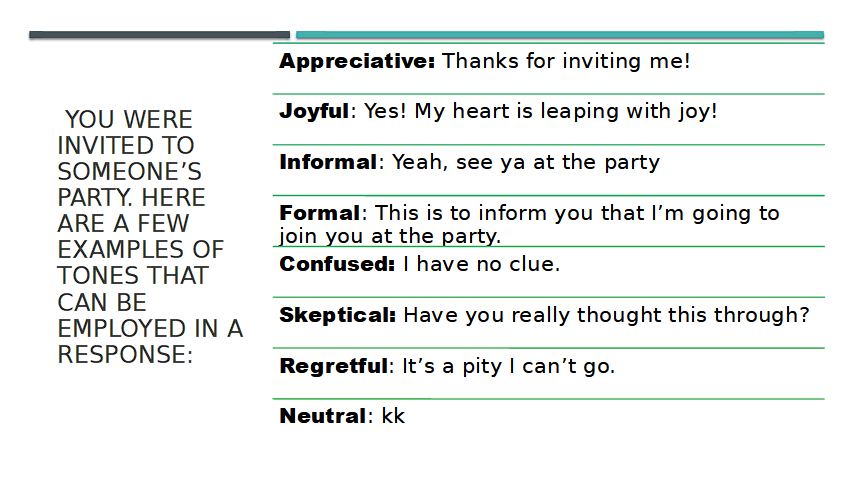
Example piece to identify tone
And the trees all died. They were orange trees. I don't know why they died; they just died. Something was wrong with the soil, or maybe the stuff we got from the nursery wasn't the best. We complained about it. So we've got thirty kids there; each kid had his or her own little tree to plant, and we've got these thirty dead trees. All these kids looking at these little brown sticks—it was depressing.
Confused about why they died
Sad that they died
Words like ‘dead’ and ‘depressing’ set a negative tone for the piece of negative and unhappy
The initial tone was confused, then it appeared to be annoyed that the trees had died.
identifiable persuasive techniques: setting a negative tone. thirty appeals to statistics—logos. imagery that provokes an emotional response in the phrase “All these kids looking at these little brown sticks, it was depressing.” relatable story about not understanding something and the trees dying.
“Do you have a minute to talk?”
“Got time to chat real quick?
Argument Analysis
Topic
the matter or subject of the piece
consider what has triggered the argument
is it a topic with wider social or political implications?
ALWAYS NEUTRAL
Issue
The central problem being discussed
For a topic to become an issue, it must be controversial. have opposing views
Context
Background of an issue
how the persuasive text relates to a debate about the topic
Consider
how it was published or shared
Relevant details about author
events that sparked the debate
existing knowledge of the target audience
Contention
Authors point of view on the topic
this is what the author is trying to convince the audience of.
it is the idea or purpose of the text
there must be supporting arguments for the contention
Purpose
the intent of the author. usually to convince the audience on their point of view (contention)
Audience
who the text is aimed at
should be a specific group, not general
Ask: who is the author trying to persuade?
Consider context
choose arguments and evidence the appeal or oppose the targeted audiences beliefs.
Tone
The atmosphere of the text
Newspaper Article Types
Hard news stories
Who, What, When, Where, Why and How
Details in descending order of importance
Grammatically correct
Written by reporters
Objective, facts-only reporting
The purpose is to inform
Columns
Personal writing style
Mostly correct grammar, except when the writer doesn't, to make a point
usually identified with a photograph
The purpose is to advise, entertain, analyse, interpret or comment
Editorial page
Written in essay form
grammatically correct
Written by editorial page staff
Presents the opinions of the newspaper’s editorial board
The purpose is to persuade and provoke thought
Features
Personal writing style
Written by reporters
Reports facts. often has interpretations included and is longer than hard news story
The purpose is to inform and explain
Comics
Very brief, often dialogue-only
slang often appears
Written by cartoonists from newspapers or syndicates
The purpose is to entertain and comment, sometimes on political issues
Advertisements
Brief, descriptive
Not necessarily grammatically correct
Written by professional services or ad staff
The purpose is to persuade and inform about services and products
Outlines
Brief; max a few sentences
Written by copy editors
Contain facts related to photos, illustrations or accompanying stories
The purpose is to inform
Letters to the editor
Letter; essay form
Should be grammatically correct
Written by newspaper readers
Reader’s o’s opinion expressed
Purpose is to provide forum for readers’ comments
Headlines
Brief; descriptive
Not complete sentences
Written by copy editors
Purpose: to attract reader and inform