Genetic inheritance patterns
Mendel’s laws of heredity (single gene effects)
laws of heredity - single gene disorders
Mendel (1865), experiments in plant hybridization - no impact, paper essentially ignored, rediscovery in 1900
mendel’s key idea: “elements” - now called genes are the basis units of heredity. laws based on observation.
Mendel’s experiments:
in cross-pollinating plants that either produce yellow or green peas exclusively, mendel found that the first offspring (f1) always has yellow peas. However, the following generation (f2) consistently has 3:1 ratio of yellow to green.
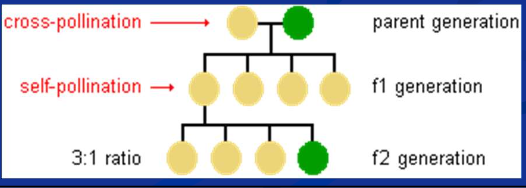
mendel’s conclusions:
inheritance of each trait is determined by ‘units‘ that are passed on to descendents unchanged (these units are now called genes)
an individual inherits one such unit from each parent for each trait
a trait may not show up in an individual but can still be passed on to the next generation.
in this experiment, the starting parent plants were homozygous for pea color. the plants in the f1 generation were all heterozygous.
Mendel’s first law: the principle of segregation
for any particular trait, the pair of alleles of each parent separate and only one allele passes from each parent on to an offspring. Which allele in a parent’s pair of alleles is inherited is a master of chance.
we now know that his segregation of alleles occurs during the process of sex cell formation (meiosis).
Mendel’s second law: principle of independent assortment
Different pairs of alleles are passed to offspring independently of each other. the result is that new combinations of genes which were present in neither parent are possible.
today, we know this is due to the fact that the genes for independently assorted traits are located on different chromosomes.
E.g. a pea plant's inheritance of the ability to produce purple flowers instead of white ones does not make it more likely that it will also inherit the ability to produce yellow peas in contrast to green ones.
inheritance of a particular eye color does not increase or decrease the likelihood of having 6 fingers on each hand.
the concept of dominance
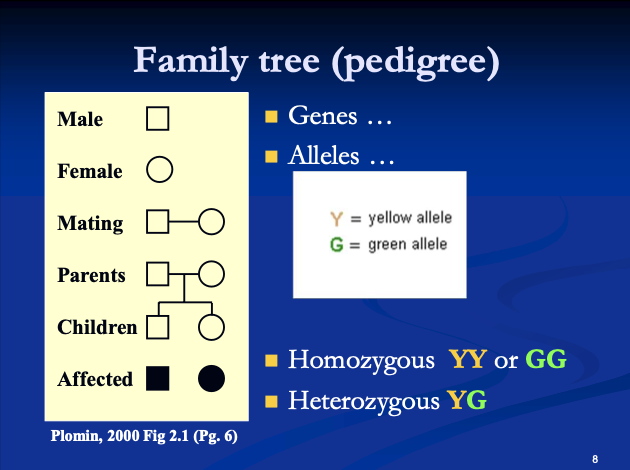
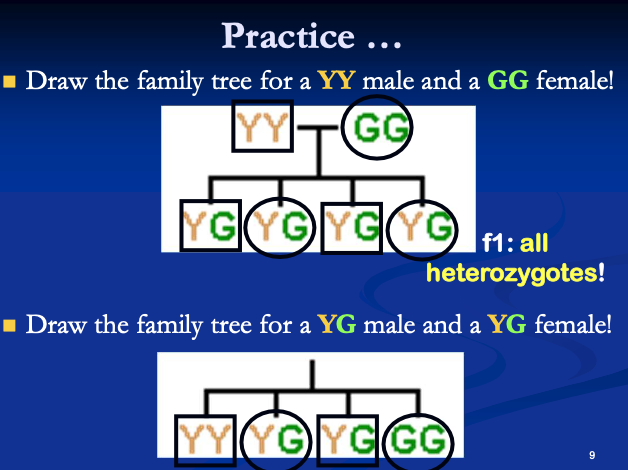
with all of the 7 pea plant traits that mendel examined, one form appeared dominant over the other. which is to say, it masked the presence of the other allele. For example, when the genotype for pea color is YG (heterozygous), the phenotype is yellow.
however, the dominant yellow allele does not alter the recessive green one in any way. both alleles can be passed on to the next generation unchanged.
mendel’s laws - summary
Law of Segregation: ...alleles separate, one allele passes from each parent ...
Law of Independent Assortment alleles pass independently of each other
Principles:
Inherited features governed by a pair of “elements”
One element inherited from each parent
Elements can dominate in their expression
terminology used today
Mendel’s“elements”arenowcalledgenes
Genes come in alternative forms, called alleles
Genotype– an individual’s combination of alleles
Phenotype– the observable trait
Homozygous– two copies of the same allele (AA, aa)
Heterozygous– one copy of each allele (Aa)
Mendelian diseases are diseases that are the result of a single gene, they generally have a large effect on behavior & distinctive patterns of familial transmission
Examples from psychiatry: genetic disorders with mendelian patterns of inheritance
genetic disorders are conditions that have some origin in genetic make-up.
genetic disorders can be classified according to the way in which they develop:
if the disorder is transmitted by genes inherited from only one parent, it is an autosomal dominant disorder
disorders that can be inherited only by the transmission of genes from the parents is called an autosomal recessive disorder.
Huntington’s disease
onset: mid-adulthood
prevalence: 1 in every 20 000
starts with: personality changes, forgetfulness
next: 15-20 years: complete loss of motor function and intellect
no treatment has been found to stop or delay the decline
cause: H mutant allele at a specific point
consistent pattern of heredity: autosomal dominant.
heredity of Huntington’s disease
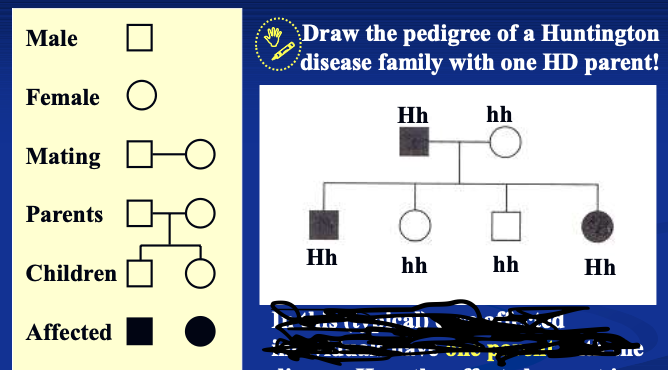
in this (typical) case affected individuals have one parent with the disease. here the affected parent is heterozygous. in this case approx. half of the children develop the disease.
Phenylketonuria
onset: early childhood
prevalence: 1 in every 10 000
severe problems in early neural development leading to mental retardation
due to disturbance in the metabolism of phenylalanine (an essential amino-acid)
treatment: special diet in early childhood lacking phenylalanine
‘runs in families‘, but typically NO affected parents: autosomal recessive
it presents if: FF Ff ff
Genes on the X chromosomes
Color blindness
Most common form: red-green colorblindness (more frequent 8% in males)
SKIP-A-GENERATION PHENOMENON:
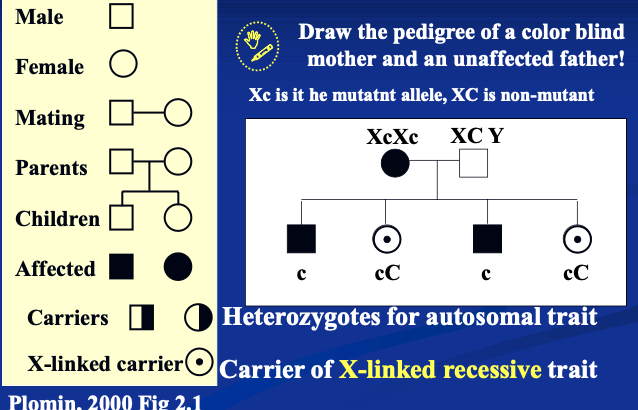
if mother is colorblind, & the father is not: all of the sons but none of the daughters are affected!
However, half the daughter’s sons are likely to be affected!
Consistent pattern of Heredity: recessive allele on the X chromosome!
Sex-linked inheritance
Males are XY and females are XX
Two sex chromosomes are not genetically equivalent
(Y is about 1⁄4 the size of the X)
Traits associated with genes on the X chromosome
- X-linked
Traits associated with genes on Y chromosome
- Y-linked
Color blindness is caused by a recessive allele on the X chromosome. But males have only one X chromosome; so, if they have one allele for color blindness (c) on their single X chromosome, they are color blind. For females to be color blind, they must inherit the c allele on both of their X chromosomes.
X - linked traites
Males
One X chromosome
Inherited from mother
Two possible genotypes
X+Y
XmY
Have trait/do not have trait
Hemizygous
Males transmit their X to their daughters, Y to their sons
Females
Two X chromosomes
Inherited from both parents
Three possible genotypes
X+X+
X+Xm
XmXm
Heterozygotes are carriers of recessive traits.
Females transmit their X randomly to either their sons or daughters
Males are more likely to be affected than females regarding X-linked recessive traits
Color blindness: an x-linked recessive trait
Changes in chromosomes
Meiosis
process of gametic (male or female germ cell) cell production (gametogenesis)
in which genetic material is reduced by half (from diploid to haploid)
Nondisjunction of chromosomes
Things can go wrong in meiosis:
e.g. nondisjunction of chromosomes: new egg and sperm should have only one member of each chromosome pair (haploid set). When the division does not occur properly, an egg (or sperm) may have both members of the chromosome resulting in trisomy!
Chromosomal abnormalities are responsible for more than half of spontaneous abortions (miscarriages)
Some fetuses with chromosomal anomalies survive, though with developmental abnormalities
Most common: Down’s syndrome
Trisomy 21 - Down’s syndrome
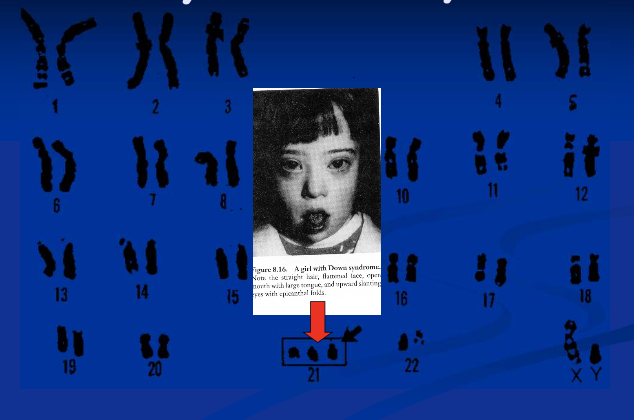
Down’s syndrome
clinical features: growth retardation, mental retardation, distinct head and facial characteristics, heart problems, premature aging.
95% of the time, nondisjunction occurred in mother
1/1000 birth increased rates with advanced maternal age (>35)
nondisjunction is more likely to occur as female grows older and activates immature eggs that have been dormant for decades
trysomnia in chromosome 21
Complex traits
complex phenotypes (depression, intelligence) also seem to run in families, but they don’t show straightforward patterns of inheritance
Lifetime expectancy of schizophrenia
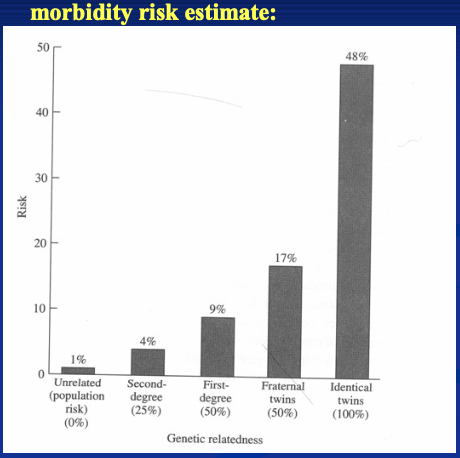
prevalence: 1/100
morbidity risk is higher if the genetic code is more similar
but NO consistent pattern of heredity
Resemblance of cognitive ability (IQ)
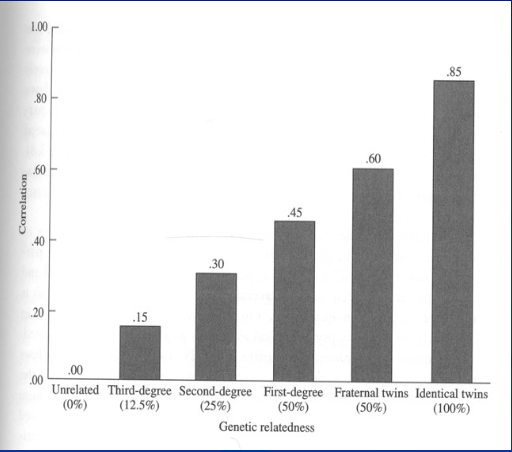
NO consistent pattern of heredity: correlation increases with genetic relatedness
Complex, quantitative traits do NOT violate Mendel’s laws
the mendelian traits are caused by a single gene. other genes and env. effects have little influence
on the other hand, complex traits, such as schizophrenia are caused by more than one gene.
when mendel’s laws were rediscovered, a battle was fought between mendelians and biometricians.
mendelians looked for single gene effects,
and biometricians argued, that these laws could not be applied for complex traits, since they do not show a simple pattern of inheritance, especially in the case of quantitative dimensions.
conclusion:
the laws of single-gene inheritance can also be applied to complex traits INFLUENCED BY SEVERAL GENES. Such traits are called POLIGENIC.
Multiple genes
IQ, height, pea size, schizophrenia, blood pressure
single locus - completely addictive model:
Genetype: A1A1 A1A2 A2A2
Phenotype, height: 71” 70” 69”
Single-locus phenotypic distribution
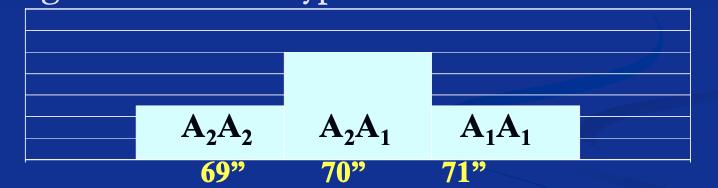
a single gene with two alleles yields three genotypes and three phenotypes. it is important to point out, that not all alleles operate in a dominant or recessive manner. many alleles are additive, meaning that all contribute something to the phenotype. if you consider height for example, you could see that…
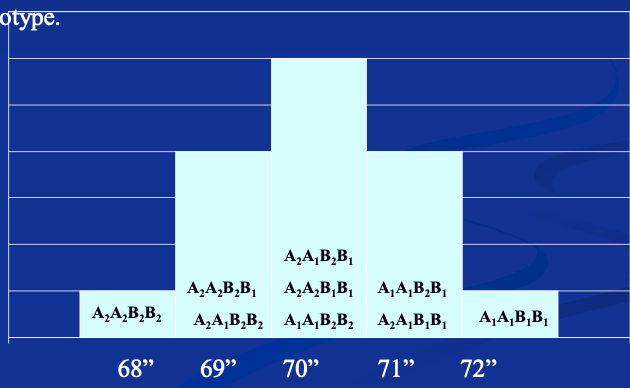
two-locus phenotype distribution
in this figure, we add another gene, which, again, has an effect on height. similarly to A1, B1 also makes you higher. The number of genotypes increased to 9, all affecting the distribution of individuals on the 5-scale phenotype.
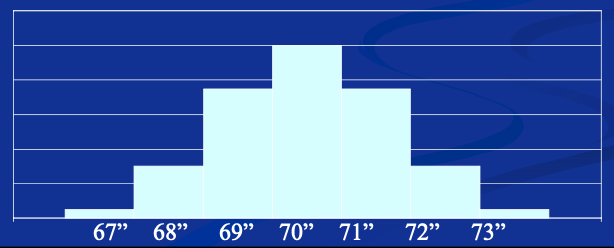
Three-locus phenotype distribution
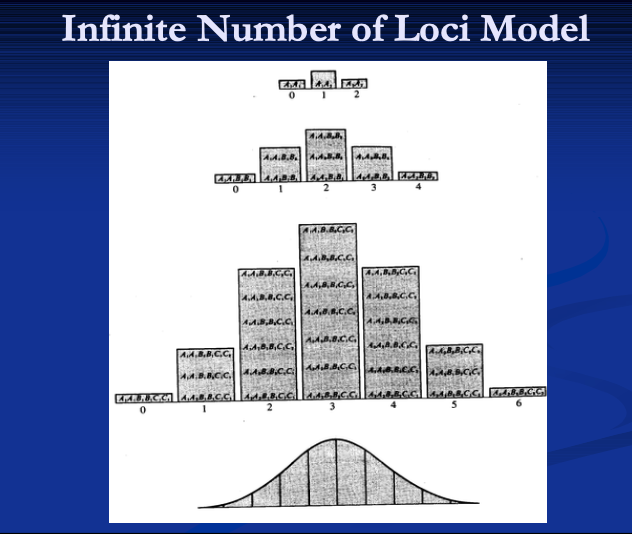
the more genes are introduced, the more fine-scaled the phenotypic representation will be, and even with just three genes the phenotypes begin to approach a normal distribution in the population. many complex behavioral traits are likely to be influenced by dozens, or even hundreds of genes. thus, continuous phenotypic representation is NOT surprising, even if each of the genes influencing the trait in question is inherited in accord with mendel’s laws.
Quantitative genetics
polygenic model: a quantitative phenotype is influenced by many loci (genes) all of which have a small (equal) and addictive effect.
type of genetic influence:
monogenic (single-gene, mendelian)
multigenic (polygenic, multifactorial)
chromosomal
summary
Mendel's experiments and laws of heredity
• Family trees of
– autosomal dominant (Huntington’s)
– autosomal recessive (Phenylketonuria) – and x-linked traits.
• Chromosomal anomalies - Down's syndrome
• Complex traits and quantitative genetics