Hip Joint
Type of joint: The hip joint is a ball and socket synovial joint.
Articulating surfaces: The acetabulum of the pelvic bone and the head of the femur.
NOTE: The hip joint aids in weight-bearing. It helps in transferring the weight of the upper body to the lower limb during standing, walking etc.
Articulating surfaces:
The hip joint consists of an articulation of the head of the femur and the acetabulum of the pelvic bone.
The acetabulum of the pelvis is deepened by the presence of a fibrocartilaginous collar called the acetabular labrum.
Both the acetabulum and the head of the femur are covered in articular cartilage which is thicker at the places of weight bearing.
The capsule of the hip joint attaches to the edge of the acetabulum proximally. Distally, it attaches to the intertrochanteric line anteriorly and the femoral neck posteriorly.
Ligaments
Iliofemoral ligament
Pubofemoral ligament
Ishiofemoral ligament
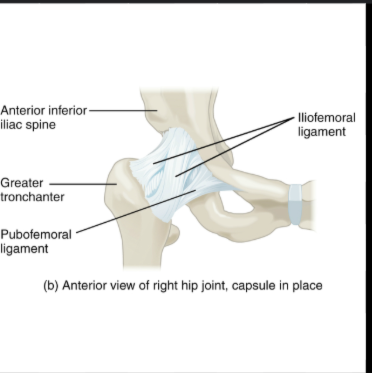
Iliofemoral ligament
rises from the anterior inferior iliac spine and then bifurcates before inserting into the intertrochanteric line of the femur.
It has a ‘Y’ shaped appearance, and prevents hyperextension of the hip joint. It is the strongest of the three ligaments.
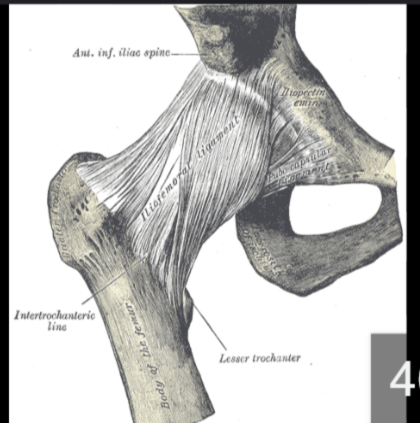
Pubofemoral ligament
spans between the superior pubic rami and the intertrochanteric line of the femur, reinforcing the capsule anteriorly and inferiorly.
It has a triangular shape and prevents excessive abduction and extension.
Ischiofemoral ligament
spans between the body of the ischium and the greater trochanter of the femur, reinforcing the capsule posteriorly.
It has a spiral orientation prevents hyperextension and holds the femoral head in the acetabulum.