SLEEP: (WK6):
CONSCIOUSNESS:
mind-body problem
levels of consciousness
minimal consciousness = a low level of sensory awareness that occurs when the mind inputs sensations and may output behaviour
full consciousness = you are able to know and report your mental state
self consciousness = distinct level of consciousness where the person’s attention is drawn to the self as an object
BIOLOGICAL CLOCK:
behaviour is not driven just by external cues
rhythms are endogenous
bio clock = neural system that times behaviour
CIRCADIAN RHYTHM:
all animals have an endogenous circadian rhythm, operates approx 24 hour cycle
can differ from person to person
changes with age
keep our internal workings in phase with the outside world
zeitgeber = term used to describe any stimulus that resets circadian rhythm e.g. light, exercise, meals and temp
RHYTHM OF WAKING AND SLEEP:
jet lag refers to the disruption of the circadian rhythms due to crossing time zones
mismatch between internal and external times, sleepiness
travelling west = ‘phase delays’
travelling east = ‘phase advances’
light treatment for SAD (seasonal affective disorder)
THE SUPRACHIASMATIC NUCLEUS:
SCN = part of the hypothalamus and the main control centre of the circadian rhythms of sleep and temp
damage to SCN results in less consistent body rhythms, no longer synced to light and dark environment
single cell extracted from the SCN and raised in tissue culture continues to produce action potential in a rhythmic pattern
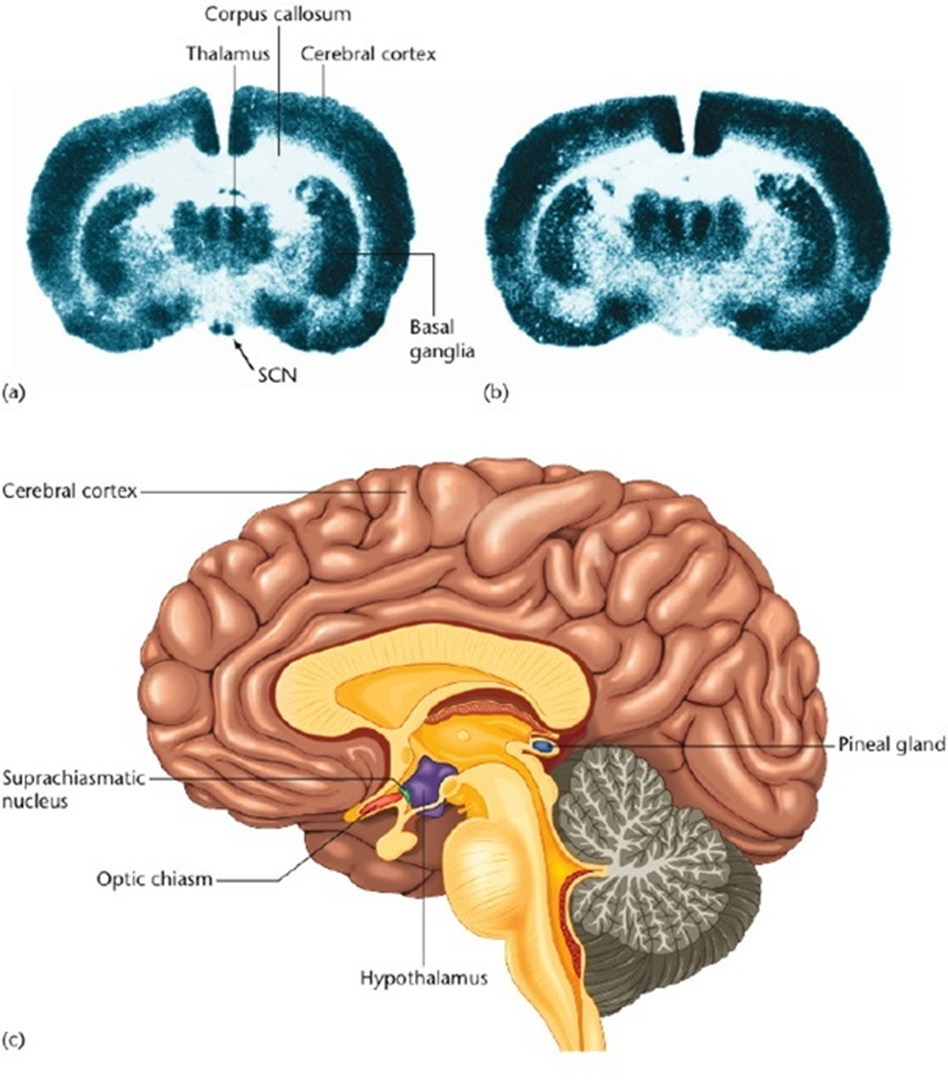
light resets the SCN vis small branch of the optic nerve
travels directly from the retina to the SCN
the retinohypothalamic path comes from a special population of ganglion cells - own photopigment called melanopsin
the cells respond directly to light and do not require input from rods or cones
GENES, PROTEINS & CIRCADIAN RHYTHM:
two types of genes responsible for generating circadian rhythm:
period = protein called PER
timeless = protein called TIM
increase activity of certain types of neurons in the SCN that regulate sleep and waking
MELATONIN:
SCN regulates pineal gland, an endocrine gland located posterior to the thalamus
pineal gland secretes melatonin, a hormone that increases sleepiness
usually begins 2-3 hours before bedtime
feeds back to the bio clock through its effects on receptors in the SCN
SLEEP:
functions of sleep:
energy conservation, restoration of the brain and body, memory consolidation
sleep enables restorative processes,
proteins rebuilt in the brain
energy supplies replenished
moderate sleep deprivation results in impaired concentration, irritability, hallucinations, unpleasant mood & decreased immune system
caffeine increases arousal by blocking the receptors for adensine
animals increase sleep in food shortage = hibernate
SLEEP STUDY:
use a electroencephalograph (EEG)
compare brain activity at different times during sleep
polysomnograph = combination of EEG and eye-movement records
STAGES OF SLEEP:
stage 1
sleep has just begun, EEG dominated by low voltage waves
brain activity begins to decline
stage 2
sleep spindles = 12- to 14-Hz waves during a burst that lasts at least half a second
k-complex = high amplitude negative wave followed by a smaller positive wave
stage 3 & 4
consitute slow sleep waves (SSW)
large, slow amplitude wave
slowing of heart rate, breathing rate and brain activity
highly synchronised neuronal activity
REM
rapid eye movement
EEG waves are irregular, low voltage and fast
sequence goes: 1, 2, 3 & 4 in order, before cycling back from 4, 3 , 2 and then REM (90 mins)
stage 3 & 4 predominate early night, REM is later (associated with dreaming)
REM:
activity increases in the pons (triggers on set of REM sleep) and limbic system (emotional systems), parietal cortex & temporal cortex
cells in pons send messages to the spinal cord which inhibit motor neurons that control the body’s larger muscles
prevents motor movement during sleep → sleep paralysis
REM is regulated by serotonin & acetylocholine
1/3 time asleep, 1/5 in REM
WHY:
FREUD’S PSYCHOANALYTIC THEORY:
wish fulfillment = gratification of our unconscious desires and needs
sexual & aggressive that are too unacceptable to be spoken aloud
manifest content = surface story that dreamer reports
latent content = dreams disguised psychological meaning
dream work = process by which a dreams latent content is transformed into manifest content
ACTIVATION-SYNTHESIS THEORY:
dreams do not have a function, product of REM neural activity
brain bombarded with random neural activity during REM sleep
explains why dreams are so bizarre
PROBLEM-SOLVING DREAM MODEL:
dreams are not constrained by reality they can help us find creative solutions to our problems
COGNITIVE-PROCESS DREAM THEORIES:
focuses on process of how we dream, proposes that dreaming and waking thought are produced by the same mental systems
SLEEP PROBLEMS:
insomnia
sleep disorder caused by pain, stress, noise or medication
can also result from other disorders
dependency on sleeping pills can also result in insomnia
night terrors
intense anxiety where one wakes from a dream screaming
sleep talking
sleep walking