Hair
Hair intro
Esp. for females, so much time, effort and money are spent in caring for hair. For males, shaving the hair (beard etc.) is sometimes necessary.
Hair is a derivative of the skin epidermis.
In an average individual, roughly 5 mills. hairs cover the body, with about 100,000 on the scalp.
5 to 200 grams the weight of a head is hair (according to the length of the hair)
Each follicle can grow about 20 individual hairs in a person's lifetime.
1 cm per month is speed at which hair grows.
The number of hairs we naturally lose each day is 100-150.
Hair is very small with average diameter of 100 nm.
Hair is as strong as copper wire of the same diameter.
It also has elastic properties. It can stretch up to 20% of its original length before breaking when it is dry and when it is wet it may stretch up to 50% before breaking.
A single hair can withstand 100 g of weight. A strand of 100 hairs would therefore be able to resist a weight of 10 kilos. And if the scalp were sufficiently resilient, an entire head of hair could support 12 tonnes! Or two elephants.
Hair function
Appearance/attractiveness
Primary function is protection from:
Injury to the scalp
Heat loss (only for scalp) because scalp has no fatty layer for protection
UV radiation exposure
Insects, lice by stimulating hair receptors
Foreign particles entering nostrils, ear canal
Foreign particles entering eye (eyelashes)
Sweat entering eye (eyebrows)
Friction during body movement (axillary hair)
Anatomy and physiology of hair
Hair is a derivative of the epidermis and is divided into two parts:
Shaft (fiber) above the skin
External, thin, flexible part that’s dead, fully keratinized epithelial cells.
Follicle fully embedded in the skin
Living hair follicles, cylindrical epithelial down growths into the dermis, enlarge at the base into the hair bulbs surrounding the dermal papilla.
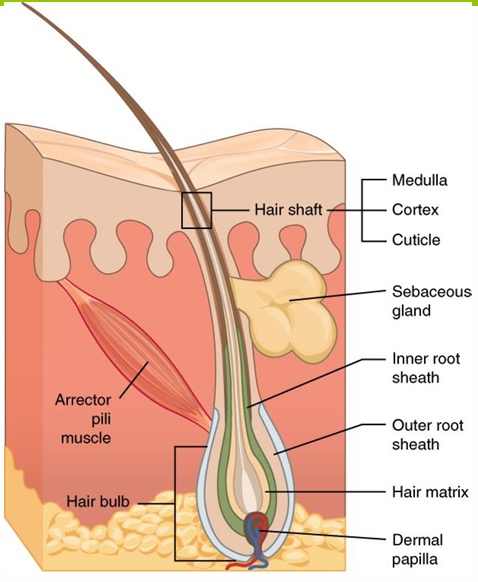
Hair follicle anatomy:
Outer root sheath (ORS)
a reservoir of multipotent stem cells (i.e. Keratinocyte & melanocyte stem cells)
Inner root sheath (IRS)
Adjoins the cuticle of the hair shaft
Anchors hair shaft to follicle
Supports and molds the growing hair shaft
Guides its upward movement
Hair bulb
Follicle portion actively producing hair.
It encloses the follicular dermal papilla, dermal papilla matrix, nerve fibers, blood rich connective tissue.
Hair structure
Hair shaft (fiber) is composed of:
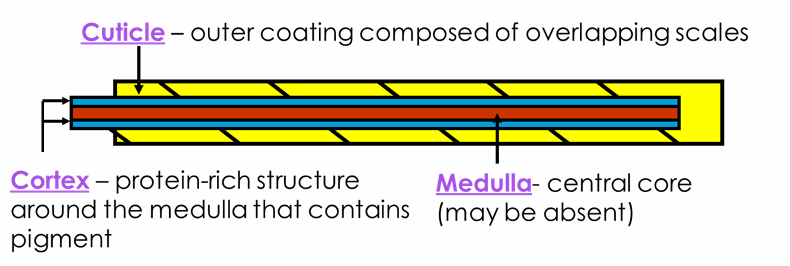
Cuticle
It’s a chemically resistant region and consists of overlapping regions (like shingles on a roof).
The integrity and properties of the cuticle layer have an imp role in:
Protecting the cortex
Maintain hair in a clean, disentangled state; impacts its appearance.
Limits friction between hair fibers
Each cuticle layer is about 60 microns long and 0.5 micron thick.
There are 6-10 cuticle layers glued together with CMC. In coily hair, sometimes only 2 cuticles layers exist.
Generally thick for Asians, slightly less in Caucasians and even less in African hair. A thinner cuticle layer makes African hair more prone to breakage
Structure
Subdivided into 4 parts: epicuticle, A-layer, exocuticles, and endocuticles.
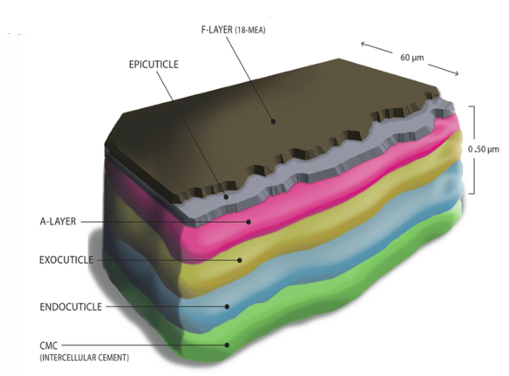
F-layer (lipid layer) |
Outermost part of the epicuticle composed of FA called 18-MEA and free lipids.
|
Epicuticle |
Outermost part of the cuticle. Very thin membrane covering the hair cuticle and hydrophobic in nature.
|
A-layer |
Has approx. 30% cystine content: cross linked which creates a structural strength and rigidity to cuticle. |
Exocuticle/B-layer |
Approx. 15% cysteine content. |
Endocuticle |
The last layer of cuticle of mostly proteins with low cystine (3% cysteine content). so, it’s mechanically softer and swells more in water than layers richer in cystine.
|
Cell membrane complex (CMC) of cuticles
Lipid material, primarily composed of polysaccharides & lipids, that acts as intercellular cement to glue (cohesion) each cuticle layer/overlapping scales.
Spaces within CMC (of unknown structure) are the preferred penetration and diffusion route of many substances into the hair cortex.
CMC and endocuticle are very susceptible regions to chemical treatments.
Everday grooming & shampooing friction may also disrupt the CMC.
The health of the cuticle greatly influences hair appearance.
Intact and closed cuticle act as a protective shield and maintain hair’s moisture.
Open (raised) cuticle scales can cause substance deposition in their structure.
Any manipulation of the cuticle scales changes hair appearance (softness, colour or texture).
So, in cosmetics, the cuticle is v. imp component of the hair fibre.
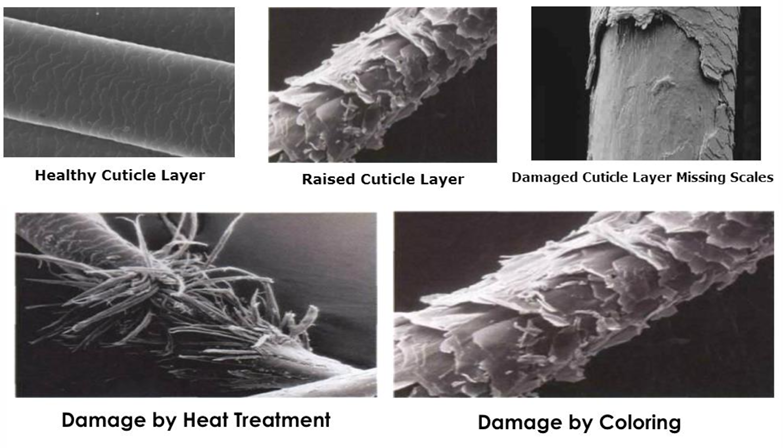
What opens up hair cuticle?
Human hairs’ pH is slightly acidic (4.5 to 5.5)—prevents fungal or bacterial growth.
Alkaline products (create negative energy) cause hair swelling and cuticle opening, which results in frizzy, dull, brittle hair.
What closes up hair cuticle?
Ingredients of an acidic nature.
ex. conditioners with positive charge or cationic surfactants.
Hair porosity level test
To determine if cuticle is open or closed by placing clean, shed hair into room temp water and waiting 1-2 min.
High porosity—→ sinks
Medium porosity—→ suspends in the middle
Low porosity—→ floats, then sinks
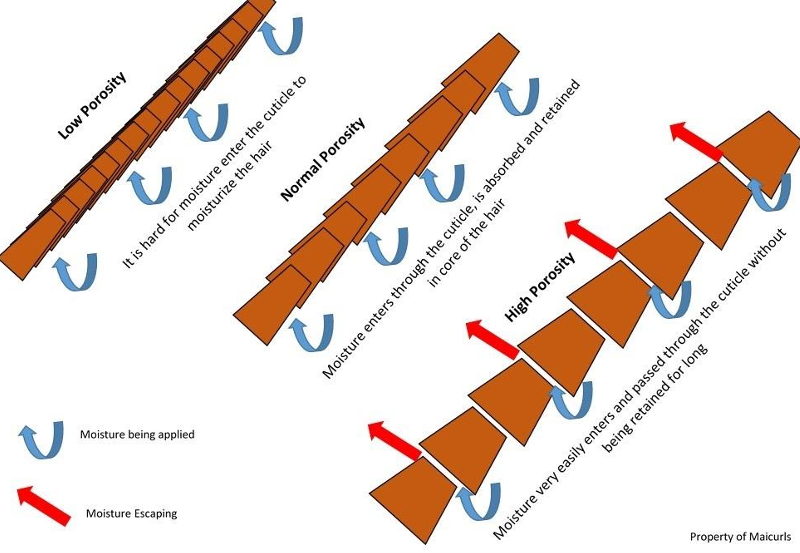
Hair porosity level depends on the compactness of the cuticle to the hair shaft (closed).
Understanding hair porosity can help choose the correct products for the hair to achieve optimum balance of hair moisture for strength and flexibility.
Low porosity hair is sometimes considered healthy.
High porosity hair will lead to easy breakage (saturation of hair with agents from open cuticles).
Apple Vinger could help stabilize hair pH and provide nourishment.
Tricks to seal hair cuticles.
Cold water
At the end of showering to flatten and seal hair cuticles (reduces frizz and provides shine).
Correct pH
Shampoos (alkaline nature) unbalance pH of hair (rougher cuticles).
Apple Vinger after shampoo may help.
Avoid scalp.
Smell is gone after drying.
Oils
Could help seal hair cuticles.
Sebum hair oil is naturally produced.
Avoid frequent shampooing to avoid excessive sebum loss.
Olive oil drops throughout hair ends could help hair, esp. in winter or dry climates.
The cortex
Central core of hair. Occupies 75-80% of hair volume.
Primarily made up of cortical cells and is responsible for hair elasticity and tensile strength.
Composed of:
Dimer—→ Protofilaments—→ Intermediate filament —→ Macrofibril—→ Cortical cells.
Cortical cells
Elongated, proteinaceous cells of regular and irregular cross-sections connected by CMC and contain pigment protein, melanin.
Number is around 100.
Separated and glued together by CMC.
Types:
Para cortical cells
Uniform spindle shape.
Hair with mostly para cortical cells have:
Straighter hair (due to uniformity of diameter and shape).
Relatively uniform diameter.
More cystine
More heat stable.
Ortho cortical cells
Non-uniform in shape.
(If the more component of hair, hair is likely to be textured).
Inside structure of cortical cells
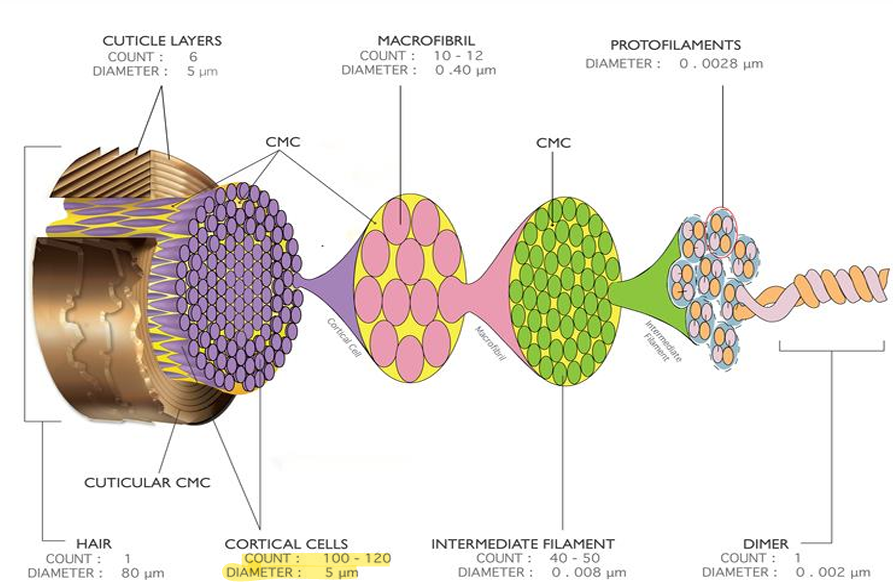
/1 cortical cell =
10-12 macrofibrils embedded in matrix (called keratin associated proteins (KAP) with high cystine content).
Macrofibrils: contain = 40-50 intermediate filaments (microfibril) = consists of 8 protofibrils = dimers coiled into 2 protein chains
Microfibrils/Intermediate filaments (IF): there are about 40 to 50 IFs. Contain very organized helical material protein chains twisted together like a rope.
Protofibrils: one IF consists of 8 protofibrils. Each protofibril is composed of 4 Protofilaments, which are joined by chemical forces (ionic forces, hydrogen bonds, Van der Waals’ forces & disulfide bonds to form a Dimer (2 of which give a tetramer=protofilament).
Hair straightening involves breaking those coils’ bonds.
Dimer proteins coil by these bonds, and then two of them aggregate to form tetramer/protofilament—→4 protofilaments (have 8 protein units) and make up a protofibril.
Dimer: twisted helical proteins.
If 2 dimers make up a tetramer/protofilament and 4 protofilaments make up 1 protofibril (8 dimers) and 8 protofibrils make up an IF/microfibril, then IF/microfibril consists of 16 dimers.
Combination of these protein elements makes up a composite structure of hair fiber.
Medulla
Empty, intermittent space in middle of hair fiber. Unstudied and unclear.
Coarse hair texture: have degree of medulla
Fine hair texture: has little to no medulla.
1. Chemical composition of hair
65-95% of hair weight is proteins with other constituents are water, lipid, pigment and trace elements. 80% of that protein is keratin, insoluble protein with C, H, O, N, S.
Keratin isoelectric point (PI) is acidic 4.5-5.5. Keratin carries positive and negative charges and hair tends to obtain negative charges throughout days (imbalance of pH which harm hair).
Alpha- keratins
(in alpha-helix conformation) found in hair, nails, claws, etc.
Type I keratins
Smaller with acidic PI points (4.5-5.5).
Type II keratins
Larger with neutral to slightly basic PI points (6.5-7.5)
Keratins further divide into “a” subtypes (type Ia & type IIa) for hard keratins such as in hair and nails. While “b” subtypes are for epidermal and soft keratins.
IF filaments in keratin fibers are formed by both “a” subtype (hard keratins) parallel to one another.
Types of hair protein bonds
Peptide bonds
Amino acids—→Connected by peptide bonds. —→ peptide—→ polypeptide.
Cystine/disulfide bonds
In hair, one of the most imp amino acid is cysteine, forming a cystine bond with another cysteine molecule, forming a cystine molecule (has SH as R group).
The cystine molecule is a crosslink in the hair that plays a role in hair strength and any changes in it may cause permanent changes in hair.
When 2 polypeptides with cysteine residues come close, the S atoms crosslink, forming disulfide/cystine link.
Hydrogen bonds
Present in dry hair but lost when hair is wetted, thus wet hair is weaker in tensile strength.
Salt linkages
between acidic (negative charge R groups) and basic (positive charge) residues of amino acids or polypeptides.
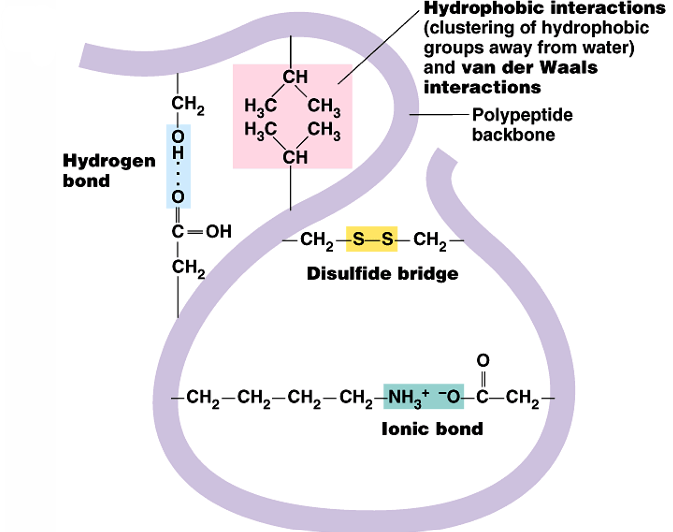
Important bonds crosslinked in polypeptides of hair:
Cystine/disulfide bonds and peptide bonds
Very permanent and key for keratin stability.
Reduction and oxidation of these bonds is the basis of chemical modifications to the hair and consequent hair properties changes. These modifications may be the goal to achieve hair straightening or waving.
Hydrogen bonds & salt linkages
Weak bonds that aren’t permanent.
2. Water content
An essential factor for protein structure stabilization (affects physical and cosmetic properties).
Hair is hygroscopic, and good condition hair can absorb >30% of its weight water; damaged hair can absorb 45%.
Water is assumed to adsorbed by hydrophilic matrix of cortical cells.
Moisture in the keratin fibers:
Dryness of hair fiber.
Air relative humidity (RH)
Water absorption is also related to:
Lipid quantity of hair
pH level
Hair hygrometers were used to measure air humidity on the principle of hair length variations when atmospheric vapour is absorbed.
Disadvantages: not accurate, need frequent adjustments and calibrations.
3. Hair lipids
External lipids
from sebaceous glands to supply sebum.
Sebum production is hormone dependant.
Mixture of TG, waxes that coat skin and lubricate hair.
Internal lipids
Free or part of CMC
From in hair bulb.
The majority of lipids are cholesterol, cholesterol esters, cholesterol sulfate, free fatty acids, triglycerides, paraffins, and ceramides.
A major component of exogenous lipids is 18-MEA.
Content may varies depending on several factors, such as origin, gender and age.
4. Trace elements
Inorganic. Most are alkaline elements (K & Na), alkaline earth metals (Mg, Ca), other metals.
Their detection may be used for diagnostic purposes, since systemic diseases may result in elements accumulations.
5. Hair pigments (Melanin)
Naturally from melanin pigments.
Melanin is made in melanocytes from aa’ tyrosine.
Functions:
Hair colour
Absorbing light
Free radical sink (eumelanin)
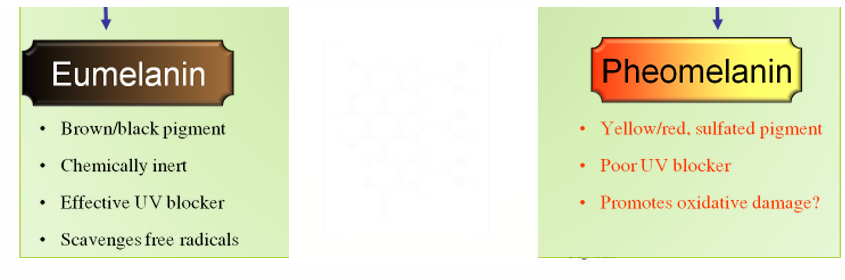
Premature greying of hair
When >50% of hair greys by age 30.
Causes:
Largely determined by genes, with the first discovered related gene is IRF4. However, genetics only play a 30% role.
Others:
HOH/dyes
Smoking
Vit B12/anaemia deficiency
Obesity
Oxidative stress (free radicals from poor diet, stress, pollution may exceed the antioxidant defences).