Week 4
4.4 Newton’s Third Law of Motion: Symmetry in Forces
Whenever one body exerts a force on a second body, the first body experiences a force that is equal in magnitude and opposite in direction to the force that it exerts.
This law represents a certain symmetry in nature: Forces always occur in pairs, and one body cannot exert a force on another without experiencing a force itself.
This is sometimes referred to as “action-reaction,” where the force exerted is the action and the force experienced as a consequence is the reaction.
Example 1
Consider a swimmer pushing off from the side of a pool. She pushes against the pool wall with her feet and accelerates in the direction opposite to that of her push. The wall has exerted an equal and opposite force back on the swimmer.
You might think that two equal and opposite forces would cancel, but they do not because they act on different systems. In this example it is the swimmer or the wall.
If we select the swimmer to be the system of interest, as in the figure, then Fwall on feet is an external force on this system and affects its motion. The swimmer moves in the direction of Fwall on feet.
In contrast, the force Ffeet on wall acts on the wall and not on our system of interest. Thus Ffeet on wall does not directly affect the motion of the system and does not cancel Fwall on feet.
Example 2
As a professor paces in front of a whiteboard, she exerts a force backward on the floor. The floor exerts a reaction force forward on the professor that causes her to accelerate forward.
Example 3
A car accelerates because the ground pushes forward on the drive wheels in reaction to the drive wheels pushing backward on the ground. You can see evidence of the wheels pushing backward when tires spin on a gravel road and throw rocks backward.
Example 4
Rockets move forward by expelling gas backwards at high velocities. This means the rocket exerts a large backward force on the gas in the rocket combustion chamber, and the gas therefore exerts a large reaction force forward on the rocket. This reaction force is called thrust.
7.1 Work: The Scientific Definition
What it means to do work
The scientific definition of work reveals its relationship to energy - whenever work is done, energy is transferred.
For work to be done a force must be exerted and there must be displacement in the direction of the force.
Formally, the work done on a system by a constant force is defined to be the product of the component of the force in the direction of motion times the distance through which the force acts.
For one-way motion in one dimension, this is expressed in equation form as
W =
where W is work, d is displacement of the system, and is the angle between the force vector F and the displacement vector d.
We can also write this as,
W= Fdcos
To find the work done on a system that undergoes motion that is not one-way or that is in two or three dimensions, we divide the motion into one-way one-dimensional segments and add up the work done over each segment.
Calculating Work
Work and energy have the same units. From the definition of work, we see that those units are fore times distance. Thus, in SI units, work and energy are measured in newton-meters. A newton-meter is given the special name joule (J).
7.2 Kinetic Energy and the Work-Energy Theorem
Work Transfers Energy
What happens to the work done on a system? Energy is transferred into the system, but in what form? Does it remain in the system or move on? The answers depend on the situation.
For example, if a lawn mower is pushed just hard enough to keep it going at a constant speed, then energy put into the mower by the person is removed continuously by friction, and eventually leaves the system in the form of heat transfer.
In contrast, work done on the briefcase by the person carrying it up stairs is stored in the briefcase-Earth system and can be recovered at any time
Net Work and the Work-Energy Theorem
We know that net force causes acceleration. Work done by the net force gives a system energy of motion.
Let us start by considering the total, or net, work done on a system. Net work is defined to be the sum of work on an object. The net work can be written in terms of the net force on an object. Fnet. In equation form Wnet=Fnetdcos
where is the angle between the force vector and the displacement vector.

This graph shows a graph of force versus displacement for the component of the force in the direction of the displacement - that is, an Fcos vs d graph. In this case Fcos is constant
You can see that the area under the graph is Fdcos, or the work done.


This shows a more general process where the force varies. The area under the curve is divided into strips, each having an average force (Fcos)i(ave) . The work done is (Fcos)i(ave)di for each strip, and the total work done is the sum of the Wi. Thus the total work done is the total area under the curve, a useful property to which we shall refer later.
Net work will be simpler to examine if we consider a one-dimensional situation where a force is used to accelerate an object in a direction parallel to its initial velocity. Such a situation occurs for the package on the roller belt conveyor system shown above.
The force of gravity and the normal force acting on the package are perpendicular to the displacement and do not work. Also they are equal in magnitude and opposite in direction so they cancel in calculating the net force.
The net force is achieved only from horizontal applied force Fapp and the horizontal friction force f. Thus, as expected, the net force is parallel to the displacement, so that and cos = 1, and the net work is given by
Wnet=Fnetd
The effect of the net force Fnet is to accelerate the package from v0 to v. The kinetic energy of the package increases, indicating that the net work done on the system is positive.
By using Newton’s second law, substitute Fnet=ma gives,
Wnet=mad
To get a relationship between net work and the speed given to a system by the net force acting on it, we take d=x-x0 and use the equation for change in speed over a distance d if the acceleration has the constant value a (𝑣2=𝑣02+2ad). Since a exists in both equations we can substitute a in the question above, this gives,
𝑊net
or
𝑊net =
This is called the work-energy theorm, and it applies in general (even for forces that vary in direction and magnitude), although we have derived it for a special case of a constant force parallel to the displacement. The theorem implies that the net work on a system equals the change in the quantity . This quantity is our first example of a form of energy.
The net work on a system equals the change in the quantity .
𝑊net =
The quantity in the work-energy theorem is defined to be the translational kinetic energy (KE) of a mass m moving at a speed v.
In equation form, the translational kinetic energy,
KE = ,
is the energy associated with translational motion. Kinetic energy is a form of energy associated with the motion of a particle, single body, or system of objects moving together.
Example 1: Calculating the Kinetic Energy of a Package
Suppose a 30.0kg package on the roller belt conveyor system is moving at 0.500m/s. What is its kinetic energy?
Use the formula KE =
KE =
= 3.75 J
Example 2: Determining the Work to Accelerate a Package
Suppose that you push on the 30.0-kg package with a constant force of 120 N through a distance of 0.800 m, and that the opposing friction force averages 5.00 N.
(a) Calculate the net work done on the package.
Fnet = 120-5 = 115 N
Wnet = Fnetd
= 115 × 0.8
= 92.0 J
(b) Solve the same problem as in part (a), this time by finding the work done by each force that contributes to the net force.
The forces acting on the package is gravity, the normal force, the force of friction and the applied force.
The normal force and gravity are each perpendicular to the displacement and therefore do no work.
Wapp = Fappdcos(0) = Fappd
= 120 × 0.8 × 1
= 96.0 J
Wapp = Fappdcos(0) = Fappd
= -5 × 0.8 × 1
= -4.0 J
Wtotal = 96 -4
= 92.0 J
Example 3: Determining Speed from Work and Energy
Find the speed of the package at the end of the push, using work and energy concepts.
𝑊net =
92.0 = x 30 x v2 - 3.75
95.75 = 15v2
v=2.53m/s
Example 4: Work and Energy Can Reveal Distance, Too
How far does the package coast after the push, assuming friction remains constant? Use work and energy considerations.
The normal force and force of gravity cancel in calculating the net force. The horizontal friction force is then the net force, and it acts opposite to the displacement so = 180.
To reduce the kinetic energy of the package to zero, the work Wfr by friction must be minus the kinetic energy that the package started with plus what the package accumulated due to the pushing.
Thus Wfr = -95.75 J. Furthermore, Wfr = fd’ cos = -fd’, where d’ is the distance it takes to stop. Thus,
d’ =
7.3 Gravitational Potential Energy
Work Done Against Gravity
Calculating the work done in lifting an object of mass m through a height h.
If the object is lifted straight up at constant speed, then the force needed to lift it is equal to its weight mg.
The work done on the mass is then W = Fd = mgh.
We define this to be gravitational potential energy (PEg) put into (or gained by) the object-Earth system.
This energy is associated with the state of separation between two objects that attract each other by the gravitational force, this is refered to as the PEg.
Why do we use the word system?
Potential energy is a property of a system rather than of a single object - due to its physical position.
An object’s gravitational potential is due to its position relative to the surroundings within the Earth-object system.
The force applied to the object is an external force, from outside the system.
When it does positive work it increases the gravitational potential energy of the system. Because gravitational potential energy depends on relative position, we need a reference level at which to set the potential energy is equal to 0.
We usually choose this point to be Earth’s surface, but this point is arbitrary, what is important is the difference in gravitational potential energy, because this difference is what relates to the work done.
Converting Between Potential Energy and Kinetic Energy
Gravitational potential energy may be converted to other forms of energy, such as kinetic energy.
If we release the mass, gravitational force will do an amount of work equal to mgh on it, thereby increasing its kinetic energy by the same amount.
We define the change in gravitational potential energy to be
ΔPEg=mgh,
where for simplicity we denote the change in height by h rather than the usual Δh. Note that h is positive when the final height is greater than the initial height.
If a 0.500kg mass hung from a cuckoo clock is raised 1.00m, then its change in gravitational potential energy is
mgh = 0.500 × 9.8 × 1
= 4.9 J
Using Potential Energy to Simplify Calculations
The equation ΔPEg=mgh applies for any path that has a change in height of h, not just when the mass is lifted straight up.
The idea of gravitational potential energy has the double advantage that it is very broadly applicable and it makes calculations easier.
From now on, we will consider that any change in vertical position h of a mass m is accompanied by a change in gravitational potential energy mgh, and we will avoid the equivalent but more difficult task of calculating work done by or against the gravitational force.
Example 1:The Force to Stop Falling
A 60.0-kg person jumps onto the floor from a height of 3.00 m. If he lands stiffly (with his knee joints compressing by 0.500 cm), calculate the force on the knee joints.
The person’s energy is brought to zero in this situation. The initial PEg is transformed in to KE as he falls. The work done by the floor reduces this kinetic energy to zero.
W = Fdcos = -Fd
The kinetic energy the person has upon reaching the floor is the amount of potential energy lost by falling through height h:
KE = -ΔPEg=-mgh
The knee joint compression is so small that we can ignore it.
The work W done by the floor on the person stops the person and brings the person’s kinetic energy to zero:
W = -KE = mgh
-Fd = mgh
F = -(mgh)/d
= -(60 × 9.8 × -3)/0.005
= 3.53 × 10⁵ N
Finding the Speed of a Roller Coaster from its Height
(a) What is the final speed of the roller coaster shown in Figure 7.8 if it starts from rest at the top of the 20.0 m hill and work done by frictional forces is negligible? (b) What is its final speed (again assuming negligible friction) if its initial speed is 5.00 m/s?
The roller coaster loses potential energy as it goes downhill. We neglect friction, so that the remaining force exerted by the track is the normal force, which is perpendicular to the direction of motion and does no work.
The net work on the roller coaster is then done by gravity alone. The loss of gravitational potential energy from moving downward through a distance h equals the gain in kinetic energy.
This written in equation form as -ΔPEg=ΔKE
a) Initial kinetic energy is 0 so ΔKE= .
The equation for change in potential energy states that ΔPEg=mgh. Since his negative in this case ΔPEg=mg
mg =
masses cancel
9.8 × 20 = 0.5 x v2
v = 19.8 m/s
b) In this case there is initial kinetic energy so ΔKE=𝑚𝑣2−𝑚𝑣02
g = −𝑣02
2 x 9.8 × 20 = v2 - 5 × 5
v = 20.4m/s
7.4 Conservative Forces and Potential Energy
Potential Energy and Conservative Forces
Work is done by a force and some forces such as weight have special characteristics.
A conservative force is one, like the gravitational force, for which work done by or against it depends only on the starting and ending points of a motion and not on the path taken.
We can define potential energy (PE) for any conservative force, just as we did for the gravitational force.
This stored energy is recoverable as work and it is useful to think of it as potential energy contained in the spring. Indeed, the reason that the spring has this characteristic is that its force is conservative. That is a conservative force results in stored or potential energy.
Gravitational potential energy is one example, as is the energy stored in a spring.
We will also see how conservative forces are related to the conservation of energy.
Potential Energy of a Spring
Calculating the potential energy stored in a spring (PEs)
We calculate the work done to stretch or compress the spring that obeys Hooke’s law
𝑊s=Fd=
PEs =
where k is the spring’s force constant and x is the displacement from its undeformed position.
Conservation of Mechanical Energy
When only conservative forces are involved this leads to the conservation of energy principle. The work-energy theorem states that the net work done by all forces acting on a system equals its change in kinetic energy. Its equation is stated below.
𝑊net= =ΔKE.
If only conservative forces act, then
Wnet=Wc
where Wc is the total work done by all conservative forces. Thus,
Wc = ΔKE
If all conservative force such as gravitational force or a spring force does work the system loses potential energy. That is Wc=-PE. Therefore,
-ΔPE=ΔKE or ΔKE+ΔPE = 0
This equation means that the total kinetic and potential energy is constant for any process involving only conservative forces. That is,
KE + PE = constant
or
KEi + PEi = KEf + PEf
This is known as the conservation of mechanical energy principle. This only applies when all the forces are conservative, so that friction is negligible.
The total kinetic plus potential energy of a system is defined to be its mechanical energy (KE + PE).
7.5 Nonconservative Forces
Nonconservative Forces and Friction
A nonconservative force is one for which work depends on the path taken.
Friction is a good example of nonconservative force. Work done against friction depends on the length of the path between the starting and ending points. Because of this dependence on path, there is no potential energy associated with nonconservative forces.
An important characteristic is that the work done by a nonconservative force adds or removes mechanical energy from a system.
Friction creates thermal energy that dissipates, removing energy from the system. Furthermore, even if the thermal energy is retained or captured, it cannot be fully converted back to work, so it is lost or not recoverable in that sense as well.
How Nonconservative Forces Affect Mechanical Energy
Mechanical energy may not be conserved when nonconservative forces act.
For example, when a car is brought to a stop by friction on level ground, it loses kinetic energy, which is dissipated as thermal energy, reducing its mechanical energy.
How the Work-Energy Theorem Applies
When conservative and nonconservative forces act, the work done by nonconservative forces equals the change in the mechanical energy of a system. The work-energy theorem states that the net work on a system equals the change in its kinetic energy, or Wnet=ΔKE.
The net work is the sum of the work by nonconservative forces plus the work by conservative forces. That is,
Wnet = Wnc + Wc
so that
Wnc + Wc =ΔKE
where Wnc is the total work done by all nonconservative forces and Wc is the total work done by all conservative forces.
Example 1
A person pushes a crate up a ramp and is opposed by friction.
Work done by a conservative force comes from a loss of gravitational potential energy, so that Wc = -ΔPE.
Substituting this equation into the previous one and solving for Wnc gives,
Wnc = ΔKE + ΔPE
This equation means that the total mechanical energy (KE + PE) changes by exactly the amount of work done by nonconservative forces.
In the diagram above the work done by the person minus the work done by friction. So even if energy is not conserved for the system of interest (such as the crate), we know that an equal amount of work was done to cause the change in total mechanical energy.
We rearrange Wnc = ΔKE + ΔPE to obtain
KEi + PEi + Wnc = KEf + PEf
This means that the amount of work done by nonconservative forces adds to the mechanical energy of a system.
If Wnc is positive, then mechanical energy is increased, such as when the person pushes the crate up the ramp.
If Wnc is negative, then mechanical energy is decreased, such as when the rock hits the ground.
If Wnc is zero, then mechanical energy is conserved, and nonconservative forces are balanced.
For example, when you push a lawn mower at constant speed on level ground, your work done is removed by the work of friction, and the mower has a constant energy.
Applying Energy Conservation with Nonconservative Forces
When no change in potential energy occurs, applying
KEi + PEi + Wnc = KEf + PEf
amounts to applying the work-energy theorem by setting the change in kinetic energy to be equal to the net work done on the system, which in the most general case includes both conservative and nonconservative forces.
But when seeking instead to find a change in total mechanical energy in situations that involve changes in both potential and kinetic energy the previous equation
KEi + PEi + Wnc = KEf + PEf
says that you can start by finding the change in mechanical energy that would have resulted from just the conservative forces, including the potential energy changes and add to it the work done, with proper sign, by any nonconservative forces involved.
Example 1 - Calculating Distance Travelled: How Far a Baseball Player Slides
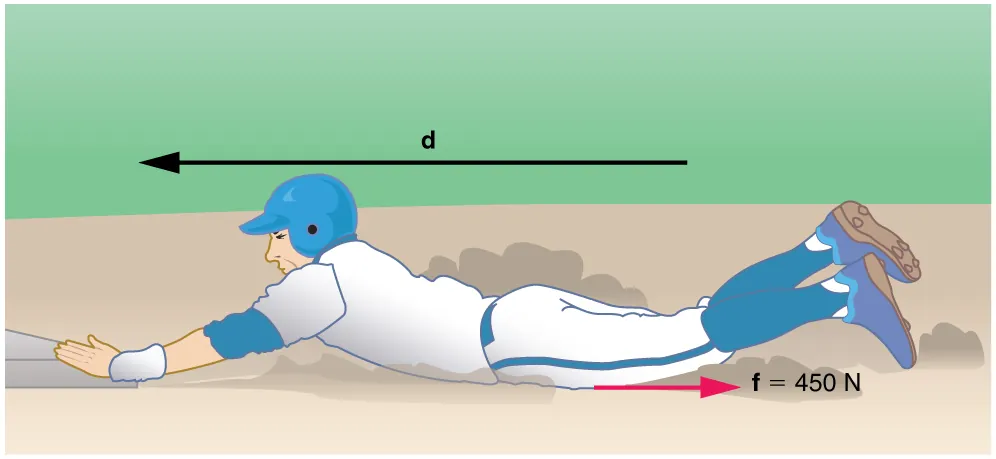
A baseball player slides to a stop on level ground. Using energy considerations, calculate the distance the 65.0kg baseball player slides, given that his initial speed is 6.00 m/s and the force of friction against him is a constant 450N.
The work done by friction, which is negative is added to the initial kinetic energy to reduce it to zero.
KEi + Wnc = 0
The work done by friction is negative, because f is in the opposite direction of the motion. Thus Wnc= -fd.
KEi - fd = 0
mvi2 - fd = 0
d = 2.60m
Example 2 - Calculating Distance Travelled Sliding Up an Incline
A player is running up a hill having a 5.00 degree incline upward with a surface similar to that in the baseball stadium. The player slides with the same initial speed and the frictional force is still 450N. Determine how far he slides.
KEi + PEi + Wnc = KEf + PEf
mvi2 + mgh - fd = mvi2 +mgh
x 65 × 62 + 65 × 9.8 × 0 - 450 x d = x 65 × 02 +65 × 9.8 x dsin(5)
1170 -450d = 637dsin(5)
1170 = d(637sin(5) + 450)
d= 2.31m
7.6 Conservation of Energy
Law of Conservation of Energy
The law of conservation is stated below
Total energy is constant in any process. It may change in form or be transferred from one system to another, but the total remains the same.
Two major energy types - mechanical energy (KE + PE) and energy transferred via work done by nonconservative forces (Wnc).
Other Forms of Energy than Mechanical Energy
We lump these into a section called other energy (OE). Then we can state the conservation of energy in equation form as
KEi +PEi + Wnc +OEi =KEf + PEf + OEf
All types of energy and work can be included in this very general statement of conservation of energy.
Kinetic energy is KE, work done by a conservative force is represented by PE, work done by nonconservative forces is Wnc, and all other energies are included as OE.
This equation applies to all previous examples, in those situations OE constant, and so it subtracted out and was not directly considered.
When does OE play a role?
One example occurs when a person eats. Food is oxidised with the release of carbon dioxide, water, and energy. Some of this chemical energy is converted to kinetic energy when the person moves, to potential energy when the person changes altitude and to thermal energy.
Some of the Many Forms of Energy
Electrical energy
Chemical energy
Radiant energy
Nuclear energy
Thermal energy
Transformation of Energy
The transformation of energy from one form into others is happening all the time.
The chemical energy in food is converted into thermal energy through metabolism, light energy is converted into chemical energy through photosynthesis.
In a larger example, the chemical energy contained in coal is converted into thermal energy as it burns to turn water into steam in a boiler.
This thermal energy in the steam in turn is converted to mechanical energy as it spins a turbine, which is connected to a generator to produce electrical energy.
Not all of the initial energy is converted into the forms mentioned.
Another example of energy conversion occurs in a solar cell. Sunlight impinging on a solar cell produces electricity, which in turn can be used to run an electric motor. Energy is converted from the primary source of solar energy into electrical energy and then into mechanical energy.
Object/phenomenon | Energy in joules |
|---|---|
Big Bang | 1068 |
Energy released in a supernova | 1044 |
Fusion of all the hydrogen in Earth’s oceans | 1034 |
Annual world energy use | 4×10²⁰ |
Large fusion bomb (9 megaton) | 3.8×10¹⁶ |
1 kg hydrogen (fusion to helium) | 6.4×10¹⁴ |
1 kg uranium (nuclear fission) | 8.0×10¹³ |
Hiroshima-size fission bomb (10 kiloton) | 4.2×10¹³ |
90,000-metric ton aircraft carrier at 30 knots | 1.1×10¹⁰ |
1 barrel crude oil | 5.9×10⁹ |
1 ton TNT | 4.2×10⁹ |
1 gallon of gasoline | 1.2×10⁸ |
Daily home electricity use (developed countries) | 7×10⁷ |
Daily adult food intake (recommended) | 1.2×10⁷ |
1000-kg car at 90 km/h | 3.1×10⁵ |
1 g fat (9.3 kcal) | 3.9×10⁴ |
ATP hydrolysis reaction | 3.2×10⁴ |
1 g carbohydrate (4.1 kcal) | 1.7×10⁴ |
1 g protein (4.1 kcal) | 1.7×10⁴ |
Tennis ball at 100 km/h | 22 |
Mosquito (10–2gat0.5m/s) | 1.3×10⁻⁶ |
Single electron in a TV tube beam | 4.0×10⁻¹⁵ |
Energy to break one DNA strand | 10−19 |
Efficiency
Even though energy is conserved in an energy conversion process, the output of useful energy or work will be less than the energy input.
The efficiency Eff of an energy conversion process is defined as
Efficiency (Eff) = (useful energy or work output)/(total energy input) =
Efficiencies of mechanical devices and human activities
Activity/device | Efficiency (%)1 |
|---|---|
Cycling and climbing | 20 |
Swimming, surface | 2 |
Swimming, submerged | 4 |
Shoveling | 3 |
Weightlifting | 9 |
Steam engine | 17 |
Gasoline engine | 30 |
Diesel engine | 35 |
Nuclear power plant | 35 |
Coal power plant | 42 |
Electric motor | 98 |
Compact fluorescent light | 20 |
Gas heater (residential) | 90 |
Solar cell | 10 |
8.1 Linear Momentum and Force -ND

where Fnet is the net external force, Δp is the change in momentum, and Δt is the change in time

8.2 Impulse
The quantity is Fnet Δt is impulse and is the same as change in momentum.
8.3 Conservation of Momentum

where p’1 and p’2 are the momenta of cars 1 and 2 after the collision.
Workshop
Impulse is the same thing as change in momentum
Net force times by time is change in momentum or impulse
When landing after jumping you bend your knees to increase the time taken to fall and decrease the force.