7. Stem cell therapies
Stem cells- An undifferentiated cell that can divide to produce some offspring cells that continue as stem cells and some cells that are destined to differentiate (become specialized).
Stem cells have two defining qualities:
- They can self-renew (a property that makes cells live longer)
- They can differentiate into specialized mature cells
Stem cell therapy-
- Utilised in regenerative medicine
- Repairing tissues/organs rather than treating symptoms
- Replacing defective/diseased cells with new functional cells
Stem cell classification
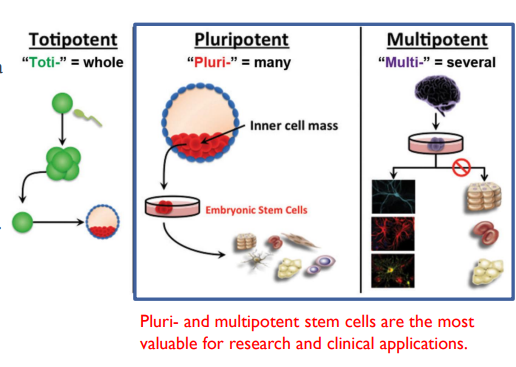
Totipotent stem cells- Totipotent stem cells can give rise to an organism: e.g. a zygote. cells can produce a complete organism. “Toti” means whole
Pluripotent stem cells- Pluripotent stem cells can give rise to all three germ layers (mesoderm, endoderm and ectoderm) but not extraembryonic structures: e.g. embryonic stem cells. “Pluri” means many
Multipotent stem cells- Multipotent stem cells are adult stem cells, e.g a neutral stem cell or a hematopoietic stem cell. “Multi” means several
Current limitation for stem cell therapies
- Ethical concerns
- Immune rejection
- Tumorigenicity
- Safety and regulatory challenges
Origin of stem cells?
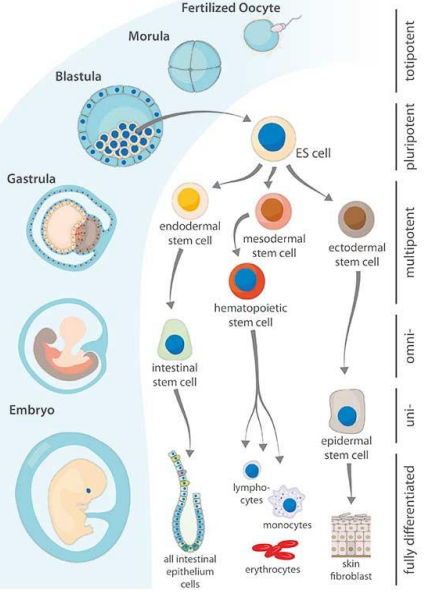
- Blastula has two layers.
- Gastrula have three different layers
- Embryo has a lot of specific stem cells
- Embryonic stem cells can produce any cell type in our body. They are pluripotent cells
- Multipotent cells stay in our body for the full lifetime
Embryonic stem (ES) cells
- ES cells are pluripotent stem cells
- ES cells can proliferate indefinitely (process by which a cell grows and divides to produce two daughter cells)
- ES cells can give rise to all three germ layers. To this day, ES cells have been successfully converted to neurons, blood cells, cardiomyocytes and liver cells, among others.
- ES cells can be isolated from excess in vitro fertilized (IVF) eggs which have been donated for research purposes.
- Can potentially be used for disease modelling (e.g genetic disease), vitro study of developmental processes, transplantation of cells of interest differentiated from ES cells into patients
- Ethical concerns about the human blastocysts which have to be sacrificed to obtain ES cells.
Steps to circumvent ethical issues:
- Derivation of ES cell lines without destroying the embryo
Steps to circumvent immune rejection:
- Biobanking: ES cell bank with ES cell lines derived from HLA haplotypes commonly found in the population
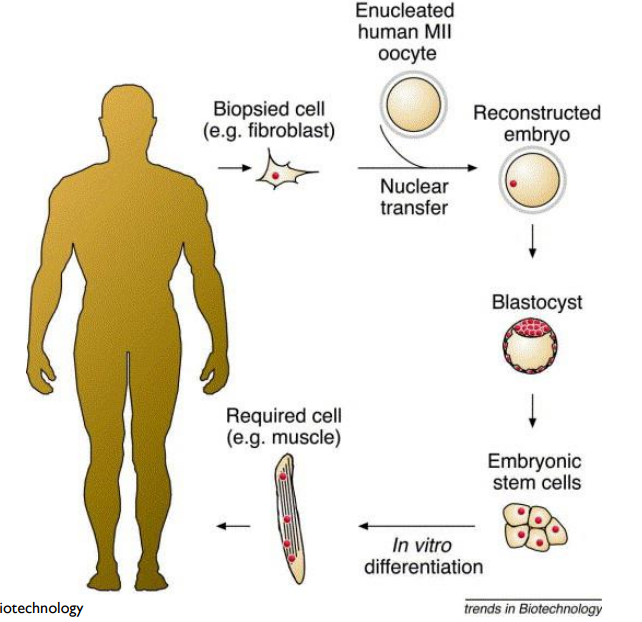
- Somatic cell nuclear transfer (SCNT): production of ES cells from the patients
themselves by therapeutic cloning. Embryonic cells from the person directly and the patient will not reject it
Therapeutic cloning
- Isolate skin cells and introduce them into an enucleated oocyte to reconstruct embryo → differentiation.
- It is more complicated since several eggs are needed.
- Finding egg donors is challenging and ethically dubious.
- Expensive!
Induced Pluripotent Stem Cells (iPSCs)
- Generated by reprogramming fully differentiated somatic cells using specific genes to pluripotent stems.
- Potentially used for disease modelling and gene therapy (mutations can be corrected).
Pros:
- Vastly renewable
- Easily accessible
- Non-immunogenic
Cons:
- Personalised medicine (Highly cost)
- Tumorigenicity
- Risk of transplanting incompletely differentiated cells.
- Genomic and epigenetic alterations in the iPSC-derived cells
Multipotent stem cells
- They are tissue-specific
- Hard to access and isolate
Hematopoietic stem cells (HSCs)
- Hematopoietic stem cells (HSCs) are the multipotent stem cells that give rise to other blood cells.
- Most widely transplanted cells in stem cell therapies, particularly for haematological disorders.
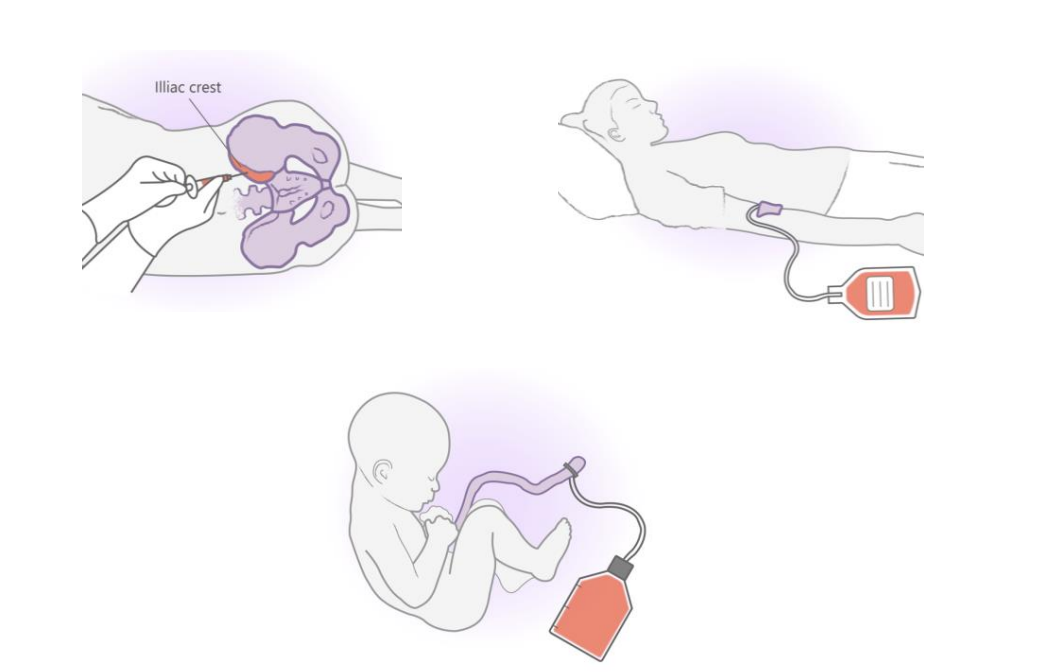
- Can be sourced from bone marrow, umbilical cord blood and Cytokine G-CSF
- HSCs replenish the recipient’s hematopoietic system
- Donor needs to match a certain level
- Graft versus host disease (GVHD) occurs when immune cells transplanted from a non-identical donor (the graft) recognize the transplant recipient (the host) as foreign, thereby initiating an immune reaction that causes disease in the transplant recipient.
Mesenchymal stem cells (MSC)
- Mesenchymal stem cells are multipotent stromal cells that can differentiate in vitro into a variety of cell types, including osteoblasts (bone cells), chondrocytes (cartilage cells) and adipocytes (fat cells which give rise to marrow adipose tissue).
- Can be sourced from bone marrow, umbilical cord blood and adipose tissue (body fat)
- Can be used for tissue repair
- Anti-inflammatory properties (heal the wounds) influence on tissue repair
- Short-term existence: allogeneic safety
Cord blood
Cord blood advantages
- Increased donor availability (every child that is born every day, great availability)
- Non-invasive process
- Lower risk of GvHD (Doesn’t have the same degree of immune cells as adults)
- Reduced need for HLA (human leukocyte antigen) matching
Cord blood disadvantages
- Limited HSC number
Challenges and Considerations-
- Overcoming scarcity by expanding stem cells ex vivo.
- Ensuring safety through quality control, avoiding tumorigenicity, and addressing immunogenicity concerns.
Quiz
Pluripotent stem cells can give rise to neutral stem cells
- True
ESCs and iPSCs are equivalent to transplantations as part of stem cell therapies.
- False (iPSCs: risk for teratomas)
Umbilical cord blood derived stem cells can be used for clinical applications directly
- False (the numbers are not enough in umbilical cord)
Induced pluripotent stem cells (IPSC) pose no concern of immune rejection.
- False (risk for GvHD depending on iif it's autologous or allogeneic)
Guided differentiation of induced pluripotent stem cells into blood cells in a lab setting can be used for clinical applications.
- False (not used in clinical applications today)