biochem ch 6
chapter 6
6.1 Catalytic Power and Specificity
Enzymes are highly efficient catalysts that can accelerate reaction rates by factors of or more. Without them, most biological reactions would occur too slowly to sustain life.
Example: Carbonic anhydrase, one of the fastest enzymes, facilitates transport by hydrating millions of times faster than the uncatalyzed rate.
Specificity: Enzymes are specific to both the reaction and the substrate. This is determined by the enzyme's complex three-dimensional structure.
Proteolytic Enzymes: These enzymes catalyze protein hydrolysis but vary in specificity:
Papain: Broad/undiscriminating (cleaves many peptide bonds).
Trypsin: Specific to the carboxyl side of Lysine and Arginine.
Thrombin: Highly specific; cleaves only Arg–Gly bonds in specific sequences.
6.2 The Six Major enzyme Classes
Enzymes are categorized into six functional groups:
Oxidoreductases: Catalyze oxidation–reduction reactions (transfer of electrons).
Transferases: Transfer functional groups between molecules.
Hydrolases: Cleave molecules by adding water ().
Lyases: Add/remove groups to form or break double bonds.
Isomerases: Move functional groups within a single molecule.
Ligases: Join two molecules using energy from ATP hydrolysis.
6.3 Nomenclature and Classification
While many enzymes have common names ending in "-ase" (e.g., ATP synthase), the Enzyme Commission (EC) system provides a precise four-digit identification number.
Example (Trypsin): Identified as EC 3.4.21.4.
3: Hydrolase class.
4: Cleaves peptide bonds.
21: Uses a serine residue for hydrolysis.
4: Specific to Lysine or Arginine carboxyl donors.
ACTUAL 6.2
Many enzymes require cofactors—small molecules beyond the standard amino acid repertoire—to execute catalysis.
Key Terminology
Apoenzyme: An enzyme lacking its necessary cofactor (inactive states).
Holoenzyme: The complete, catalytically active complex (enzyme + cofactor).
Classification of Cofactors
Coenzymes: Small organic molecules, typically derived from vitamins.
Prosthetic Groups: Tightly bound or covalently attached coenzymes.
Cosubstrates: Loosely bound coenzymes that associate and dissociate like substrates.
Metals: Inorganic ions required for activity (e.g., in Carbonic anhydrase).
Examples of Cofactors and Respective Enzymes
Thiamine pyrophosphate (TPP): Pyruvate dehydrogenase
Flavin adenine dinucleotide (FAD): Monoamine oxidase
Nicotinamide adenine dinucleotide (NAD): Lactate dehydrogenase
Biotin: Pyruvate carboxylase
Coenzyme A (CoA): Acetyl CoA carboxylase
Metal Ions: Found in enzymes like Carbonic anhydrase, Urease, and Superoxide dismutase.
ACTUAL 6.3
Enzymes accelerate reaction rates by lowering the activation energy, but they do not alter the reaction's thermodynamics or equilibrium.
Principles of Gibbs Free Energy ()
Spontaneity:
If \Delta G < 0: The reaction is exergonic and occurs spontaneously.
If \Delta G > 0: The reaction is endergonic and requires energy input to proceed.
If : The system is at equilibrium.
Path Independence: depends only on the free energy of the products minus that of the reactants; it is independent of the reaction mechanism.
Rate vs. Spontaneity: provides no information about the reaction rate. Rate is determined by the activation energy ().
Standard Free-Energy Change (\Delta G^\circ')
The standard free-energy change is measured at standard conditions (, for reactants, and ).
Equation:
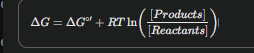
At equilibrium (), the relationship between \Delta G^\circ' and the equilibrium constant ( K′eq ) is:
\Delta G^\circ' = -RT \ln K'{eq}For every 10-fold change in , \Delta G^\circ' changes by approximately at .
Enzymes and Equilibrium
Enzymes accelerate the attainment of equilibrium but do not change the equilibrium position.
The final concentration of products is identical with or without an enzyme
ACTUAL 6.4
6.4 Enzyme Mechanism and the Transition State
Enzymes accelerate reactions by decreasing the activation energy () but do not alter the overall free-energy change () or the equilibrium of the reaction.
The Transition State (‡)
A fleeting, high-energy molecular structure that is no longer substrate but not yet product.
Enzymes function by stabilizing the transition state, making its formation more frequent.
The Active Site
A specific 3D cleft or crevice created by amino acids from different parts of the primary sequence.
Occupies a small volume of the enzyme but requires the entire protein (typically >100 residues) for proper scaffolding.
Provides a unique, often nonpolar, microenvironment where water is excluded unless it is a reactant.
Substrate Binding
Substrates bind via multiple weak, noncovalent interactions (van der Waals, hydrogen bonds, electrostatic forces).
Models of Binding:
Lock and Key: Substrate and active site have complementary shapes.
Induced Fit: The enzyme changes shape upon binding to optimize recognition (dynamic process).
Binding Energy
The free energy released by the formation of weak interactions between enzyme and substrate.
This energy is the source used to lower the activation energy.
Maximal binding energy is released only when the enzyme interacts with the transition state.
Transition-State Analogs
Compounds that mimic the transition state but cannot be catalyzed.
These serve as potent inhibitors because ellos bind to the enzyme much more tightly than the substrate.
Catalytic Antibodies (Abzymes): Artificially created antibodies that recognize transition states and can function as enzymes.