Routing in IPv4
Network-Layer Functions
Forwarding - move packets from router’s input to appropriate router output
Data plane
Routing - determine route taken by packets from source to destination
Control plane
Per-Router Control Plane
Individual routing algorithm components in each and every router interact in the control plane
Routing Protocols
Routing protocol goal - determine “good” paths (equivalently, routes), from sending hosts to receiving host, through network of routers
Path - sequence of routers packets traverse from given initial source host to final destination host
“good” - least “cost”, “fastest”, “least congested”
Routing - a “top-10” networking challenge
Graph Abstraction Link Costs
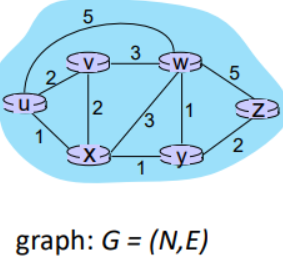
N: set of routers = { u, v, w, x, y, z }
E: set of links ={ (u,v), (u,x), (v,x), (v,w), (x,w), (x,y), (w,y), (w,z), (y,z) }
Routing Algorithm Classification

Dijkstra's Link-State Routing Algorithm
Centralised - network topology, link costs known to all nodes
Accomplished via “link state broadcast”
All nodes have same info
Computes least cost paths from one node (“source”) to all other nodes
Gives forwarding table for that node
Iterative - after k iterations, know least cost path to k destinations
Notation
c_{x,y} - direct link cost from node x to y; =\infty if not direct neighbours
D(v) - current estimate of cost of least-cost-path from source to destination v
p(v) - predecessor node along path from source to v
N' - set of nodes whose least-cost-path definitively known
Why it works?
At each iteration, select the node with the smallest tentative distance (from the source) that hasn’t been processed
Finalise the shortest path to this node, and update the tentative distances of its neighbours
Once a node's shortest path is finalised, it cannot be improved later because
The shortest paths have the optimal substructure property (as long as the link costs are not negative)
Optimal substructure property - any sub-portion of a shortest path starting from the source is itself a shortest path
Example - if the shortest path from S to D is S→A→B→D then
S→A→B is the shortest path from S to B
S→A is the shortest path from S to A
Algorithm Complexity - n Nodes
Each of n iteration - need to check all nodes w not in N
n(n+1)/2 comparisons: O(n^2) complexity
More efficient implementations possible: O(nlog(n))
Message Complexity
Each router must broadcast its link state information to other n routers
Efficient broadcast algorithms - O(n) link crossings to disseminate a broadcast message from one source
Each router’s message crosses O(n) links - overall message complexity - O(n^2)
Oscillations Possible
When link costs depend on traffic volume, route oscillations possible
Sample scenario:
Routing to destination a, traffic entering at d, c, e with rates 1, e (<1), 1
Link costs are directional, and volume-dependent

Making Routing Scalable
Our routing study thus far - idealized
All routers identical
Network “flat”
… Not true in practice
Scale - billions of destinations
Can’t store all destinations in routing tables
Routing table exchange would swamp links
Internet Approach
Aggregate routers into regions known as “autonomous systems” (AS) (a.k.a. “domains”)
Intra-AS (aka “intra-domain”)
Routing among routers within same AS (“network”)
All outers in AS must run same intradomain protocol
Routers in different AS can run different intra-domain routing protocols
Gateway router: at “edge” of its own AS, has link(s) to router(s) in other AS’es
Inter-AS (aka “inter-domain”)
Routing among AS’es
Gateways perform inter-domain routing (as well as intra-domain routing)
Interconnected ASes
Forwarding table configured by intra- and inter-AS routing algorithms
Intra-AS routing determine entries for destinations within AS
Inter-AS & intra-AS determine entries for external destinations
Intra-AS routing - routing within an AS
Most common intra-AS routing protocols:
RIP - Routing Information Protocol [RFC 1723]
Classic DV - DVs exchanged every 30 secs
No longer widely used
EIGRP - Enhanced Interior Gateway Routing Protocol
DV based
Formerly Cisco-proprietary for decades (became open in 2013 [RFC 7868])
OSPF - Open Shortest Path First [RFC 2328]
Link-state routing
IS-IS protocol (ISO standard, not RFC standard) essentially same as OSPF
OSPF (Open Shortest Path First) Routing
“open” - publicly available
Classic link-state
Each router floods OSPF link-state advertisements (directly over IP rather than using TCP/UDP) to all other routers in entire AS
Multiple link costs metrics possible: bandwidth, delay
Each router has full topology, uses Dijkstra’s algorithm to compute forwarding table
Security - all OSPF messages authenticated (to prevent malicious intrusion)
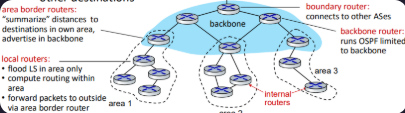
Hierarchical OSPF
Two-level hierarchy - local area, backbone
Link-state advertisements flooded only in area, or backbone
Each node has detailed area topology; only knows direction to reach other destinations