Local anaesthesia for children
Success relies on co-operation
DHT can administer LA to a child for:
cavity prep that involves cutting into dentine
extraction of primary teeth
Topical agents:
Physical
ethyl chloride
rarely used in children
Pharmacological
topical sprays or gels
5% lidocaine or 18-20% benzocaine (not under age 2)
Use of topical gel
success depends on technique
anaesthetises 2-3mm depth
area must be dry
gel should be applied over a limited area
applied for sufficient time
limit the amount used
cotton bud/cotton wool roll
Equipment
syringe
needle
cartridge
LA solutions
lidocaine 2% 1:80,000 adrenaline - gold standard
articaine 4%, 1:100 000 or 1:200,000 adrenaline - effective alternative to IDB, not under 4yrs, infiltrate only
mepivacaine 3% plain - when adrenaline contra-indicated
prilocaine 3% octapressin - caution, for known latex allergy
at room temp
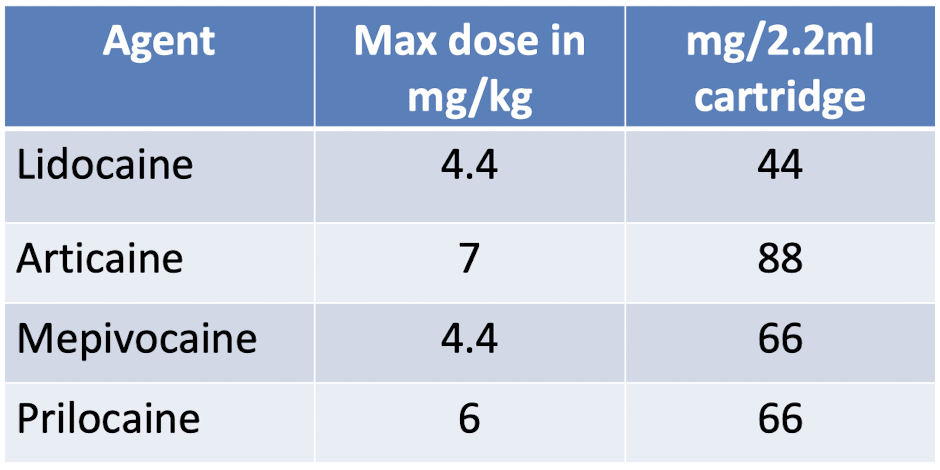
Max doses
Max dose: 3 x (age) + 7 = weight in kg
Basic technique
same for adults
assemble equipment and hide
check expiry date and integrity
check MH, consent, prescription
ensure
correct pt positioning, ideally 30 degrees to the vertical
good lighting
correct operator positioning
dry mucosa
apply topical gel
stretch mucosa
distract the pt
insert the needle
aspirate
inject very slowly
confirm anaesthesia
Infiltration
Buccal:
method of choice for maxilla and anterior mandible
effective alternative to IDB with articaine
sufficient for restorative work
Palatal:
painful
Intrapapillary
reduces discomfort of palatal
short (blue) or extra short needle (purple)
Maxillary buccal infiltration
pull the cheek outwards so mucosa is taut
insert needle into muco-buccal fold
aspirate
advance upwards towards the apex
inject slowly
Upper anteriors
more uncomfortable
initially inject into buccal sulcus and “chase” anaesthesia across
extra short needle (purple)
Intrapapillary
for extraction of primary teeth following buccal infiltration
extra short needle (purple)
insert into base of interdental papilla at 90 degrees
advance palatally while injecting
performed mesially and distally
look for blanching palatally/lingually
supplement with painless palatal infiltration
Palatal
supplements the intrapapillary for extractions
extra short needle (purple)
check that the palate has blanched when giving intrapapillary
insert at right angles to the mucosa approx ½ cm away from gingival margin
Regional block
inferior alveolar and lingual nerve
long (yellow) needle
childs mouth must be open wide
insert 5mm above occlusal plane
advance to bone
aspirate
inject slowly ¾ cartridge
withdraw and deposit rest of cartridge for lingual nerve
Post op instructions
numb feeling will last for a few hours
avoid eating on the anaesthetised side
avoid anything very hot or cold
do not bite/chew soft tissues
Complications
generalised
localised
early onset
late onset
Generalised:
psychogenic
allergy
toxicity
cardiovascular effects
CNS effects
methaemoglobinaemia
drug interactions
infection
Localised complications - early onset
pain
intravascular injections
failure of LA
facial paralysis
sensory interference
haematoma
Localised complications - late onset
self inflicted trauma
oral ulceration
prolonged anaesthesia
trismus
infection
Contra-indications
maturity
intellectual or physical disability
acute infection
allergy
medical conditions
poor blood supply
wouldn’t rlly do IDB in a child under 7? do articaine infiltrations
Scenarios
restoration of URD
extraction of LLE
restoration of LR6
active recall qs
what does success rely on
what are the reasons a DHT can administer LA to a child
what are the two types of topical agents that can be used
describe how topical gel should be used
what equipment is needed
what LA solutions are available for use
how is max dose calculated
what is the basic technique for LA
what are the different infiltrations
maxillary buccal infiltration method
upper anteriors method
intrapapillary method
palatal method
regional block method
what are the post op instructions
what complications can occur
what generalised complications can occur
what are the early onset localised complications
what are the late onset localised complications
what are the contraindications