B Cells and Antibodies
Lecture 3 - B cells and Antibodies
Overview
Key Concept: The evolution of adaptive immunity in higher life forms.
Occurred 200 million years ago in fish.
Adaptive immunity can respond to a wide range of invaders.
B lymphocytes: Critical cells that detect antigens using B cell receptors (BCR).
BCRs detect the antigen and signal the B cell to activate, divide, and produce antibody with the same specificity as the BCR
Objective 1.1 - BCR Structure and Function
BCR Composition:
Made of light chains (Lc) and heavy chains (Hc).
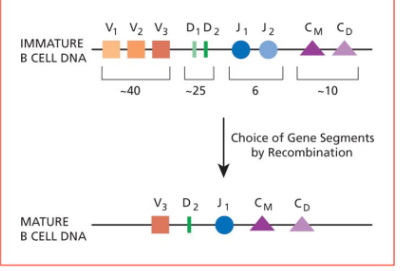
Diversity arises from rearranging gene segments on chromosome 14.
Two copies of chromosome 14 (one from each parent) compete for selection.
Objective 1.2 - BCR Structure and Function
Gene Segments Selected to make a BCR
Four segments: V, D, J, and C.
Heavy chain (Hc) is produced first, followed by testing for functionality.
Cut and paste in order, test to see if the receptor works.
The successful chromosome shuts down the other.
Heavy chain and light chain have to fit together to work
Objective 1.3 - BCR Structure and Function
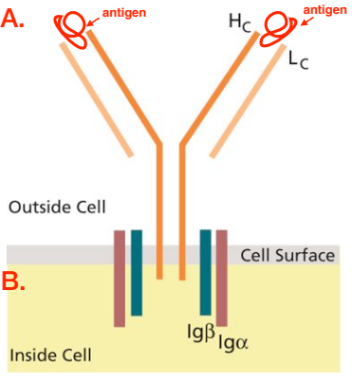
How the BCR signals - two interacting components
Antigen Recognition:
B cell epitope: Small region on the antigen (50-79 amino acids).
Binding occurs through Hc and Lc "antennae."
Signaling Mechanism:
Proteins Igβ and Igα transmit signals to activate antibody production.
Objective 1.4 - BCR Structure and Function
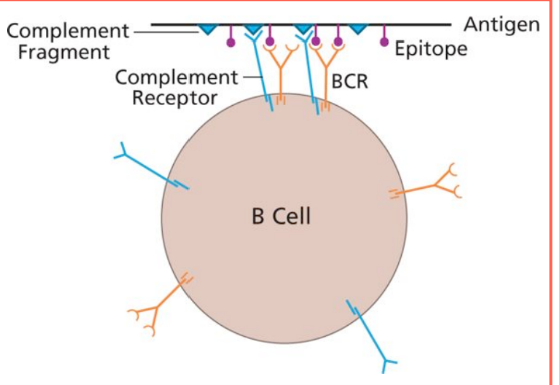
How the BCR signals - concept of cross-linking
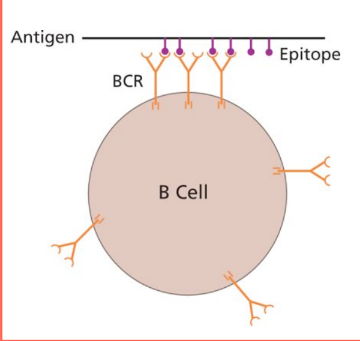
Cross-Linking:
Polymeric antigens (one with repeats of an epitope) can bind multiple BCRs, enhancing signaling.
Many copies of the same antigen on the invader can do this.
Complement receptors on the B cell recognize a fragment of iC3b, enhancing the clustering that occurs on BCRs
This amplifies B cell signaling over 100-fold.
Objective 2.1 - Second Signals for B Cell Activation
Activation Requirements:
B cells need two signals for activation.
Types of activation:
T-independent response (without T helper cell help).
T-dependent response (with T helper cell help).
Regardless of which way the cell is activated, the process requires 2 signals
First signal: cross-linking (clustering) of BCR
Second signal: co-stimulatory signal determines the quality of the B cell response
Objective 2.2 - Second Signals for B Cell Activation
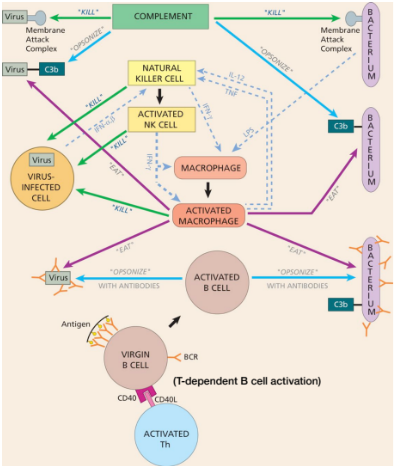
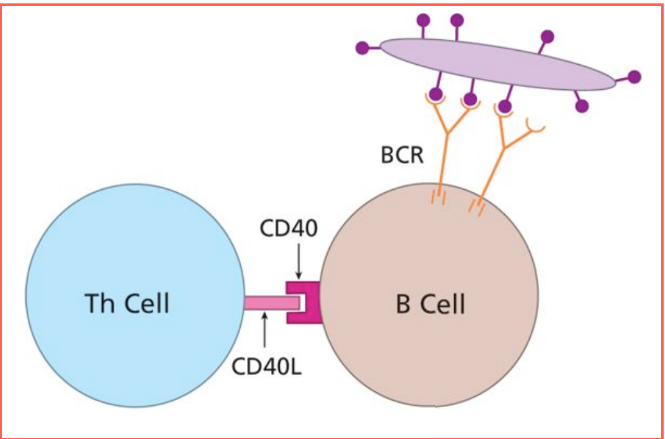
T Cell-Dependent Activation: Interaction with co-stimulatory molecule on Th cell (T-helper cell)
Involves interaction with CD40 on B cells and CD40L (ligand) on T helper cells.
The second signal is crucial for the quality of the B cell response.
Objective 2.3 - Second Signals for B Cell Activation
T Cell-Independent Activation: Danger signal
Involves recognition of PAMPs by Toll-like receptors (PRRs).
Qualities of the T-independent B cell response
1. Fast - Don’t need to wait for T helper cells to be activated
2. Responds to non-protein antigens
The second, co-stimulatory signal helps prevent B cells from being activated against polymers from our own bodies (like DNA)
Objective 2.4 - Second Signals for B Cell Activation'
A third, bad way to stimulate B cells
Mitogen Activation:
Mitogens can bind to molecules on B cells that just happen to be associated with BCRs
Mitogens can cluster BCRs without antigen recognition.
Results in the activation of many B cells (polyclonal activation, as many clones of B cells activate this way)
Results in polyclonal activation, which can confuse immune responses. This is a bad way to stimulate B cells
Objective 3.1 - Class Switching
What happens after B cells are stimulated? Maturation of B cells in 3 steps
Post-Stimulation Processes:
1. Class switching: Changing antibody class (e.g., IgM to IgG).
2. Somatic hypermutation: Increases BCR affinity for antigens.
Done via mutations that increase the affinity of BCR for its cognate antigen
3. Decision between becoming a plasma cell or memory cell.
Objective 3.2 - Class Switching
Mechanism:
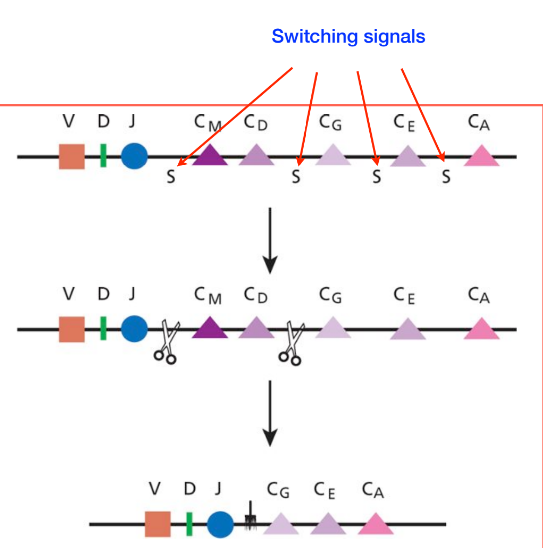
Activated B cells initially produce IgM or IgD.
Cutting and pasting heavy chain (Hc) genes on chromosome 14 leads to changes in antibody class
Heavy chain gene rearrangement leads to class switching.
Objective 4.1 - Antibody Classes and Functions
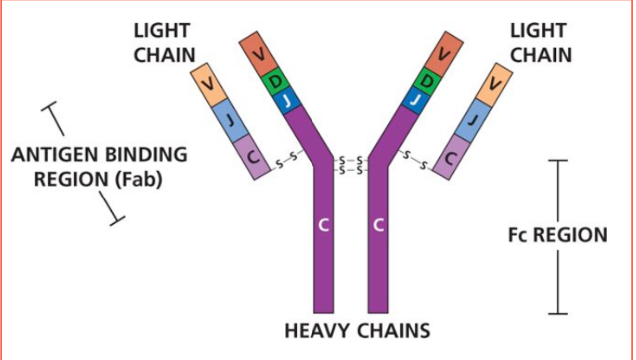
Antibody Structure:
Constant region (Fc) determines function of Ab (antibody)
Fab (antigen binding) region determines antigen specificity.
Objective 4.2 - Antibody Classes and Functions
IgM Antibody: First antibody in evolution, gene sequence, and
expression activated by B cells
Held together by a J chain
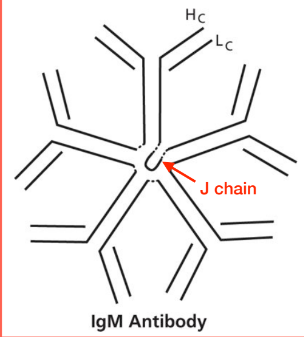
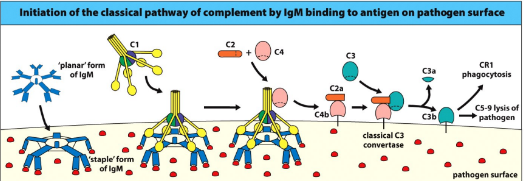
Very good at activating (“fixing”) complement (by the classical pathway)
Allows two C1qrs protein complexes to come together
via the Fc region when IgM binds to the cognate antigen on an invader
Causes C1s to lose thier inhibitor molecule which leads to the activation of a C3 convertase —> same pathway as seen in the innate immune system
IGM is a good neutralizer
: Objective 4.3 - Antibody Classes and Functions
IgG Antibodies: Gamma globulins
Multiple subclasses; IgG3 and IgG1 have specific functions.
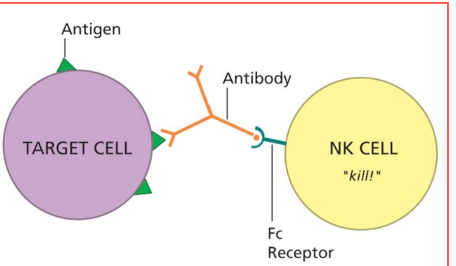
IgG3 fixes complement, can be recognized bt NK cells
Recognized by antibody dependent cell-mediated cytotoxicity, ADCC)
IgG1 opsonizes - coat cells or pathogens so cells of your immune system (phagocytes) can find them, attach to them, swallow them and break them apart
Crosses the placenta, providing fetal protection.
Good neutralizer
Most abundant class of antibodies in the blood; has a half life of 3 weeks (c.f IgM = one day)
Objective 4.4 - Antibody Classes and Functions
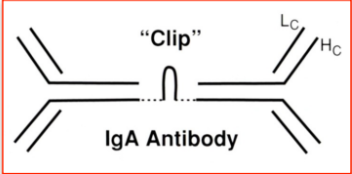
IgA Antibody:
Most abundant - rare in blood but common on mucosal surfaces and mucsosal secretions.
Found in breast milk
Structure - 2 IgGs held together by a clip protein
Clip is a passport for secretion into the gut
Good neutralizer
Objective 4.5 - Antibody Classes and Functions
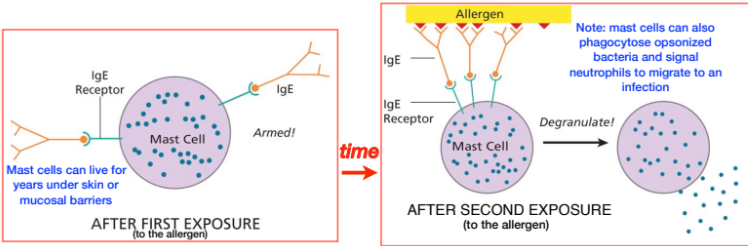
IgE Antibodies:
Associated with allergic reactions and anaphylaxis.
Involved in defense against parasites.
Caused by mast cells degenerating
Objective 4.5 - Summary of Antibody Classes
Antibody Class | Antibody Properties |
IgM |
|
IgA |
|
IgG |
|
IgE |
|
Class Switching - controlled by the cytokines produced by T-helper cells. Ex.
Cytokines | Class Switch | Main targetsfor Ab (antibodies) |
IL-4 | IgE | Worm infection |
IFN-γ | IgG | Bacteria and Viruses |
TGF-β | IgA | Respiratory virus |
ll Maturation
Somatic Hypermutation:
High mutation rate in V, D, and J regions post-class switching.
Affinity for cognate antigens:
unchanged
reduced
increased
B cells will keep dividing when constantly re-stimulated by antigen.
B cells that producer higher affinity Ab (bind more tightly to antigen) are favored, so we continually select for better Ab through this fine tuning
Objective 5.2 - B Cell Maturation
Career Choices for B Cells:
Plasma cells: Secrete antibodies after migrating to spleen or bone marrow.
Memory B cells: retains memory of first antigenic stimulation to give faster response to subsequent encounter with cognate antigen.
Principle behind immunization
Only occurs with T-dependent antigens and Th help