chapter 14: social psychology
overview
- social psychology is a broad field devoted to studying the way that people relate to others
- a major influence on the first two areas discussed in this chapter (attitude formation and attribution theory) is social cognition
- social cognition - applies many of the concepts that are in the field of cognition, such as memory and biases, to help explain how people think about themselves and others
- the basic idea is that as people go through their lives, they act like scientists, constantly gathering data and making predictions about what will happen next
attitude formation and change
- the main focus of social psychology is attitude formation and change
- attitude - a set of beliefs and feelings
- attitudes are evaluative, meaning our feelings toward such things could be positive or negative
- a great deal of research focuses on the ways to affect people’s attitudes
- mere exposure effect - states that the more one is exposed to something, the more one will come to like it
- persuasive messages can be processed through the central route or the peripheral route
- central route to persuasion - involves deeply processing the content of the message
- peripheral route to persuasion - involves other aspects of the message including the characteristics of the person imparting the message, the communicator
- certain characteristics of communicators have been found to influence the effectiveness of a message, such as attractive people, famous people, and experts
- certain characteristics of an audience also can affect how effective a message is
- research suggests that more educated people are less likely to be persuaded by advertisements
- the way a message is presented can influence how persuasive it is
- research has found that when dealing with an uninformed audience, presenting a one-sided message is best but attempting to influence a more sophisticated audience, a communication that acknowledges and then refuted opposing arguments will be more effective
the relationship between attitudes and behavior
- research has found that the relationship between attitudes and behavior is far from perfect
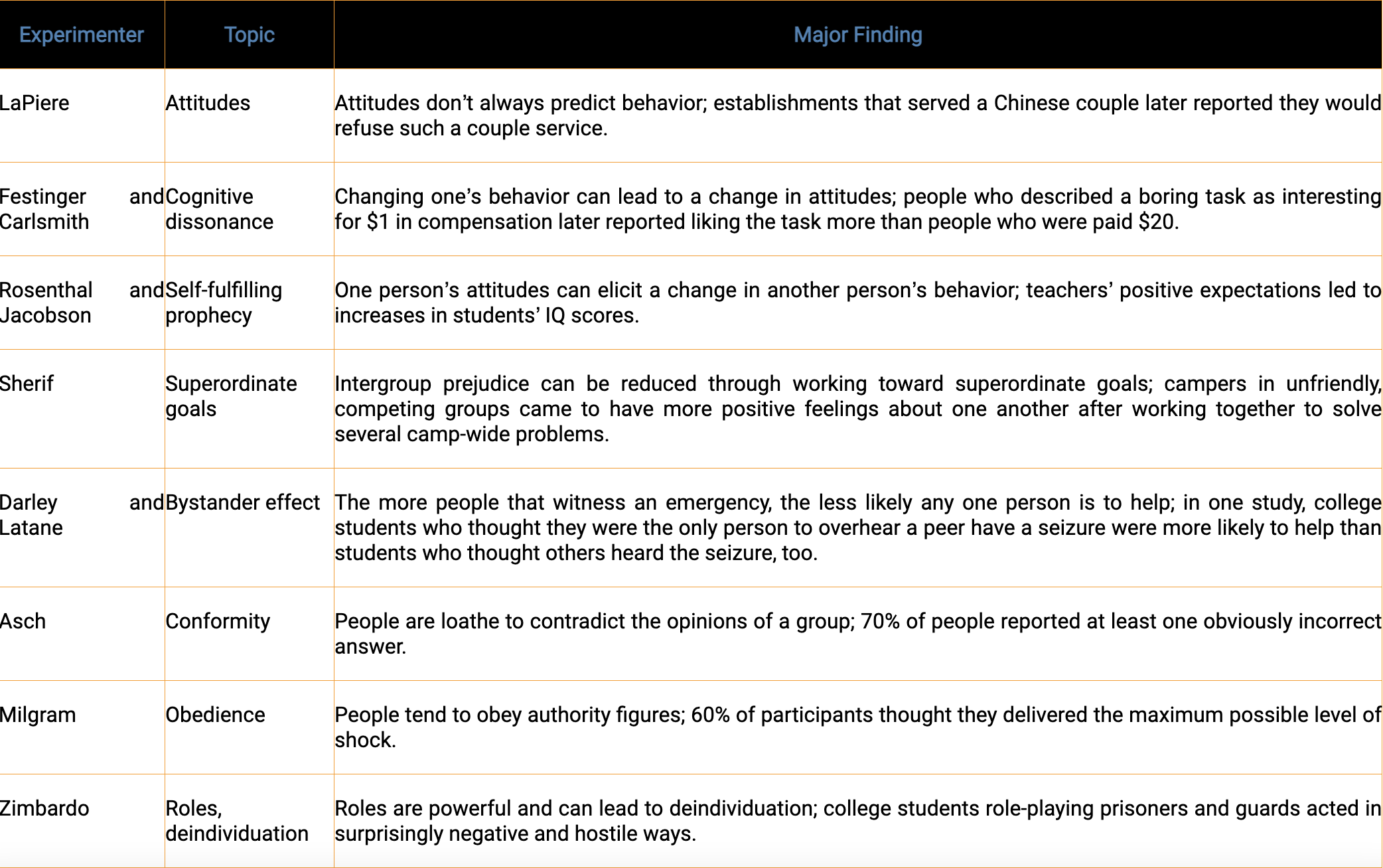
- Richard LaPiere conducted a study where he traveled throughout the West Coast to visit many hotels and restaurants with an Asian couple to see how they would be treated
- after, he contacted all of the establishments they visited and asked about their attitude towards Asian patrons and many of them said that they wouldn’t have served Asians
- this study shows that attitudes do not perfectly predict behaviors
- sometimes if you can change people’s behaviors, you can change their attitudes as well
- cognitive dissonance theory - based on the idea that people are motivated to have consistent attitudes and behaviors
- when they don’t, they experience unpleasant mental tension or dissonance
- Leon Festinger and James Carlsmith conducted an experiment about cognitive dissonance where participants performed a boring task and were asked to lie and tell the next subject that they had enjoyed the task
- in one condition, subjects were paid a dollar to lie, and in another condition, they were paid 20 dollars. afterward, the participant's attitudes toward the task were measured
- the subjects who had been paid a dollar were found to have more positive attitudes than those who were paid 20 dollars
- according to Festinger and Carlsmith, having said that the boring task was interesting, the subjects were experiencing dissonance but the subjects that had been paid 20 dollars experienced little dissonance
compliance strategies
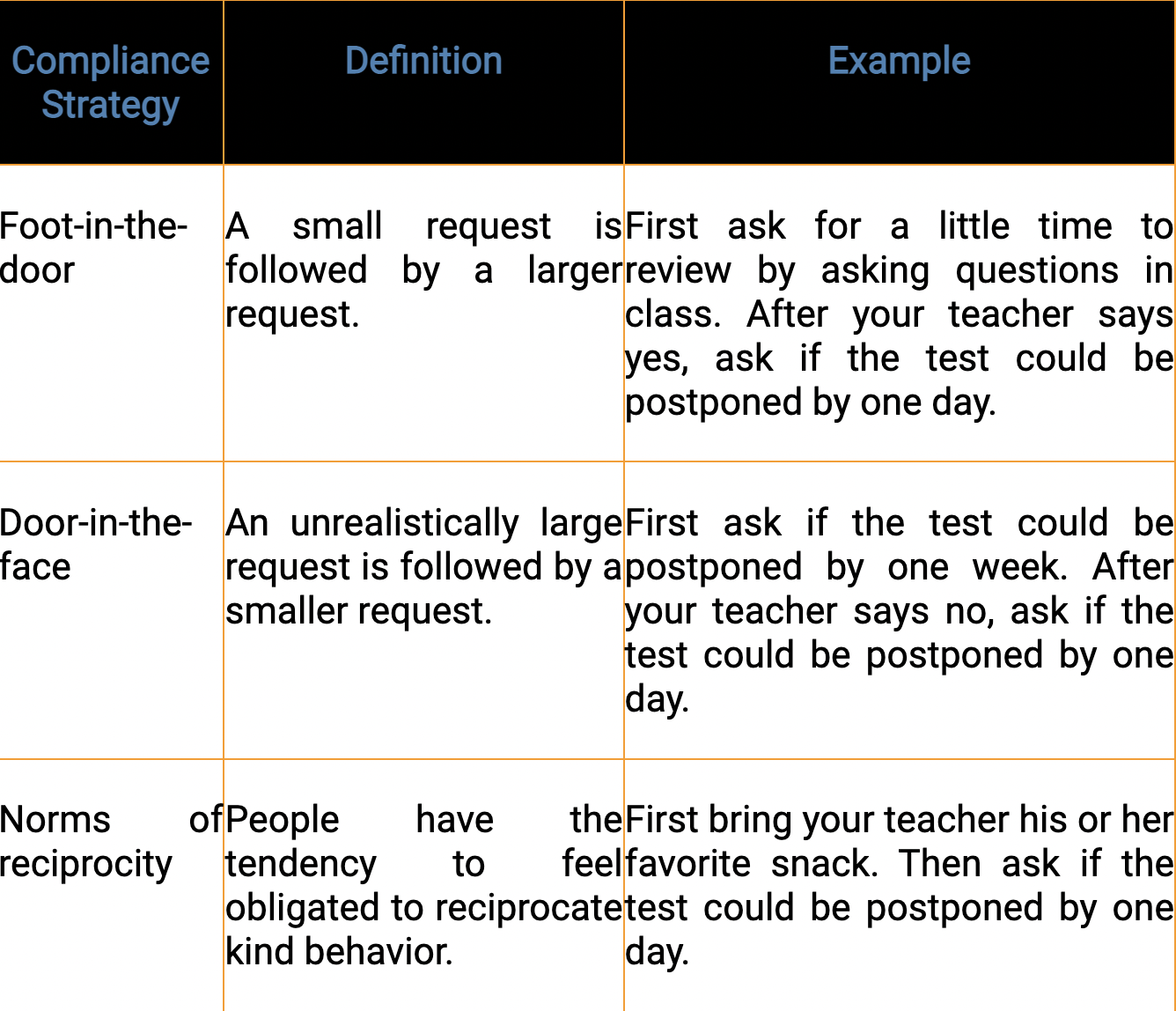
- people use certain strategies to get t others to comply with their wishes, which are called compliance strategies
- foot-in-the-door phenomenon - suggests that if you can get people to agree to a small request, they will become more likely to a follow-up request that is larger
- door-in-the-face phenomenon - argues that after people refuse something large, they will most likely have a follow-up request that seems more reasonable
- another common strategy is using the norms of reciprocity
- norms of reciprocity - when you feel compelled to do something for someone who did something for you
attribution theory
attribution theory - tries to explain how people determine the cause of what they observe
dispositional or person attribution - when someone tells you a positive thing about themselves, it forces you to give that same attribution to them, or forces you to act differently (positively) towards them
situation attribution - if someone says something positive about themselves, it could've been influenced by other environmental/situational factors
attributions can also be stable or unstable
person-stable attribution - infer that an event or behavior is due to unchanging factors
person-unstable attribution - infer that an event or behavior is due to temporary factors
situation-stable attribution - when the cause of a situation is unchanging
situation-unstable attribution - when the cause of a situation is temporary
Harold Kelly had a theory that people make attributions based on three kinds of information
- consistency: refers to how similarly the individual acts in the same situation over time
- distinctiveness: refers to how similar these situations are to other situations which we have seen from the same individual
- consensus: asks us to consider how others in the same situation have responded
consensus is an important piece of information to use when determining where to make a person or situation attribution
people often have ideas or prejudices about other people before they can even meet them
these ideas can affect the way someone acts toward another person
self-fulfilling prophecy - the idea that the expectations we have about others can influence the way those others behave
a study about self-fulfilling prophecy was done by Rober Rosenthal and Leniore Jacobson’s “Pygmalion in the Classroom” experiment
this was when they administered a test to children that would identify which children were on the verge of significant academic growth, but in reality, it was just an IQ test
the researchers randomly selected a group of children from the population who took the test and informed the teachers that these students were having intellectual progress
by the end of the year, the researchers returned to take another measure of the student's IQ and found that the identified children had increased more than the scores of their classroom
attributional biases
- a few biases are the fundamental attribution error, false-consensus effect, self-serving bias, and the just-world belief
- fundamental attribution error - when looking at the behavior of others, people tend to overestimate the importance of dispositional factors and underestimate the role of situational factors
- people do not use this tendency in explaining their own behaviors but are more likely to say that their own behavior depends upon the situation
- this was named to be fundamental because it was said to be very widely spread but was actually less likely to occur in collectivist cultures than in individualistic cultures
- in individualistic cultures, the importance and uniqueness of the individual are stressed
- in collectivist cultures, a person’s link to various groups such as family or company is stressed
- false-consensus effect - the tendency for people to overestimate the number of people who agree with them
- self-serving bias - the tendency t take more credit for good outcomes than for bad ones
- just-world bias - people evidence a bias toward thinking that bad things happen to bad people, in which misfortunes befall people who deserve them
stereotypes, prejudice, and discrimination
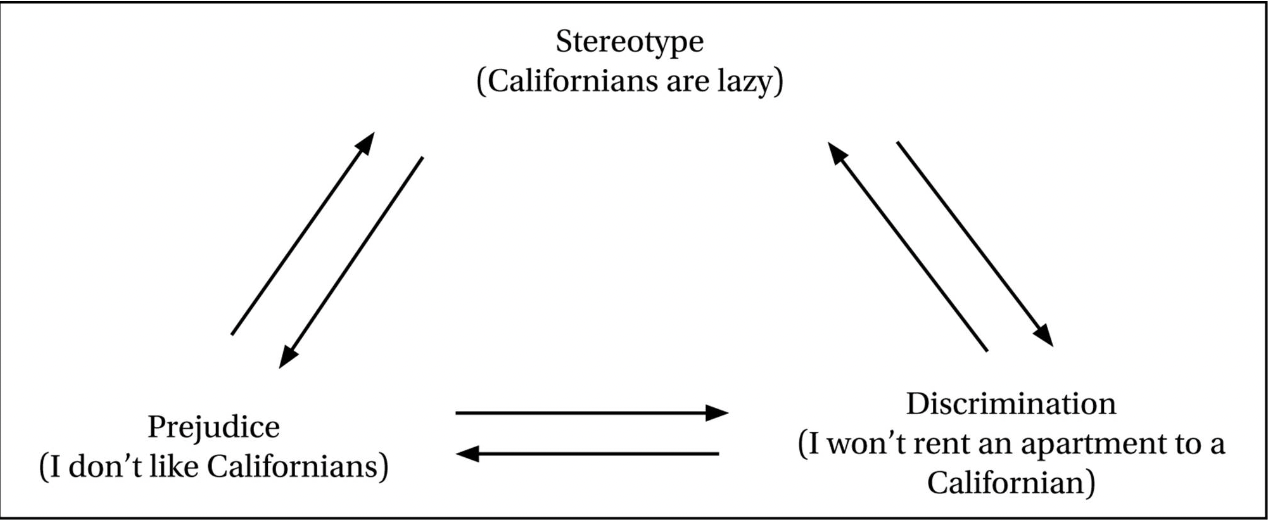
- stereotypes - ideas about what members of different groups are like and these expectations may influence the way we interact with members of the groups
- stereotypes could be positive or negative and can be applied to any group of people
- cognitive psychologists have suggested that stereotypes are basically schemata about groups
- people who distinguish between stereotypes and group schemata argue that stereotypes are more rigid and more difficult to change than group schemata
- prejudice - undeserved, usually negative, attitude toward a group of people
- stereotyping can lead to prejudice when negative stereotypes are applied uncritically to all members of a group, and a negative attitude results
- ethnocentrism - the belief that one’s culture is superior to others
- ethnocentrism is a specific type of prejudice since people become so used to their own cultures that they see them as the norm and use that as the standard by which to judge other cultures
- discrimination - instead of an attitude, an action is done negatively against someone
- when someone discriminated, they act on one’s prejudices
- stereotypes, prejudice, and discrimination all reinforce one another, since people’s beliefs and attitudes influence each other and guide people’s behavior
- when people act in discriminatory ways, they are motivated to strengthen their prejudices and stereotypes to justify their behavior
- in-group - members of someone’s own group
- out-group - members of other groups
- out-group homogeneity - people tend to see members of their in-group as more diverse than members in the out-groups
- in-group bias - a preference for one’s own group, is thought to stern from people’s belief that they themselves are good people, so the people with who they share group membership are thought to be good as well
origin of stereotypes and prejudice
- many different theories attempt to explain how people become prejudiced
- psychologists have suggested that people naturally magnify differences between their group and others
- by taking into account the in-group bias, this idea suggests that people cannot avoid forming stereotypes
- social learning theorists stress that stereotypes and prejudice are often learned through modeling and this theory suggests that prejudices could be unlearned by exposure to different models
combating prejudice
- contact theory - states that contact between hostile groups will reduce animosity, but only if the groups are made to work toward a goal that benefits all and necessitated the participation of all
- superordinate goal - a goal that benefits all and necessitates the participation of all
- Muzafer Sherif’s camp study illustrated how easily out-group biases can be created and how superordinate goals can be used to unite formerly antagonistic groups
- he first divided campers into two groups and arranged for them to compete in a series of activities, then staged several camp emergencies that required the groups to cooperate
- the superordinate goal of solving the issues improved the relations between the groups
- a number of researchers attempted to use the contact theory to reduce prejudice between members of different groups in school, one of them being to bring members of different social groups into contact with one another as they work toward a superordinate goal
aggression and antisocial behavior
- psychologists distinguish two types of aggression
- instrumental aggression: the aggressive act is intended to secure a particular end
- hostile aggression: a type of aggression that is committed in response to a perceived threat or insult
- many theories exist about the cause of human aggression
- frustration-aggression hypothesis - holds that the feeling of frustration makes aggression more likely
prosocial behavior
- social psychologists have also studied the factors that make people more likely to help one another
- prosocial behavior - factors that make people more likely to help one another
- bystander intervention - the conditions under which people nearby are more and less likely to help someone in trouble
- bystander effect - the larger the number of people who witness an emergency situation, the less likely anyone is to intervene
- one explanation for this is the diffusion of responsibility
- the larger the group of people who witness a problem, the less responsible any one individual feels to help
- people assume that someone else will take action so they don’t need to
- another factor contributing to the bystander effect is pluralistic ignorance
- people seem to decide what constitutes appropriate behavior in a situation by looking at others
attraction
- social psychologists also study what factors increase e the chance that people will like one another
- there are three factors that have been deducted
- similarity - we are drawn to people that are similar to us
- proximity - people closer to us are people that we are more likely to be attracted to
- reciprocal liking - the more someone likes you, the more you will probably like that person
- people are also attracted to others who are physically attractive
- research has stated that good-looking people are perceived as having more positive attributes such as better personalities and greater job competence
- self-disclosure - a term often used for liking and loving studies
- someone self-discloses when someone shares a piece of personal information with another
- close relationships are built through a process of self0disclosure
the influence of others on an individual’s behavior
- a major area in social psychology is how an individual’s behavior can be affected by another’s actions or even merely by another person’s presence
- a number of studies have shown that people perform tasks better in front of an audience than they do when they are alone
- social facilitation - the presence of others improves task performance
- conformity - the tendency of people to go along with the views or actions of others
- Soloman Asch conducted an experiment where they brought participants into a room with confederates and asked them to make a series of simple judgments
- he showed the participants three vertical lines of varying sizes and asked them to indicate which one was the same length as a different target line
- all of the trials had a correct answer but the confederates would give the same wrong answer
- the results were that in approximately one-third of the cases when the confederated gave an incorrect answer, the participants conformed
- studies have shown that conformity is more likely to occur when a group’s opinion is unanimous
- groups larger than three do not significantly increase the tendency to conform
- obedience studies - focus on participant’s willingness to do what another asks them to do
- Stanley Milgram conducted a study for obedience studies where his participants were told that they were taking part in a study about teaching and learning and they were assigned to play the part of the teacher, while the learner was a confederate
- each participant’s job was to give the learner an electric shock for every incorrect response and wanted to see how far participants would go before refusing to deliver any more shocks
- over 60 percent of the participants obeyed the experimenter and delivered the shocks
group dynamics
- we are all members of different groups, and these groups have norms
- norms - rules about how group members should act
- within groups are roles
- roles - refers to the social position people have
- social loafing - taking advantage of being part of a group, individuals do. not put in as much effort when acting as part of a group as they do when acting alone
- group polarization - the tendency of a group to make more extreme decisions than the group members would make individually
- groupthink - a term that was coined by Irving Janis, and describes the tendency of some groups to make bad decisions, occurs when group members suppress their thoughts about the ideas supported by the group
- deindividuation - loss of self-restraint occurs when group members feel anonymous and aroused
- Phillip Zimbardo conducted a prison experiment where a group of Stanford students was to either play the role of a prison guard or prisoner
- the prisoners were locked in the basement of the psychology building and the guard were put in charge of their treatment.
- the experiment had to be ended early because of the cruel treatment the guards were inflicting on the prisoners