Quality Improvement
Quality improvement (QI) is defined as planning changes in processes or systems that will improve client outcomes, efficacy, and clinical performance of related health care practices. Examples of QI processes include studying the prevention of catheter-related infections, reducing nursing fatigue or stress, and decreasing medication errors. QI methods focus on identifying and correcting problems to improve outcomes by minimizing the chance of human error, standardizing processes, and utilizing data-driven decision making. In the health care realm, QI focuses on improving the quality and safety of client care by evaluating performances, identifying medical errors, standardizing processes, and incorporating QI processes, models, and tools into nursing practice.
quality improvement (QI)
Proactive, process-driven, systematic actions to improve client outcomes and improve performance in healthcare delivery.
Quality Assurance Versus Quality Improvement
Both QI and quality assurance (QA) are processes that improve quality of care and safety of the physical environment, but they rely on much different approaches. QI is a proactive and process-driven approach, whereas QA is a reactive and problem-driven approach to improving client outcomes and health care delivery.
To see these differences in action, consider the following scenario: A charge nurse is not receiving phone messages from the unit secretary correctly and in a timely manner. QA would focus on who is not getting the information and why it is not being delivered on time. This effort entails being reactive to a problem. In contrast, QI would focus on the whole process of taking the calls/messages and standardizing the process of how messages are received and delivered. This approach means being proactive to improve the process and outcome.
quality assurance (QA)
Reactive, problem-driven measures to improve client outcomes and improve healthcare delivery.


Client Safety and Quality of Care
The American Nurses Association (ANA) has created a variety of initiatives that focus on the safety and quality of client care within the nursing profession. The roles of nurses in these initiatives include QI process development, educating staff and clients on safety and quality health care, and utilizing tools to evaluate the safety and quality of the care provided to clients. The ANA has also developed the National Database of Nursing Quality Indicators, which emphasizes nursing-sensitive quality indicators and their impact on the quality of client care.
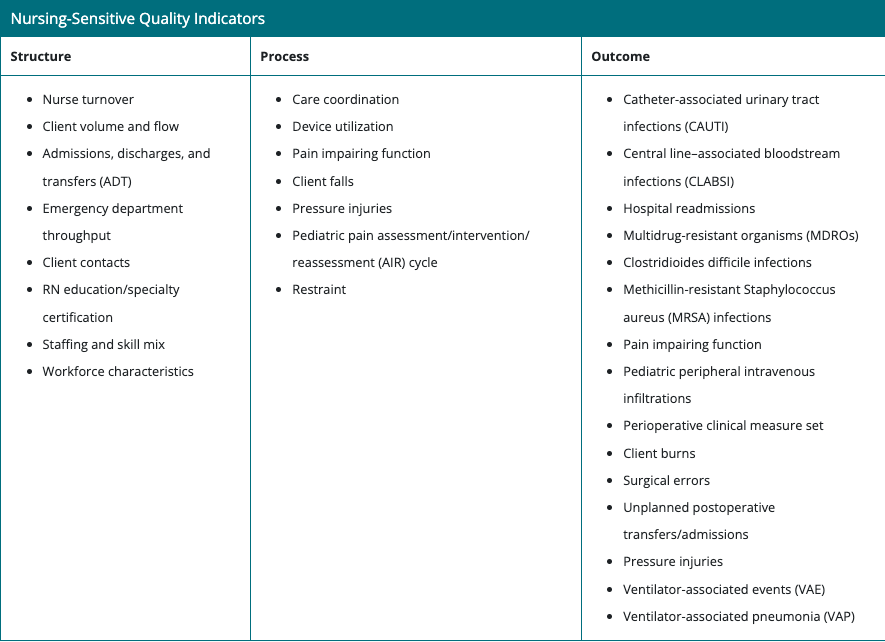
Nursing-sensitive quality indicators measure elements of client care that are affected by nursing care. Health care organizations may address a variety of these indicators as part of their operations.
Quality measurements can also be classified into three categories: structure, process, and outcomes. Structure is the condition or environment in which care is provided. The process category measures the mechanisms of the care provided, while the outcomes category includes measurable results that may be positive or negative. Benchmark comparisons assess outcomes against goals that are set to determine the industry standard outcome levels.
structure
The condition or environment in which the care is provided.
process
Measures the mechanisms of the care provided.
outcomes
Includes measurable results that may be positive or negative.
The National Quality Forum (NQF) is a not-for-profit organization dedicated to improving the quality of client care and outcomes. The NQF achieves this through setting standards for health care measurements, recommending measures for payment and reporting of quality programs, promoting QI priorities, providing tools to measure quality and performance, and endorsing nursing-sensitive quality indicators. Nursing plays a critical role in ensuring client safety and providing quality of care in meeting quality standards.
The Agency for Healthcare Research and Quality (AHRQ) has launched multiple safety initiatives to assist health care facilities in providing safer health care and improving quality of care. To decrease medical errors and improve the quality of care, it is recommended that health care facilities assess the client safety culture to identify how communication, teamwork, client safety, management teams, and staff are involved in planning to improve quality care. Nurses are essential members of QI teams because they provide direct care to clients and play an integral role in identifying and reporting processes that need improvement to ensure client safety and the delivery of quality care. The primary goal is to reduce and avoid occurrences that place clients at risk for avoidable incidents such as falls, hospital-acquired infections, and medication errors.
QI Model
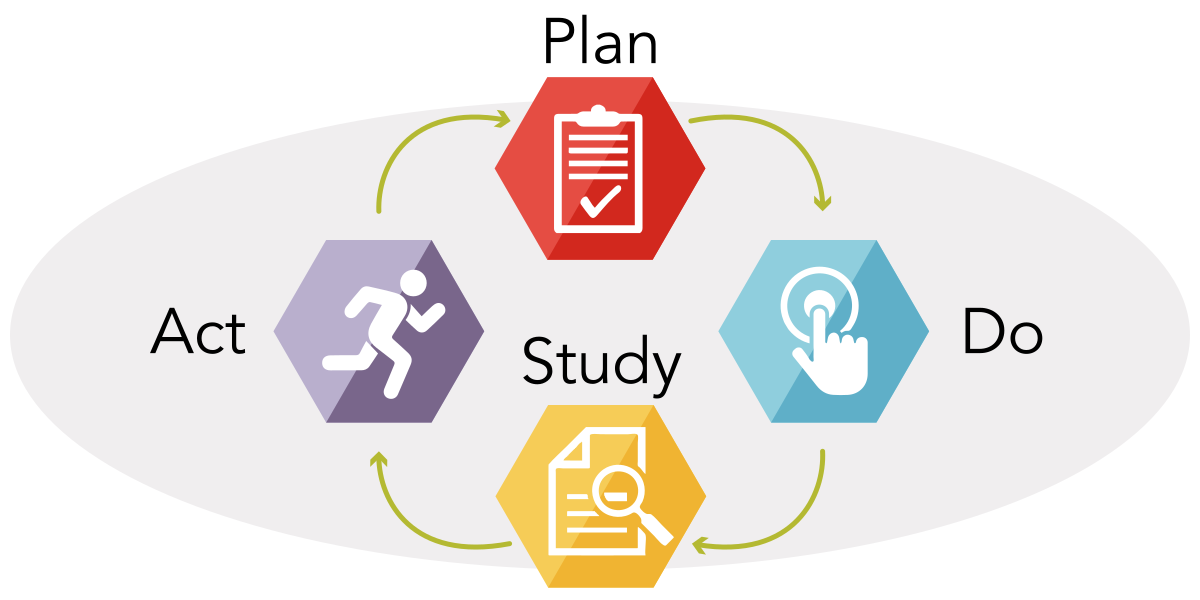
Several frameworks (models) are used to assess quality in health care and to develop processes intended to improve client safety and care. Using a QI model assists health care personnel in developing and changing practices to implement quality standards in a structured manner. The most commonly used model is the four-step plan–do–study–act (PDSA) model, but other models—such as the Six Sigma and Lean models—that are widely used in the business world can be used for QI as well.
plan–do–study–act (PDSA) model
A four-step process for quality improvement that includes plan, do, study, act.
Plan–Do–Study–Act
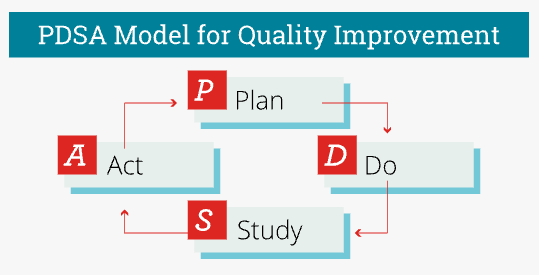
The PDSA model includes four steps. Step 1 begins when the need for change is recognized and “plans” are developed to initiate the change. In step 2, or “do,” steps or actions are taken to implement the plan. Step 3 involves “studying” the results and summarizing the information. Step 4, the last step of the cycle, is to accept and “act” on the changes. At this point, it is possible that the changes may need to be abandoned and the cycle started over with revisions to the plan.
Numerous quality organizations, such as the AHRQ and the Institute for Healthcare Improvement (IHI), have adopted the PDSA model. In a hospital, an example of the PDSA model in action might be the development of a process improvement plan with the goal of decreasing the number of client falls on a unit. This plan would include implementing various monitoring and prevention steps, such as increased observation by nursing staff of high-risk clients or installation of bed alarms or cameras. The results would then be reviewed to see if the steps decreased the number of falls or if revisions to the plan are needed.
QI Tools
QI tools used in the improvement process may communicate information, identify problems, locate where problems may be occurring, and assist in decision making when developing a plan. A nurse should know the basics of these tools, how they are used, and which data may be needed to apply them. A few of the more commonly used tools are profiled in this section.
Flow Chart
A QI process flow chart clarifies a complex process by visually depicting the steps in a sequential manner. Using a flow chart helps to identify the value of each step in the process and assist in developing additional steps that can improve the process. For example, this tool might be used to visualize the complex process of admitting a client to an acute care facility and to identify problem areas in this process.
process flow chart
A visual diagram used to clarify a complex process by providing a visual view of the steps in a sequential manner
Histogram
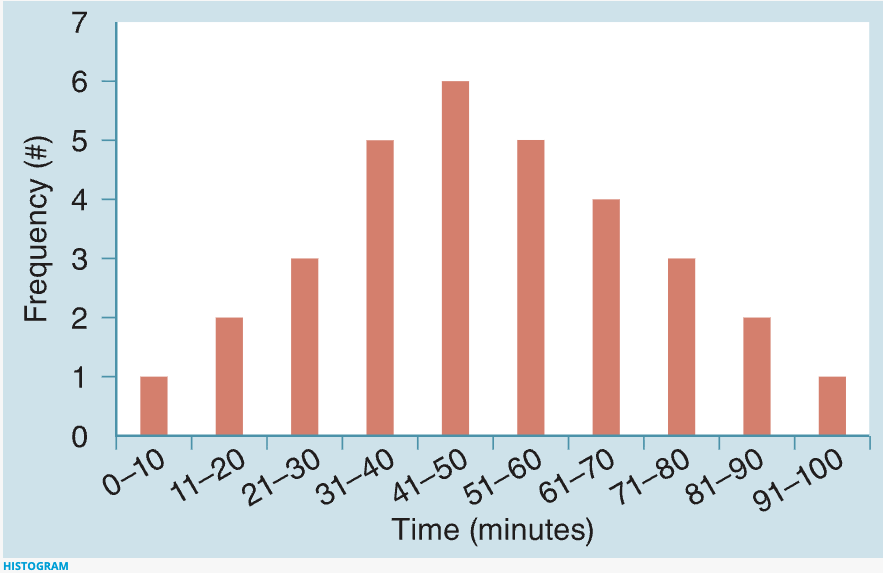
A histogram is a type of bar chart that displays the distribution of continuous numerical values. This graphic assists in recognizing and reviewing patterns and finding the median or mean of the data. A histogram is useful when evaluating hospital length of stay (LOS) or wait times.
histogram
A specific form of a bar chart that displays the distribution of continuous numerical value.
Run Chart
A run chart displays data over a period of time. Often the plotted data points are connected with a line to visualize the data trends. A run chart can display the mean or median of a set of data; it is typically used to determine if a process is working effectively by evaluating the numbers. For example, nurses can use a run chart to determine the number of client falls on their unit over a specific time period, or to evaluate for changes in the rate of hospital-acquired infections.
run chart
A visual aid using lines to connect data points depicting how a process or information has changed over time.
Nursing Audits
An audit of nursing documentation is another example of a QI tool that monitors the quality, accuracy, and development needs of clinical documentation. Auditing identifies errors or discrepancies in nursing documentation. Clinical audits can be performed retrospectively (after care is provided), concurrently (while care is being provided), or prospectively (in advance of providing care). An example of a chart audit would be the review of a client’s chart to evaluate the frequency and completeness of wound care documentation.
Audits, like nursing-sensitive quality indicators, are classified into three categories: structure, process, and outcome. Structure audits measure the setting in which care was delivered, process audits measure the process of how the care was delivered, and outcome audits measure the results of care. A fourth type of audit, known as an evidence-based audit, is a type of research that is based on studies of clinical practice; it provides new knowledge to improve client care and quality outcomes.
audit
Identifies errors or discrepancies of documentation of nursing care.
Health care organizations continually strive to improve the quality of client care and outcomes. Both nursing and health care organizations promote QI through the use of guidelines, standards, education, and QI tools. Continuous quality improvement (CQI) is the ongoing measurement, assessment, and improvement of quality initiatives to provide quality care and safety to clients by utilizing the QI tools and models as discussed previously.
continuous quality improvement (CQI)
An ongoing measurement, assessment, and improvement of quality initiatives to provide quality care and safety to clients utilizing the QI tools and models.
Risk Management
Risk management (RM) is defined as the identification, evaluation, and prioritization of risks to eliminate or mitigate their probability or severity and to leverage opportunities. The goal of RM is to protect clients, staff, and visitors from harm. Data captured through QI processes are incorporated into RM plans to identify and evaluate actual or potential risks. Following a thorough investigation and analysis, the RM plan implements methods to reduce or eliminate these identified risks. The steps of RM are much like the steps of the nursing process and QI process: identifying, investigating, analyzing, and evaluating risks. Collectively, they lead to the development and implementation of methods for correcting, reducing, managing, and/or eliminating risks.
risk management (RM)
The identification, evaluation and prioritization of risks to eliminate or mitigate their probability or severity or to leverage opportunities.
Incident Reports
An important function of RM is the identification and reporting of incidents. An incident, also known as an adverse event, is defined as any event that is not consistent with the desired or normal operation. When adverse events occur, the nurse documents the event, providing the RM team with an opportunity to analyze each detail for future QI measures aimed at eliminating risks. All staff are required to report events in which the occurrence or recurrence could or did harm the client or staff, or events where procedures or processes were not followed. Examples of adverse events include noncompliance with hand hygiene guidelines and medication administration errors.
adverse event
Any event that is not consistent with the desired or normal operation.
Sentinel Events
The Joint Commission defines a sentinel event as “a Patient Safety Event that reaches a patient and results in death, permanent harm, or severe temporary harm and intervention to sustain life.” However, these are not the only incidents that are considered sentinel events. Other examples of sentinel events include, but are not limited to, discharging an infant to the wrong family, wrong-site surgeries, and infusion of incompatible blood products. Serious reportable event, or never event, is a term coined by the NQF in 2001 to describe an event that should never occur in a health care setting. Any event that is identified as a “never event” by the NQF is also considered a sentinel event by TJC.
sentinel event
Any event causing serious injury or death to a client in healthcare facility. Sentinel events can include, medication error, transfusing the wrong blood type, client suicide, or wrong-site surgery.
never event
An adverse event that should never occur.

Root Cause Analysis
TJC requires that a root cause analysis (RCA) be completed for all sentinel events. An RCA is a systematic process that focuses on identifying the cause of an event and developing an action plan replete with strategies to prevent future events. The information gathered by a nurse as part of an incident report is an essential element in the RCA. An example of a sentinel event for which an RCA would be conducted would be determining the root cause of a medication error that led to a client’s death.
root cause analysis (RCA)
A systematic process that focuses on identifying the cause of an event and developing an action plan with strategies aimed at preventing future events.

Client Safety Goals
TJC established the National Patient Safety Goals (NPSGs) to address client safety concerns. Each year, TJC identifies goals specific to the facility type, such as the hospital or home care setting. To obtain or maintain accreditation from the TJC, facilities must implement the goals that have been established for their type of setting. The primary focus of the NPSGs is to reduce medical errors and increase client safety. For example, the goals seek to improve quality of care by addressing areas related to infection prevention, medication and surgical errors, client identification, and communication.

Performance Evaluation
Performance evaluations are central to the QI process. The data collected through these evaluations support efforts to achieve safe, quality, and cost-effective health care delivery based on specific measures, or performance levels, identified by state and national agencies. When a specific measure—for example, the number of hospital-acquired infections—is outside of the expected value, the health care team should initiate the QI process to identify the cause. Elements of performance evaluations include identification of what to monitor, determination of performance levels, collection of data, evaluation of results, development of a plan, implementation of changes, and evaluation of results.
Quality Core Measures
Quality core measures are standardized processes and best practices created to improve client care. TJC and Centers for Medicare and Medicaid Services (CMS) have created a set of measures, consistent with proven standards and recommendations, whose use can decrease complications and lead to better-quality outcomes for clients. The four criteria used to identify these core measures are research, proximity, accuracy, and adverse effects. Following the collection of data, hospitals report their compliance with the core measures to CMS and TJC for reimbursement and accreditation purposes. An example of a core measure is the standard of care for a client admitted with an acute myocardial infarction.
quality core measures
Are standardized processes and best practices created to improve client care.
Client Satisfaction
One key objective of any QI program in health care should be evaluating client satisfaction. Client satisfaction surveys are used as part of the QI process to identify ways a hospital has—effectively or ineffectively—addressed client problems or gaps in service from the clients’ perspective. Thus, managing client satisfaction requires monitoring issues and reporting results related to quality and performance improvement.
The first nationally recognized standard systematic evaluation of clients’ hospital experience is the Hospital Consumer Assessment of Healthcare Providers and Systems (HCAHPS). The HCAHPS survey is administered to clients within 6 weeks of discharge from an inpatient facility. The survey can be completed by mail, by telephone, or through electronic methods. It seeks to evaluate the client’s perspective of the hospital stay by asking questions about the efficiency of communication between the provider and the client, courtesy of providers and nurses, response time to call lights, environmental quality, and adequacy of discharge education. The HCAHPS score is publicly available for consumer consideration, and can bolster the hospital’s regional and national standing. Moreover, the HCAHPS score has a direct correlation with the amount of government funding a hospital receives.
Hospital Consumer Assessment of Healthcare Providers and Systems (HCAHPS)
A data collection survey utilized to measure client's perception of their inpatient experience.
Cost-Effective Care
Another objective in QI is to protect the health care facility from increased client care costs due to QI-identified risks, such as hospital-acquired infections. Cost-effective health care—that is, health care that uses minimal expenses of dollars, time, and other elements to achieve the desired results—helps to reduce costs by identifying low-cost QI measures that can improve client health outcomes. A cost-effectiveness analysis (CEA) compares health care interventions to see which is most effective for the least amount of money without producing negative client outcomes. A CEA is helpful to evaluate whether a QI plan has included steps that will result in positive financial gains for the institution.
The decision to implement a plan may depend on the cost of implementation and whether a financial loss or gain is expected. Nurses play a vital role maintaining efficiency within health care organizations. Through the provision of cost-effective and care-effective services to clients, nurses provide information and outcome results that help reduce the costs associated with care delivery. For example, a nurse could advocate for an improved process for prescribing wound dressing supplies, which in turn leads to a cost reduction.
cost-effective
The minimal expense of dollars, time, and other elements used to achieve results.
cost-effectiveness analysis (CEA)
Compares health care interventions to see which is most effective for the least amount of money without producing negative client outcomes.
Health Care Grades
The Leapfrog Group is a nonprofit organization that conducts free, annual surveys of hospitals and ambulatory care centers on a voluntary basis. Measurements included in the Leapfrog survey align with the TJC, CMS, and CDC data sets. The data collected through the survey are assessed alongside national performance measures. The general hospital survey focuses on evidence-based practices (EBP) and quality measures to improve health care delivery, such as client safety (e.g., handwashing), medication safety (e.g., opioid prescribing), and policy management (e.g., antibiotic use). Once a determination of overall hospital safety is identified, the facility is assigned one of five letter grades (A, B, C, D, F). The Leapfrog Hospital Safety Grade is updated and made public to consumers biannually. Staff nurses and nursing leadership play a key role in earning higher health care grades through the provision of competent and safe care.
Leapfrog Group
A nonprofit organization that conducts free, annual surveys of hospitals and ambulatory care centers on a voluntary basis. Measurements included in the survey align with TJC, CMS, and the Centers for Disease Control and Prevention (CDC).
Evidence-Based Practice
Evidence-based practice (EBP) is a problem-solving approach to client care that combines the most accurate scientific evidence with clinical expertise and client values. EBP, research, and QI share the common goal of improving client care and outcomes. While similar, each process contributes to the achievement of improving client care and outcomes in a unique way. Research is utilized to determine best practices of care through the performance of studies that provide new knowledge, or to confirm what is already known about clinical practice. Research findings contribute data that are used when developing EBP and changes in client care processes. EBP then influences implementation of QI initiatives. While research and EBP contribute to widespread professional knowledge and changes, QI initiatives are usually conducted at the institutional level. Nursing care is continuously evolving and driven by research and EBP changes. Combining research, EBP, and QI provides a strong foundation for optimal nursing care and improved client outcomes.
For EBP changes to be accepted and effective, the environment within which the changes are made must be one in which curiosity and the reexamination of current practices are supported. In addition, those who are directly involved in client care and implementation of potential changes should be encouraged to participate in selecting areas in which they feel improvements in practice are essential.
evidence-based practice (EBP)
A problem solving approach to client care that uses the most accurate scientific evidence partnered with clinical expertise and client values.
Six Steps of Evidence-Based Practice
The six steps of EBP include identifying a problem (ask a question), searching credible sources of evidence, evaluating the findings, implementing recommendations, reviewing their effectiveness, and disseminating, or sharing, the results with others.

Research
Research in nursing practice identifies new information as well as ways to improve practice and find resources effectively. Nurses will sometimes conduct literature reviews to identify practice changes needed for an identified problem or to compare two different ways of performing a certain skill. The most widely utilized type of research study is the randomized controlled trial (RCT). In an RCT, the study participants are randomly divided into two or more groups. Participants in one group then receive the treatment being tested while clients in the other group receive a standard or control treatment. For example, an RCT can be used to compare two ways of repositioning clients who have undergone hip surgery.
randomized controlled trial (RCT)
A research study in which study participants are randomly divided into 2 or more groups. After being assigned to groups, participants in one group receive the treatment being tested while clients in the other group receive a standard or control treatment.