The Past Tense: Near
This applies to events that occured in the past hour.
Modification Rules:
When stem ends in -ba, -ma, -pa, or -na the last A becomes ye
-samba → -sambye (play > played)
-gana → -ganye (refuse > refused)
-funna → funnye (get > got)
When a stem ends in -wa, or -ya they are replaced with ye
-tonnya → -tonnye (rain > rained)
When a stem ends in -la, or -ra, it is replaced with dde
-tambula → -tambudde (walk > walked)
-swala → -swadde (to be ashamed > ashamed)
When a stem ends in -da, -ga, or -ja or -la if the word is four letters, they are replaced with ze
-genda → -genze (go > went)
-kola → -koze (do > did)
-saaga → saaze (joke > joked)
When the stem ends in -sa or -za and a long vowel is found, the a changes to -izza.
-sanyusa → -sanyusizza (to make happy > made happy)
-buuza → -buuzizza (to ask > asked)
Exceptions:
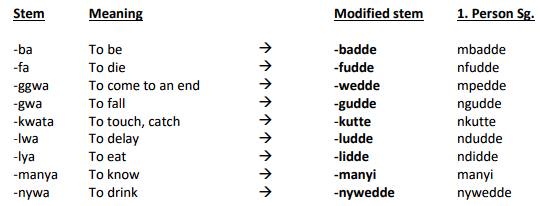
 Additionally, there are verbs that are used in their past tenses when describing a present status.
Ntudde (I am seated) → Okutuula
Ntuula (I am in the process of sitting down)
Ntidde (I am scared) → Okutya
Totya (Do you not fear?)
Mmanyi ( I know) → Okumanya (to know)
Mbadde mmanyi → I thought
Ng’enze ( I have left) → Okugenda
Ng’enda waka → Im going home
Nkooye (I am tired) → Okukoowa
Tokoowa → Do you not get tired?
Mmaze (I am done/finished) → Okumala
Mmala (never used in the present)
Mbuze (I have gotten lost) → Okubula
Mbula ( regularly getting lost)