Week 3: Distances
Speed of light = 186,000 mi/sec or 300,000 km/sec
1 light second: the distance that light travels in 1 second
NOT a time unit, it is a distant unit
aka: 186,000 miles or 300,000 kilometers

1 light-year: the distance that light travels in 1 year
1 light year = 6 trillion miles = 6,000,000,000 miles = 6×10¹² miles
1 light year = 63,000 AU = 6.3 × 10⁴ AU
Earth to Moon
Distance from Earth to Moon = 240,000 miles
light units = 1.3 light seconds
we see the moon 1.3 seconds back in time
if moon blew up, we wouldn’t see it for 1.3 seconds after the explosion due to the time it takes for light to reach us
technically seeing things in the past (1.3 seconds in the past)
time to get there at 100mph = 160.934 km/h 3 months (1/4 of a year)
Earth to Venus
Distance from Earth to Venus = 25 million miles
100x earth to moon distances
light units = 130 light seconds or around 2 light minutes
if venus blew up, we wouldn’t see it for 2 minutes after the explosion due to the time it takes for light to reach us
time to get there at 100mph = 25 years
Earth to Sun
Distance from Earth to Sun = 93 million miles
4x earth to Venus distances
1 AU
1 astronomical unit (AU or au): the average distance from earth to sun
AKA: 1 AU = 93 million miles
light units = 8 light minutes
if sun blew up, we wouldn’t see it for 8 minutes after the explosion due to the time it takes for light to reach us
Earth would be orbiting nothing for 8 minutes
time to get there at 100mph = 100 years
Sun to Pluto
Distance from Sun to Pluto = 4 billion miles
40x earth to sun distances
40 au
light units = 320 light minutes or 5 light hours
if sun blew up, we wouldn’t see it for 8 minutes after the explosion due to the time it takes for light to reach us
time to get there at 100mph = 4,000 years

Sun to Alpha Centouri Star System
distance from Sun to Alpha Centouri Star System = 4.3 light-years
1 light year = 6 trillion miles = 6,000,000,000 miles = 6×10¹² miles
distance from Sun to Alpha Centouri Star System at 25,000 mph = would take 100,000 years

HOMEWORK QUESTION:
How many miles away from sun is the alpha Centouri Star System, when it is 4.3 light years away?
convert 1 light years to miles
4.3 light years x (6×10¹² miles / 1 light year) = 25.8×10¹² miles = 2.58×10¹³ miles

How many AU away from sun is the alpha Centouri Star System, when it is 4.3 light years away?
convert 1 light years to AU
4.3 light years x (6×10⁴ AU / 1 light year) = 27×104 AU = 2.7×10⁵ AU

Milky Way Galaxy
Distance across the Milky way galaxy (diameters) = 100,000 light years
time to travel across the milky way is 100,000 years
Distance from top to bottom of the Milky Way Galaxy (width) = 1,000 light years

Milky Way Galaxy vs Galaxies
Distance from Milky Way Galaxy to the Canis Major Dwarf Galaxy = 25,000 light years
Distance from Milky way Galaxy to small and large Magellanic Clouds = 170,000 light years
Distance from Milky way Galaxy to Sagittarius Dwarf Galaxy = 70,000 light years
Distance from Milky way Galaxy to Andromeda Galaxy = 25 million light years

HOMEWORK QUESTION:
How many miles away from milky way is Andromeda Galaxy, when it is 25 million light years away?
convert light years to miles
25 million light years = 2,500,000 light years = 2.5×10⁶ light years
2.5×10⁶ light years x (6×10¹² mi/1 light year) = 15×1018 miles =15,270 miles 1.5×10¹⁹ miles

How many AU away from milky way is Andromeda Galaxy, when it is 25 million light years away?
Local Group and Beyond
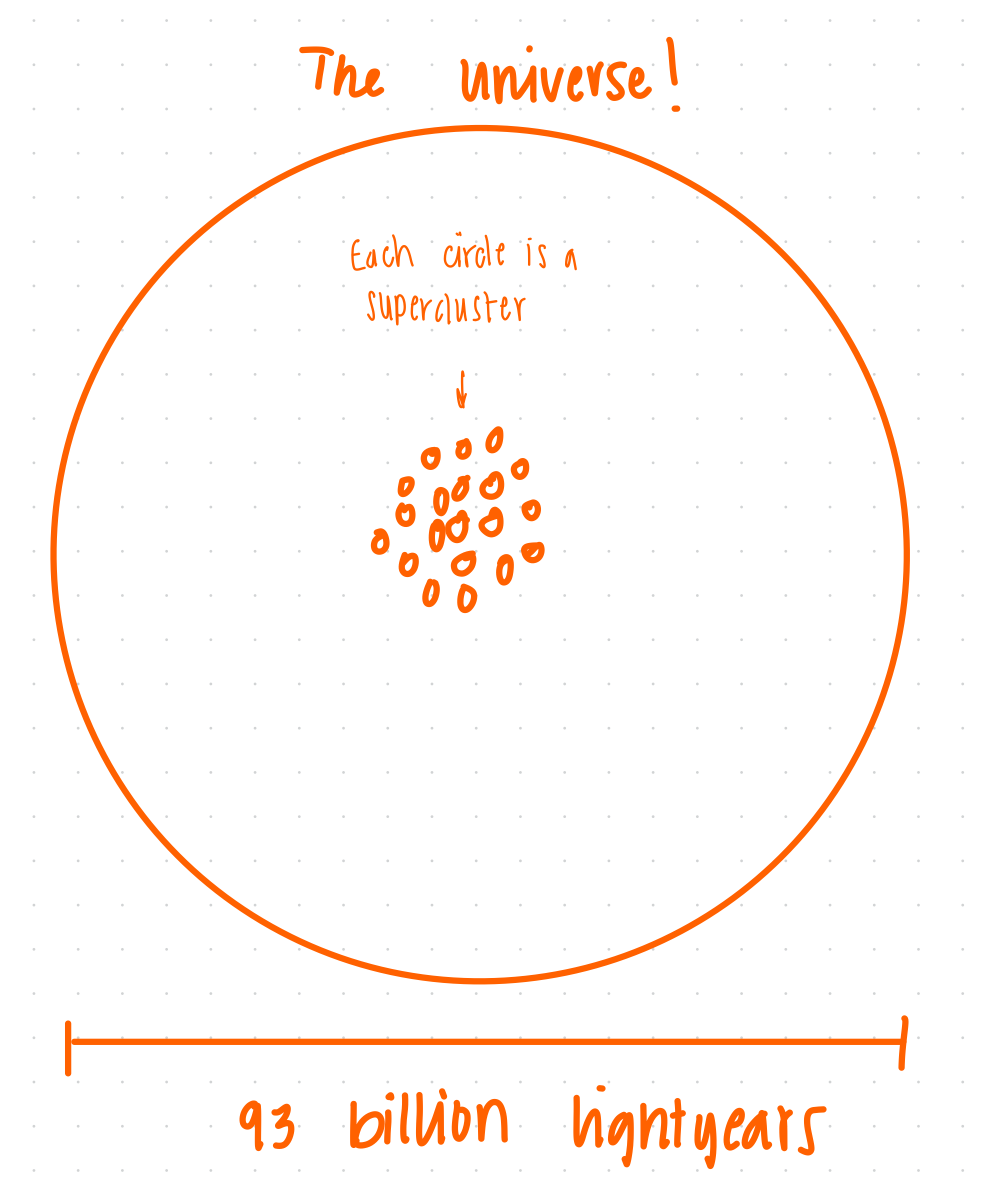
Distance across the local Group (diameter) = 10 million light years

Distance across the local Supercluster (Laniakea) = 100 million light years

Distance across the Universe = 90 billion light years
universe is expanding
if seeing galaxies from 13 billion light years away, we are observing them as they were in the past
seeing the oldest objects in the universe
Quasars
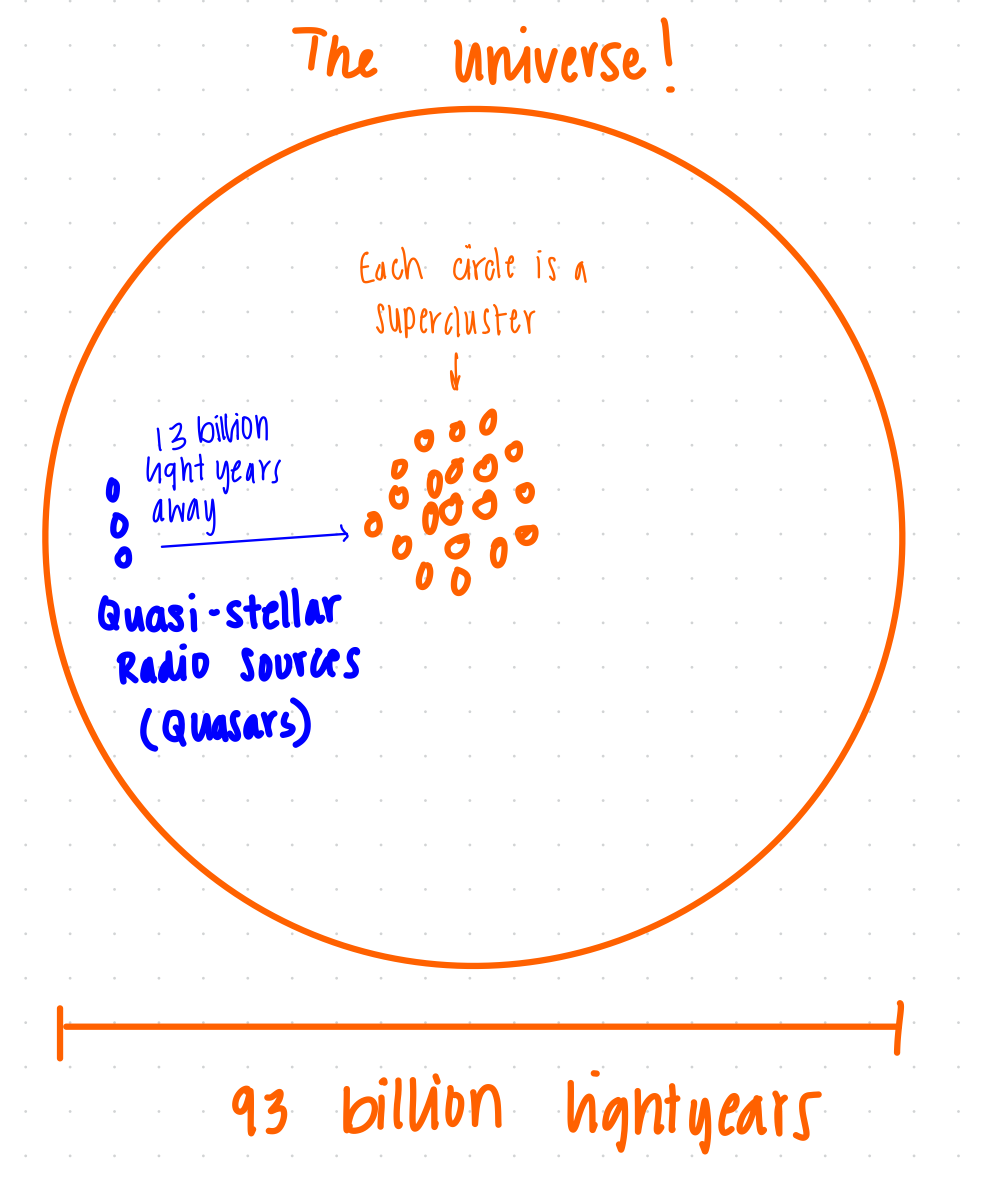
Quasars (Quasi-stellar radio sources): the most distant galaxies we see
also farthest in the past
on the edge of the universe
as bright as stars
from blackhole at center of galaxy causing hot gas to orbit it, causing bright light
Quasars are 13 billion light years away
we are observing them as they were in the past
seeing the oldest objects in the universe
Can we see further than Quasars?
Comic Microwave Background Radiation: the afterglow of the Big Bang, providing a snapshot of the universe just 380,000 years after its formation
is the farthest we can observe
