Physiological Psychology Module 6 Notes
Module 6.1 Hearing
Physics and Psychology of Sound
Hearing alerts us to many types of useful information
Auditory signals are sensed as periodic compressions of air, water, or other media
Humans experience hearing by detecting sound waves
-Amplitude refers to the intensity of the sound wave
-Frequency is the number of compressions per second, is measured in hertz (Hz), and is related to the pitch (high to low)
-Timbre is tone quality or tone complexity
Most adult humans hear sounds from about 15 to 20 Hz up to almost 20,000 Hz
Children hear higher frequencies than adults: the ability to recognize high frequencies diminishes with age and exposure to loud noises
People communicate emotion by alterations in pitch, loudness, and timbre
-Conveying emotional information by tone of voice is known as prosody
Structures of the Ear
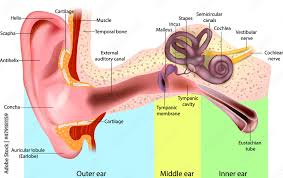
The outer ear
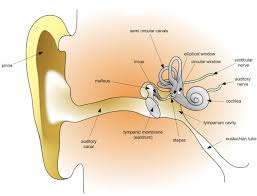
-Anatomists distinguish the outer ear, the middle ear, and the inner ear
-The outer ear includes the pinna, the structure of flesh and cartilage attached to each side of the head
Responsible for:
-Altering the reflection of sound waves into the middle ear from the outer ear
-Helping us locate the source of a sound
The middle ear
-Contains the tympanic membrane, which vibrates at the same rate when struck by sound waves
-Also known as the ear drum
-Connects to three tiny bones (malleus, incus, and stapes) that transform waves into stronger waves to the oval window
Oval window is a membrane in the inner ear
-Transmits waves through the viscous fluid in the inner ear
The inner ear
-Contains a snail shapes structure called the cochlea
-Contains three fluid-filled tunnels
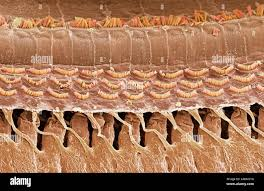
-Hair cells are auditory receptors that lie between the basilar membrane in the cochlea
-When displaced by vibrations in the fluid of the cochlea, they excite the cells of the auditory nerve by opening ion channels
Electron Micrographs of the Hair Cells of Humans
Pitch Perception
Frequency theory: the basilar membrane vibrates in synchrony with the sound and causes auditory nerve axons to produce action potentials at the same frequency
Single receptors are limited in their firing frequency
-Volleys of impulses can signal sound up to 400 per second
Place theory: eachy area along the basilar membrane has hair cells sensitive to only one specific frequency of osund wave
A modified version of place theory is this: The basilar membrane varies from stiff at its base, where the stirrup meets the cochlea, to floppy at the other end of the cochlea
Place Theory
The Auditory Cortex
The primary auditory cortex (area A1) is the destination for most information from the auditory system
-Located in the superior temporal cortex
Each hemisphere receives most of its information from the opposite ear
Parallels that of the visual cortex
-”what” and “where” pathways
-Superior temporal cortex allows detection of the motion of sound
Area A1 is important for auditory imagery
Requires experience to develop properly
-Axons leading from the auditory cortex develop less in people deaf since birth
Functions of the auditory cortex:
-Not necessary for hearing, but for processing information
-Provides a tonotopic map in which cells in the primary auditory cortex are more responsive to preferred tones
— Some cells respond better to com[plex sounds than pure ones
-Damage to A1 does not necessarily cause deafness unless damage extends to the subcortical areas
Sound Localization
Depends upon comparing the responses of the two ears
Three cues:
-Time of arrival
-Sound shadow
-Phase difference
Humans localize low-frequency sound by phase difference and high frequency sound by loudness differences
Loudness and Arrival Times as Cues for Sound Localization
Individual Differences
“Amusia”: the impaired detection of frequency changes (tone deafness)
Around 4 percent of people experience amusia
For people with amusia, the auditory cortex appears to approximate a typical structure, but it has fewer connections from auditory cortex to frontal cortex
Absolute pitch 9perfect pitch) is the ability to hear a note and identify it
-Genetic predisposition may contribute to it
-The main determinant is early and extensive musical training
More common among people who speak tonal languages, such as Vietnamese and Mandarin Chinese
Deafness
Conductive/Middle Ear Deafness
-Occurs if bones of the middle ear fail to transmit sound waves properly to the cochlea
-Can be caused by disease, infections, or tumorous bone growth
-Normal cochlea and auditory nerve allow people to hear their own voice clearly
-Can be corrected by surgery or hearing aids that amplify the stimulus
Nerve or Inner- Ear Deafness
-Results from damage to the cochlea, the hair cells, or the auditory nerve
-Can vary in degree
-Can be confined to one part of the cochlea
-People can hear only certain frequencies
-Can be inherited, caused by disease, or noise levels that damage the auditory system
Tinnitus
-Frequent or constant ringing in the ears
—Experienced by many people with nerve deafness
Sometimes occurs after damage to the cochlea
-Axons representing other body part of the body innervate parts of the brain previously responsive to sound
-Similar to the mechanisms of phantom limb
Hearing, Attention, and Old Age
Brain areas responsible for language comprehension become less active
Many older people have a decrease in the inhibitory neurotransmitters in the auditory portions of the brain
-Improves hearing most of the time, but in a noisy environment, it increases the background noise just as much as the conversation
-Attention improves if the listener watches the speaker’s face
Module 6.2 The Mechanical Senses
Introduction
The mechanical senses respond to pressure, bending, or other distortions of a receptor
-These include touch, pain, and other body sensations, as well as vestibular sensation, which detects the position and movement of the head
Audition is a complex mechanical sense because the hair cells are modifies touch receptors
Vestibular Sensation
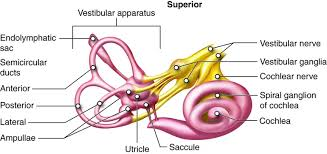
The vestibular organ is in the ear and is adjacent to the cochlea
-Comprises two otolith organs (the saccule and the utricle) and the semicircular canals
—Otoliths are calcium carbonate particles that push against different hair cells and excite them when the head tilts
-Semicircular canals are filled with a jelly-like substance and hair cells that are activated when the head moves
Structures for Vestibular Sensation
Somatosensation
Somatosensory system
-The sensation of the body and its movements
-Not one sense but many
-Touch, deep pressure, the position and movement of joints, pain, ad temperature
Somatosensory Receptors
Pacinian corpuscle, which detects vibrations or sudden displacements on the skin
-Onion-like out structure resists gradual or constant pressure
-Sudden or vibrating stimulus bends the membrane and increases the flow of sodium ions to trigger an action potential
Receptors that respond to light touch
-Men and women generally have the same number of Merkel disks, but women tend to have smaller fingers (more sensitive)
Somatosensory Receptors and Probable Functions
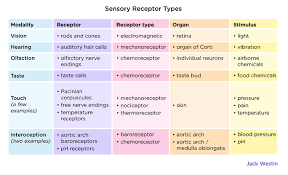
Receptors for Temperature
Important that humans can regulate temperature as both overheating and overcooling can be fatal
-Cold-sensitive neurons respond to drops in temperature, adapt quickly, and show little response to constant, cold temperatures
-Heat sensitive neurons respond to absolute temperature
-Chemicals can stimulate receptors for heat and cold, for example, capsaicin and menthol
Tickle
The sensation of tickle is poorly understood
The reason we cannot tickle ourselves is that our brain compares the resulting stimulation to the “expected” stimulation and generated a weaker somatosensory response
Somatosensation in the Central Nervous System
Information from touch receptors in the head enters the CNS through the cranial nerves
Information from receptors below the head enters the spinal cord and travel through the 31 spinal nerves to the brain
Various types of somatosensory information—such as touch, pressure, or pain—travel through the spinal cord in separate pathways toward the thalamus, which then sends impulses to different areas of the primary somatosensory cortex (S1)
Somatosensation in the Spinal Cord
Each spinal nerve has a sensory component and a motor component and connect to a limited area of the body
A dermatome: a body innervated by a single sensory spinal nerve
Sensory information entering the spinal cord travels in well-defined and distinct pathways
-Example: Touch pathway is distinct from pain pathway
The Somatosensory Cortex
Various aspects of body sensations remain separate all the way to the cortex
-Various areas of the somatosensory thalamus send impulses to different areas of the somatosensory cortex located in the parietal lobe
-Different sub areas of the somatosensory cortex respond to different areas of the body
-Damage to the somatosensory cortex can result in the the impairment of body perceptions (numbsense)
Pain
The experience evoked by a harmful stimulus and directs one’s attention toward a danger
-Pain sensation begins with the least specialized of all receptors (bare nerve endings)
-Males and females don not react the same way to pain
—Activating certain neurons in the midbrain decrease pain sensitivity in male mice, but not in females
—The pain-relieving effects of opiates and cannabinoids different between males and females
Axons carrying pain info have little or no myelin: Impulses travel slowly
-However, brain processes pain information rapidly and motor responses are fast
Mild pain triggers the release of glutamate in the spinal cord
Stronger pains triggers the release of glutamate and releases several neuropeptides including substance P and CGRO (calcitonin gene-related peptide)
Emotional Pain
Emotional associations of pain
-Activate a path that goes through the reticular formation of the medulla
-And then to several of the central nuclei of the thalamus, the amygdala, hippocampus, prefrontal cortex, and cingulate cortex
Experimenters monitored people’s brain activity and found hurt feelings activate similar pathways as physical pain
Ways of Relieving Pain
Opioid mechanisms are systems that are sensitive to opioid drugs and similar chemicals
Opiates bind to receptors found mostly in the spinal cord and the periaqueductal gray area of the midbrain
Endorphins: groups of chemicals that attach to the same brain receptors as morphine
-Different types of endorphins for different types of pain
Morphine does not affect large-diameter axons that convey sharp pain
Synapses for Pain and Its Inhibition
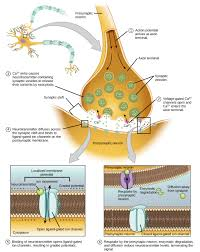
Gate Theory
Proposes that the spinal cord areas that receive messages from pain receptors also receive input from touch receptors and from axons descending from the brain
-These others areas that provide input can close the “gates” by releasing endorphins and decrease pain perception
-Non-pain stimuli around it can modify the intensify of the pain
Other Ways to Relieve Pain
When axons initially reach their targets, they form synapses with several cells
Postsynaptic cells strengthen connection with some cells and eliminate connections with others
The formation or elimination of these connections depends on the pattern of input from incoming axons
Sensitization of Pain
Mechanisms of the body increases sensitivity to pain
-Damaged or inflamed tissue releases histamine, nerve growth factor, and other chemicals that increase the responses of nearby pain receptors
Certain receptors become potentiated after an intense barrage of painful stimuli
-Leads to increased sensitivity or chronic pain later
Itch
The release of histamines by the skin produce itching sensations
-Activates a distinct pathway in the spinal cord to the brain
-Impulses travel slowly along this pathway (half a meter per second)
Pain and itch have an inhibitory relationship
-Opiates, which decrease pain, increase itch
Module 6.3 The Chemical Senses
Introduction
The first sensory system of the earliest animals was a chemical sensitivity
Chemical sense enables a small animal to find food, avoid certain kinds of danger, and even locate mates
Taste
Taste has one simple function-to tell us whether to swallow something or spit it out
-Taste results from stimulation of the taste buds, the receptors on the tongue
-Mammalian taste receptors are in taste buds located in papillae on the surface of the tongue
Our perception of flavor is the combination of both taste and smell
-Taste and smell axons converge onto many of the same cortical cells
Taste Receptors
Receptors for taste are modified skin cells
Taste receptors have excitable membranes that release neurotransmitters to excite neighboring neurons
Taste receptors are replaced every 10-14 days
-Each papillae may contain up to 10 or more taste buds
-Each taste bud contains about 50 receptors
In adult humans, taste buds lie mainly along the edge of the tongue
How Many Kinds of Taste Receptors?
Western societies have traditionally described sweet, sour, salty, and bitter tastes as the “primary” tastes and the four types of receptors
-Procedures that alter one receptor but not others can be used to identify taste receptors
Some substances that can modify tastes:
-Miracle berries-miraculin
-Most toothpastes contain sodium lauryl sulfate
-Gymnema slyvestre tea
Adaptation refers to reduced perception of a stimuli due to the fatigue of receptors
Cross-adaptation refers to reduced response to one stimuli after exposure to another
Although we describe tastes as sweet, sour, salty, and bitter as the “primary”, evidence suggests a fifth type of glutamate receptor (umami).
-MSG
-Tastes like unsalted chicken broth
Some research suggests that the ability to taste fats is a sixth type of taste
-For now, this is being called olegustus
Water replaces the bicarbonate ions usually present in the saliva on the tongue, and when it does so it changes the acid-to-base ratio and mildly stimulates the same receptors that detect sour tastes
Mechanisms of Taste Receptors
The saltiness receptor permits sodium ions to cross the membrane
-Results in an action potential
Sour receptors detect the presence of acids
Sweetness, bitterness, and umami receptors activate a G protein that releases a second messenger in the cell when a molecule binds to a receptor
Bitter taste is associated with a wide range of dissimilar substances that are toxic
-About 25 types of bitter receptors are sensitive to a wide range of chemicals with varying degrees of toxicity
-Most taste cells contain only a small number of these receptors
-We are sensitive to a wide range of harmful substances, but not highly sensitive to any single one
Taste Coding
Most taste receptors respond only to one type of chemical, but some respond to both sweet and salty, or sweet and umami
-The receptors feed into neurons that might respond to just one taste, or to several
-By the time information reaches cells in the insula in the cortex
-Most cells respond most strongly to one taste, partly to others also
Various areas of the brain are responsible for processing different taste information
-The somatosensory cortex responds to the touch aspect of taste
-The insula is the primary taste cortex
Each hemisphere of the cortex is also responsive to the ipsilateral side of the tongue
Variations in Taste Sensitivity
In humans, genetic factors and hormones can account for some differences in taste sensitivity
-Variations in taste sensitivity are related to the number of fungiform papillae near the tip of the tongue
-Supertasters have higher sensitivity to all tastes and mouth sensations in general
-A pregnant person has higher sensitivity to taste
Olfaction
The sense of smell
The detection and recognition of chemicals that contact the membranes inside the nose
Critical in most mammals for finding food and mates, and avoiding danger
-Rats and mice show an immediate, unlearned avoidance of the smells of cats, foxes, and other predators
The smell of a sweaty female increases a male’s testosterone secretions, especially if the female is near her time of ovulation
The effect is stronger for heterosexual males than for homosexual males
The smell of a sweaty male does not increase sexual arousal in females. Instead it releases cortisol, a stress hormone
Even humans can follow a scent trail to some extent, and we get better with practice
Olfactory Receptors
Olfactory cells line the olfactory epithelium in the rear of the nasal passage and are the neurons responsible for smell
Olfactory receptors are located on the cilia, which extend from the cell body into the mucous surface of the nasal passage
Vertebrates have hundreds of olfactory receptors, which are highly unresponsive to some unrelated chemicals and unresponsive to others
Proteins in olfactory receptors respond to chemicals outside the cells and trigger changes in G protein inside the cell
G protein then triggers chemical activities that lead to action potentials
Humans have several hundred types of olfactory receptors
Unlike your receptors for vision and hearing, which remain with you for a lifetime, an olfactory receptor has an average survival time of just over a month
Olfactory Coding
Axons from olfactory receptors carry information to the olfactory bulb
Most receptors respond to either just one chemical or several closely related chemicals
All the receptors sensitive to a particular chemical combination of chemicals connect to a single cluster in the olfactory bulb, called a glomerulus
The glomeruli send their axons diffusely, almost haphazardly, to the piriform cortex
How the cortex recognizes an odor remains a puzzle
Individuals Differences
Most of the genes controlling olfactory receptors have variant forms
-Two people chosen at random probably differ in about 30% of their olfactory receptor genes
Odor sensitivity declines with age
Many people who were infected with covid have an impaired sense of small, with slow recovery
Human females detect odors more readily than males, at all ages and in all cultures (female hormones)
Synesthesia
The experience of one sense in response to a stimulation of a different sense
-An example would be seeing a number or a letter as a specific color
Tends to cluster in families that also have perfect pitch
-Genetic predisposition