Workplace Attitude
Attitudinal Variables
Organizational Commitment
- The degree to which an employee identifies with a particular organization and its goals and wished to maintain membership in the organization
3 Components
- An ^^acceptance^^ of the organization’s goals
- A ^^willingness^^ to work hard for the organization
- The ^^desire to stay^^ with the organization
Dimensions
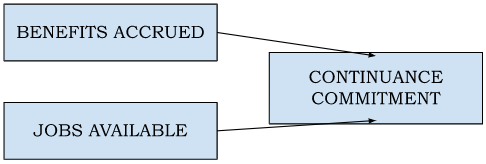
- Continuance Commitment
- ^^Rational Calculation^^
- Refers to employees’ assessment of whether the cost of leaving the organization are greater than the cost of staying
- Employees who perceive that the costs of leaving the organization are greater than the costs of staying remain because they ^^need^^ to
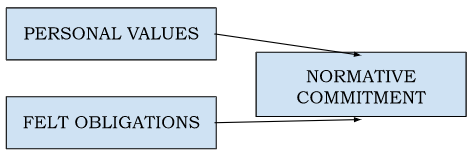
- Normative Commitment
- Refers to employee’s ^^feelings of obligation^^ to the organization
- Employees with high levels of normative commitment stay with the organization because they feel they ^^ought^^ to
- ^^“Utang na loob”^^ to the organization
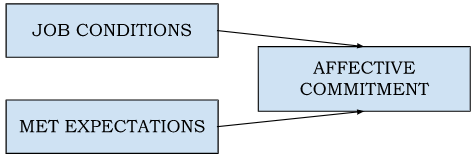
- Affective Commitment
- ^^“Genuine commitment”^^
- Refers to employee’s emotional attachment, identification with, and involvement in the organization
- Employees with a strong affective commitment stay with the organization because they ^^want^^ to
Measuring Organizational Commitment
- Organizational Commitment Scale: self-scoring questionnaire
Job Satisfaction
- A degree to which an individual feels positive or negative about a job overall as well as various aspects of them.
- Is the extent to which people like or dislike their jobs
- One of the most studied variables in organizational behavior
- Argued as the cause of important employee organizational outcomes ranging from ^^job performance^^ to ^^health and longevity^^
Satisfied and Committed Employees
- More likely to attend work
- Stay with the organization
- Arrive at work on time
- Perform well
- Engage in organizational citizenship behaviors
- Go the extra mile
- Do not behave in counterproductive ways
- Engage in ethical behavior
Approaches to the Study of Job Satisfaction
Global Approach
- Treats job satisfaction as a ^^single overall feeling^^ towards the job
- “All things considered, how satisfied are you with your job?”
Facet/Dimension Approach
- ^^Focuses on different aspects of the job^^, such as rewards (pay/fringe benefits), other people on the job (supervisors/co-workers), job conditions, and the nature of the work
5 Facets of Job Satisfaction
- One of the most popular measures of job satisfaction is the ^^Job Descriptive Index (JDI)^^. It measures 5 facets:
- The Work Itself: responsibility, interest, and growth
- Quality of Supervision: technical help and social support
- Relationship with Co-Workers: social harmony and respect
- Pay: adequacy of pay and perceived equity vis-a-vis others
Research Findings on Job Satisfaction
- Job satisfaction leads to better performance when rewarded
- The ^^fairness^^ with which pay is distributed or equity is more important determinant of pay satisfaction then the actual level of pay
- Many studies have shown that ^^older workers are more satisfied^^ with their jobs than younger workers (lowest level at around 26-31 years old)
- Identical twins have been found to have similar levels of job satisfaction despite being reared apart and despite work at dissimilar jobs. Inherited personality traits such as ^^negative affectivity^^ are related to our tendency to be satisfied with jobs.
- Dissatisfied employees reported more ^^physical symptoms,^^ such as sleep problems and upset stomach
EVLN: Responses to Job Dissatisfaction
- Exit: leaving the situation; quitting, transferring
- Voice: changing the situation; problem solving, complaining
- Loyalty: patiently waiting for the situation to improve; passive response
- Neglect: reducing work effort/quality; increasing absenteeism; passive-aggressive response
Job Satisfaction and OCBs
- Job satisfaction is also linked with ^^organizational citizenship behaviors (OCBs).^^
- OCB: discretionary behaviors that represent a willingness to ^^“go beyond the call of duty”^^ or ^^“go the extra mile”^^ in one’s work
- A good organizational citizen
- Interpersonal OCBs: Does things that although not required of them help others (i.e., altruism)
- Organizational OCBs: Advance the performance of the organization as a whole
- Job Satisfaction and CWBs
- Job dissatisfaction is often associated with a variety of ^^counterproductive work behaviors (CWBs), behaviors intended to harm^^ the organization and other people at work, such as co-workers, supervisors, and customers
- Personal Aggression: sexual harassment, verbal abuse, intimidation, humiliation
- Production Deviance: wasting resources, avoiding work, disrupting workflow, making deliberate work errors
- Political Deviance: spreading harmful rumors, gossiping, using bad language, lacking civility in relationships
- Property Deviance: destroying or sabotaging facilities and equipment, stealing money, and other resources
- Job Satisfaction and Customers
- Job satisfaction increases customer satisfaction and profitability because
- Job satisfaction ^^affects mood^^, leading to positive behaviors toward customers
- Job satisfaction ^^reduces employee turnover,^^ resulting in more consistent and familiar service
Organizational Identification (OID)
- The process whereby individuals derive ^^a feeling of pride and esteem^^ from their association with an organization. Individuals may also take pains to distance themselves from the org for which they work -- organizational disidentification.
- Social Identity Theory consists of 3 propositions
- People value and seek self-esteem
- Group memberships lay a role in a person’s self-concept
- Individuals seek to maintain a positive social identity by making ^^favorable distinctions^^ between their social in-group and other out-groups
- 4 Variations of Identification
- Identification: Individuals ^^defined themselves^^ in terms of the ^^attributes of the organization^^
- Disidentification: Individuals define themselves as ^^not having the attributes of the organization^^
- Ambivalent Identification: Individuals identify with ^^some attributed^^ of the organization but ^^reject other aspects^^
- Neutral Identification: Individuals remain ^^aggressively neutral, neither identifying nor disidentifying^^ with the attributes of an organization
Employee Engagement
- An individual’s ^^involvement^^ with, ^^satisfaction^^ with, and ^^enthusiasm^^ for the work he/she does
- Overlaps positively with job satisfaction, organizational commitment, and job involvement
- The ^^opposite of psychological burnout^^
- Surveys indicate that few employees (between 17% to 29%) are highly engaged by their work.