Chapter 6: Economic Growth
1.The Basics of Economic Growth
Economic growth is not simply the recovery from a recession.
Economic growth fundamentally increases the nation’s ability to produce goods and services.
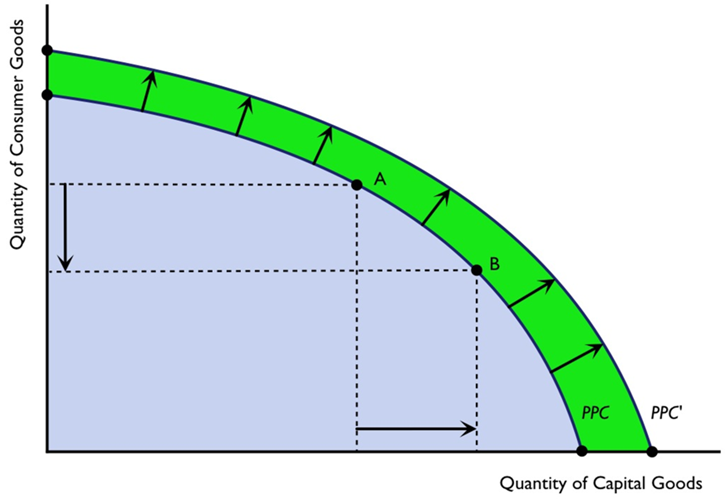
One way to think about economic growth is to think back to the model of production possibilities.
Short-run recovery is a movement from a point inside the PPC to the limits of the PPC.
Long-run economic growth is an outward shift of the entire PPC.
Calculating Growth Rates
GDP is a measure of economic growth because, as we have learned, GDP measures the total value of an economy’s production of final goods and services as well as the income earned in that economy in a given year.
We express the economic growth rate as the annual percentage change of real GDP. We use Real GDP because it is adjusted for inflation.
To calculate this growth rate, we use this formula:
The key statistic used to track economic growth is real GDP per capita—real GDP divided by the population size.
Real GDP per capita because it isolates the effect of changes in the population. Recall standard of living depends on real GDP per person.
For Example:

Real GDP per person grows only if real GDP grows faster than the population grows.
Growth rates are like compounded interest
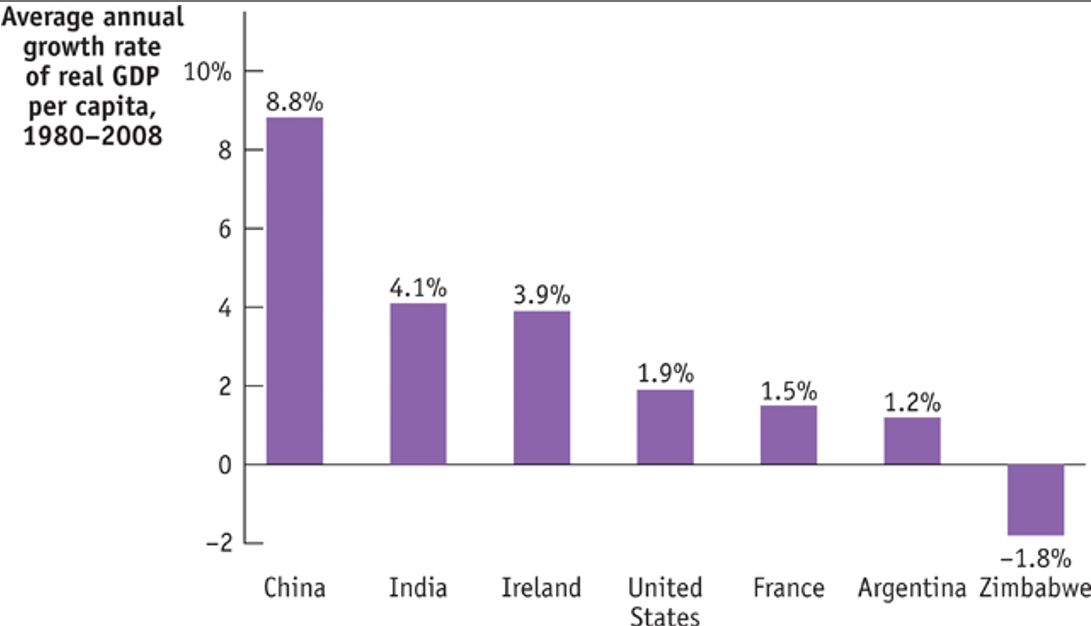
If the economy grows by 2% one year, and another 2% the following year, and another 2% the year after that, these annual growth rates are compounded into larger and larger increases in per capita real GDP.

2. Rule of 70
Rule of 70 approximates how many years it will take for the economy to double at a given rate of economic growth.
# of years for a number to double = (70/annual growth rate of that number)
For example If annual per capita real GDP increases at 5% every year, it will take approximately 14 years for it to double.
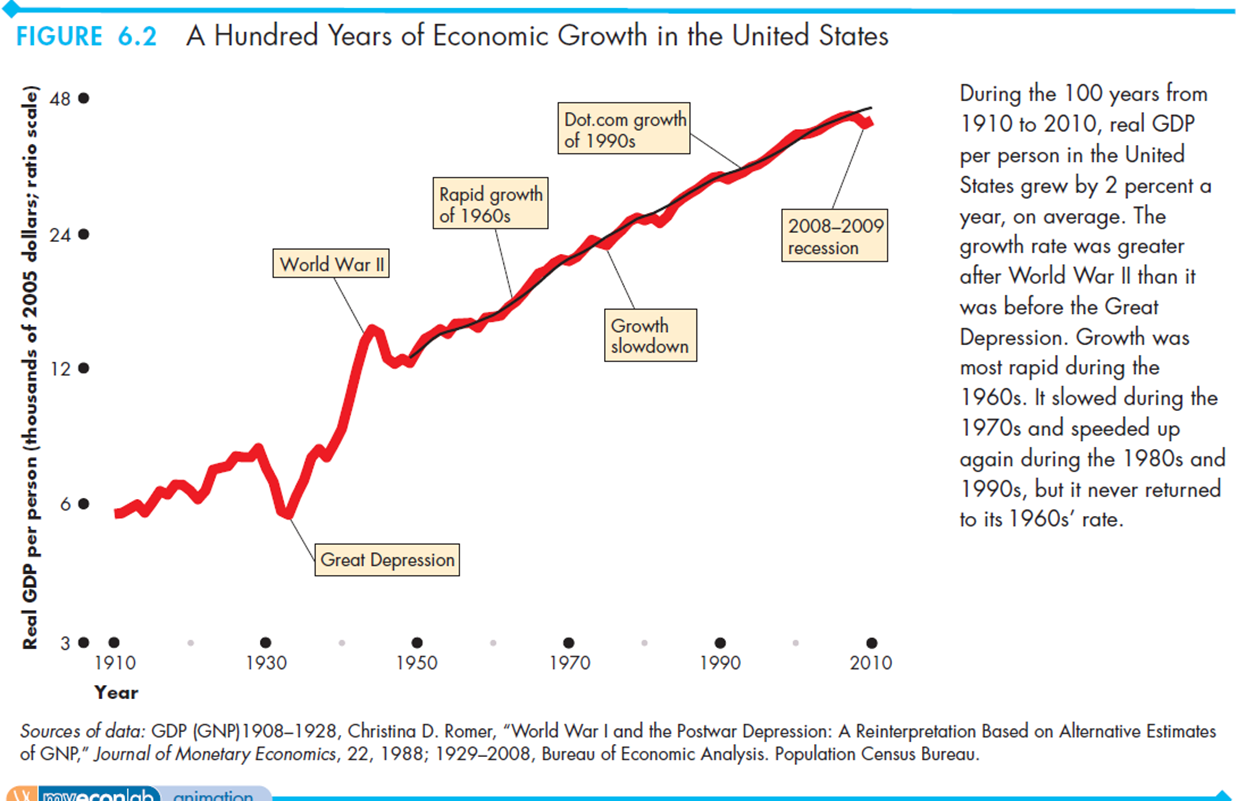
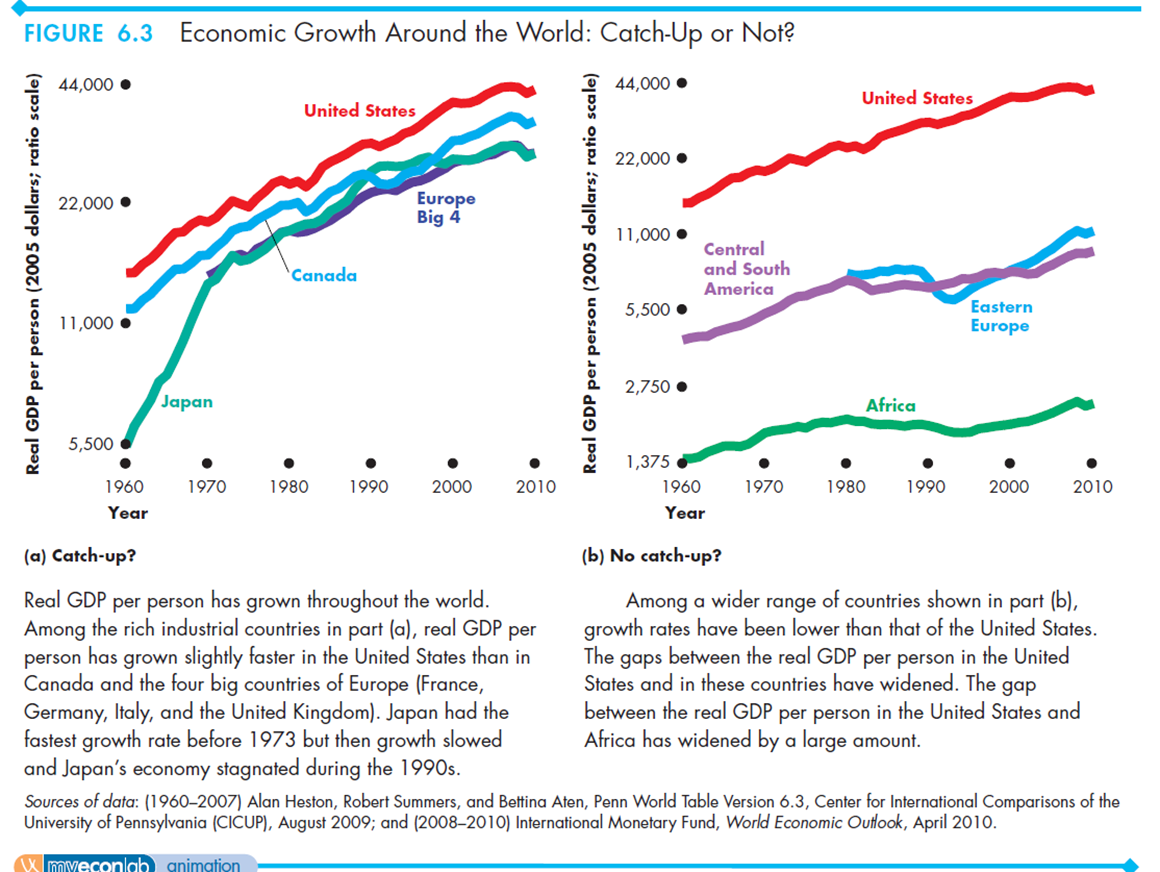
3. Economic Growth Trends
4. How Potential GDP Grows
Labor, capital, land, and entrepreneurship produce real GDP, and the productivity of the factors of production determines the quantity of real GDP that can be produced.
The quantity of land is fixed and on any given day, the quantities of entrepreneurial ability and capital are also fixed and their productivities are given. The quantity of labor employed is the only variable factor of production.
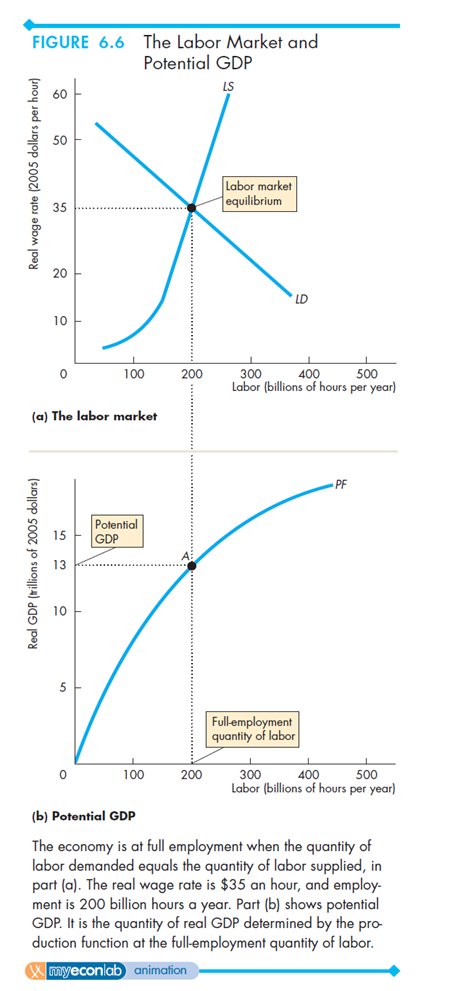
Potential GDP is the level of real GDP when the quantity of labor employed is the full-employment quantity.
To determine potential GDP, we use a model with two components:
An aggregate production function
An aggregate labor market
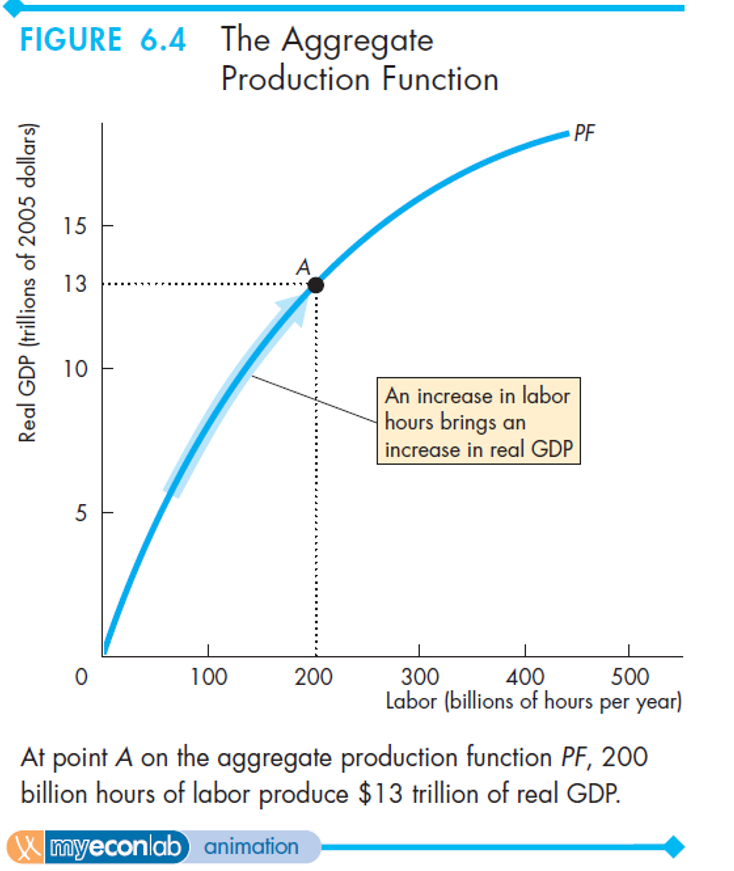
The aggregate production function is the relationship that tells us how real GDP changes as the quantity of labor changes when all other influences on production remain the same.
An increase in the quantity of labor (and a corresponding decrease in leisure hours) brings a movement along the production function and an increase in real GDP.
Aggregate Labor Market
In macroeconomics, we pretend that there is one large labor market that determines the quantity of labor employed and the quantity of real GDP produced.
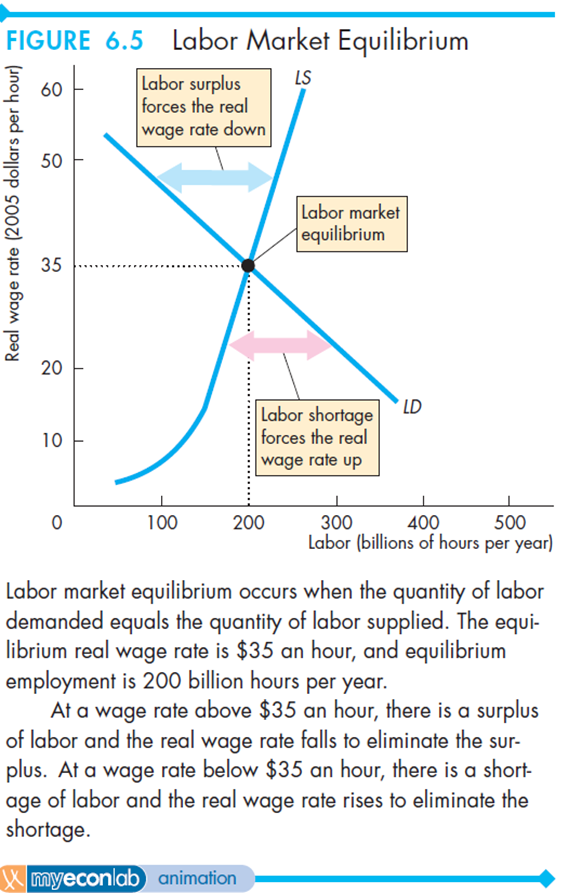
To see how this aggregate labor market works, we study the demand for labor, the supply of labor, and labor market equilibrium
The Demand of Labor The quantity of labor demanded is the number of labor hours hired by all the firms in the economy during a given period.
The Supply of Labor The quantity of labor supplied is the number of labor hours that all the households in the economy plan to work during a given period.
When there is neither a shortage nor a surplus, the labor market is in equilibrium— a full-employment equilibrium.
At the equilibrium quantity of labor, the economy is at full employment, and the quantity of real GDP at full employment is potential GDP. So the full-employment quantity of labor produces potential GDP.
What Makes Potential GDP Grow?
We can divide all the forces that make potential GDP grow into two categories:
Growth of the supply of labor
- 1. Average hours per worker
- 2. The employment-to-population ratio
- 3. The working-age population
Growth of labor productivity
Growth of the supply of labor
- 1. Average hours per worker
- 2. The employment-to-population ratio
- 3. The working-age population
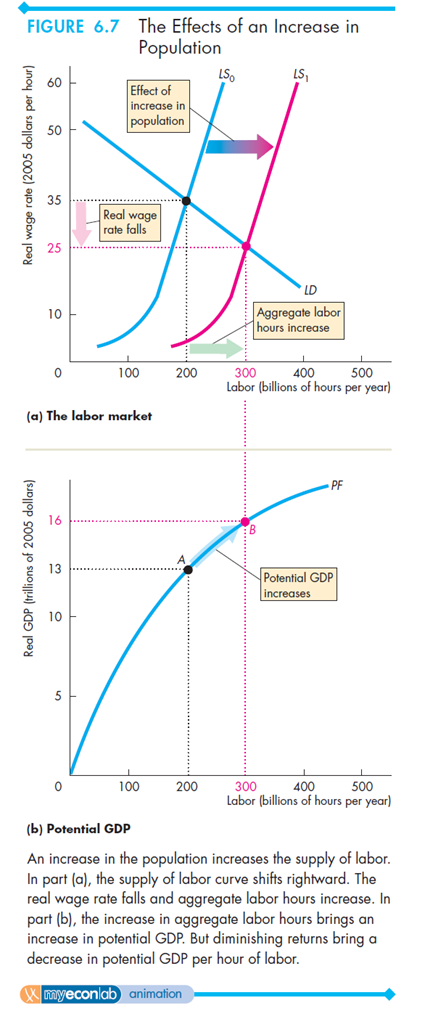
The Effects of Population Growth
In the long run, the working-age population grows at the same rate as the total population.
Population growth brings growth in the supply of labor, but it does not change the demand for labor or the production function.
Growth of labor productivity
Labor productivity is the quantity of real GDP produced by an hour of labor.
The Effects of Labor Productivity
If labor productivity increases, production possibilities expand.
The quantity of real GDP that any given quantity of labor can produce increases. If labor is more productive, firms are willing to pay more for a given number of hours of labor so the demand for labor also increases.
Now labor productivity increases. The increase in labor productivity shifts the production function upward to PF1.
At each quantity of labor, more real GDP can be produced.
5. Why Labor Productivity Grows
Sustained growth in real GDP per capita occurs only when the amount of output produced by the average worker increases steadily.
Labor productivity = (real GDP/# of people working)
If workers are creating more output, on average, the size of the economic pie will be rising and the average person’s slice will also be rising.
What factors lead to higher productivity?
The Sources of Long-Run Growth
Labor productivity
Explaining productivity growth:
- Physical Capital
- Human Capital
- Technology
1. Physical Capital
If you give a worker more physical capital (tools) with which to do the work, he/she will almost always be more productive.
A carpenter with a hydraulic nail gun will build more houses in a year, than a carpenter with a claw hammer.
A book keeper with a laptop computer and software will create more financial statements in year than a book keeper with a hand-held calculator.
2. Human Capital
If a worker has more education and training, human capital, he/she tends to be more productive.
As jobs and the global economy become more complex, nations with a more highly educated workforce will be able to produce more output per worker than nations with a lower level of education.
Today nearly 30% of American workers have a college degree. In 1910, only 3% had college degrees.
This significantly contributed to the growth of the U.S. economy.
3. Technology
We can think of technology as our collective body of knowledge. How do we know how to build a satellite that will orbit the earth and tell me how to get from my hotel in Washington, DC to the Lincoln Memorial? It takes years and years of collective learning to build such useful devices as GPS systems.
These innovations, and many others large and small, are major factors in allowing an average worker to increase his/her output in a given year.
So, if you give a worker more tools, better tools, and the education and training to know what to do with them, that worker will be more productive.
5. Growth Theories, Evidence, and Policies
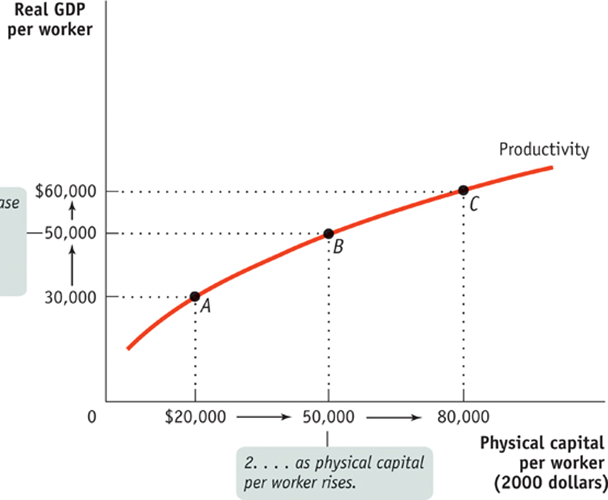
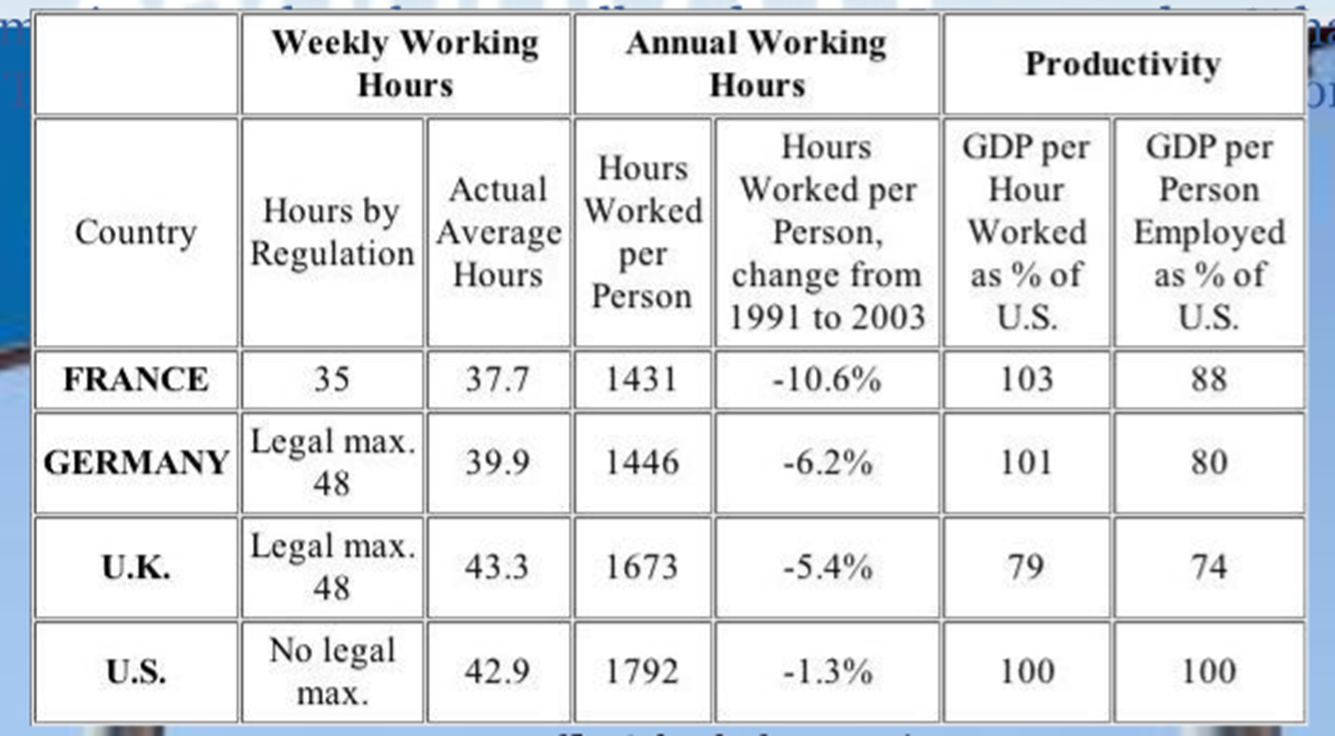
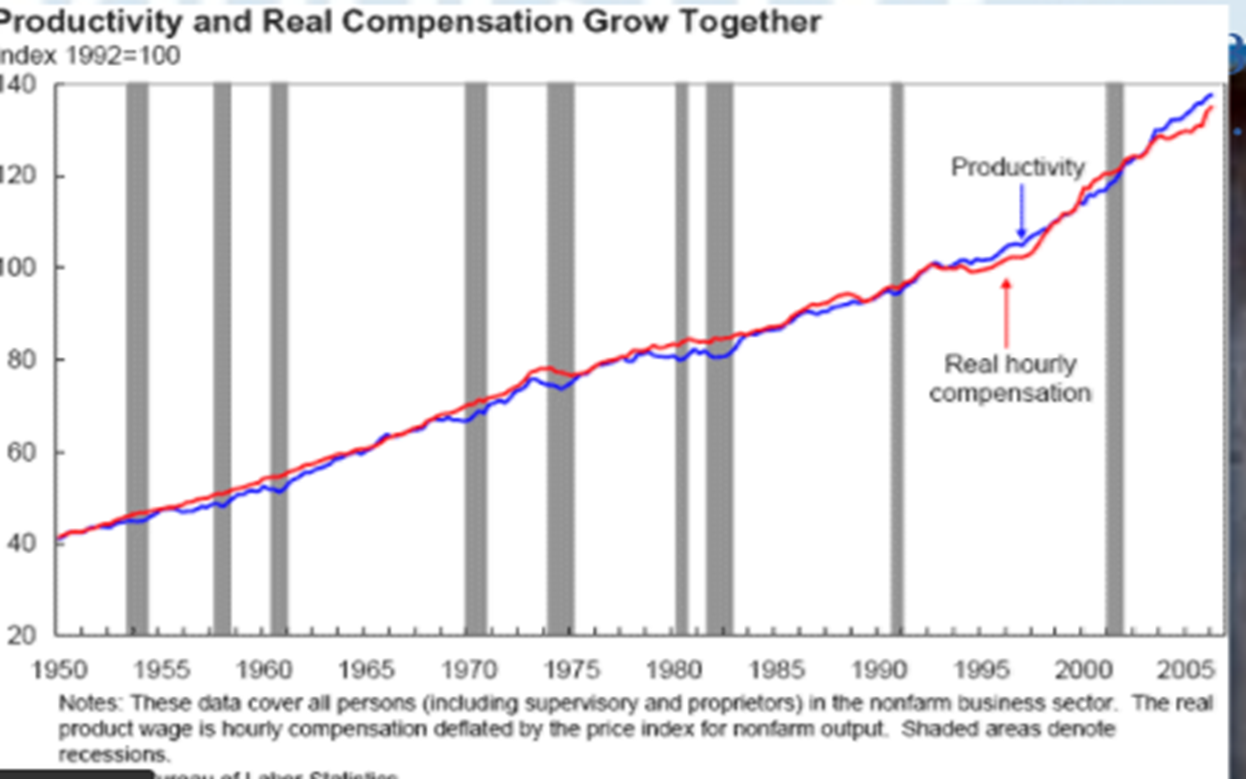
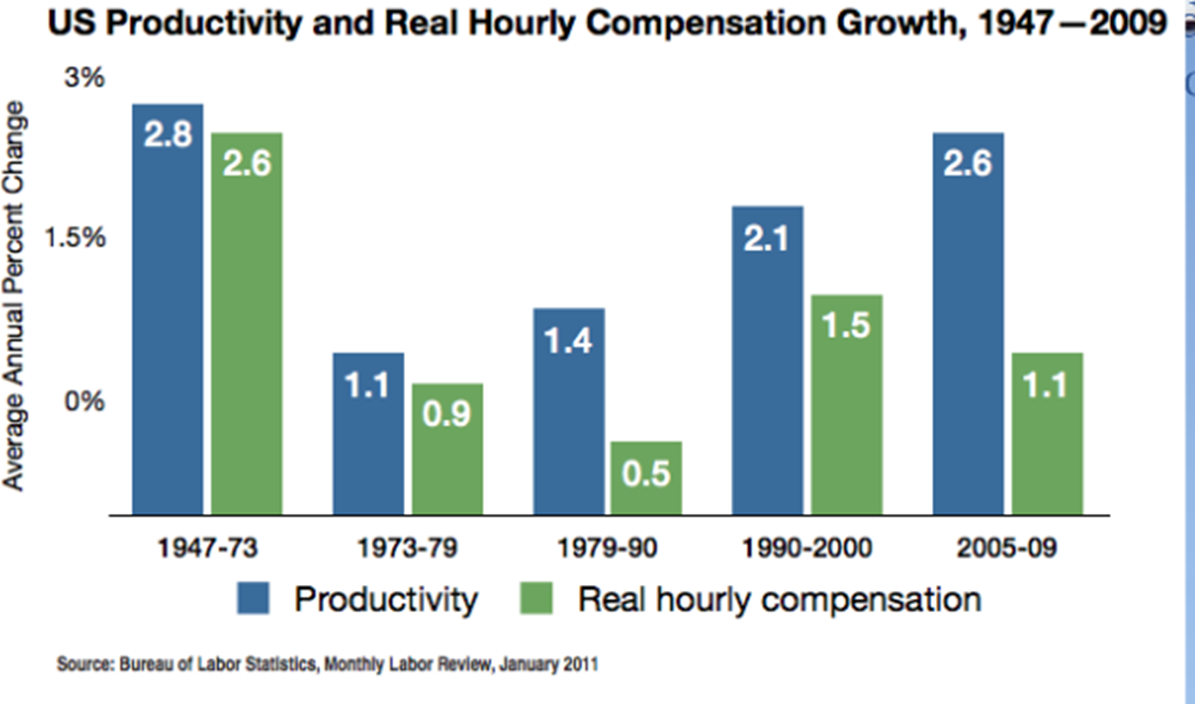
Productivity is higher, other things equal, when workers are equipped with more physical capital, more human capital, better technology, or any combination of the three.
Economists make use of tons of macroeconomic data to statistically estimate the nation’s aggregate production function, which shows how productivity depends on the quantities of physical capital per worker and human capital per worker as well as the state of technology.
There is an important microeconomic concept that also applies to the aggregate production function. Diminishing returns to physical capital: all else equal, as physical capital is increased, aggregate output increases by a smaller amount.
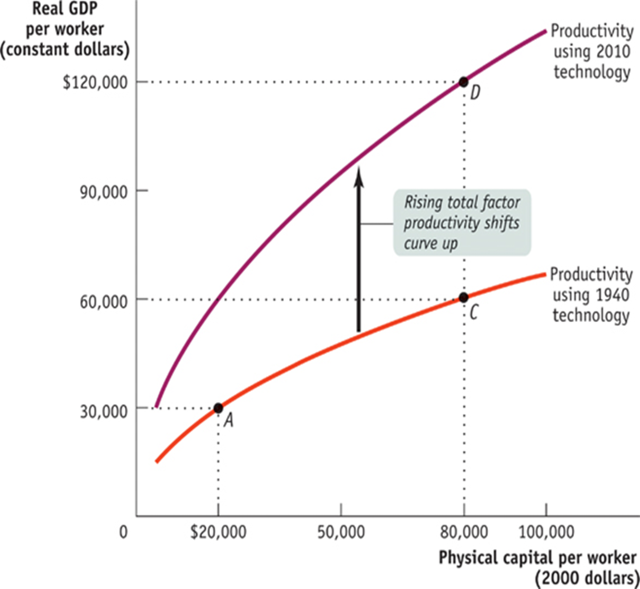
When other important factors, like human capital or technology, increase, the aggregate production function shifts upward. This tells us that, for any given level of physical capital per worker, total production has increased.
Economists try to measure higher total factor productivity: the amount of output that can be produced with a given amount of factor inputs.
So when total factor productivity increases, the economy can produce more output with the same quantity of physical capital, human capital, and labor.
For Example: Barry Bosworth and Susan Collins of the Brookings Institution estimated (using data from China and India) the following aggregate production function:
GDP per worker = T × (Physical capital per worker)*0.4× (Human capital per worker) *0.6
T: an estimated level of technology
There are three main theories of economic growth:
■ Classical growth theory
■ Neoclassical growth theory
■ New growth theory
■ Classical growth theory
Classical growth theory is the view that the growth of real GDP per person is temporary and a population explosion eventually brings it back to the subsistence level.
Adam Smith, Thomas Robert Malthus, and David Ricardo—the leading economists of the late eighteenth century and early nineteenth century—proposed this theory, but the view is most closely associated with the name of Malthus and is sometimes called the Malthusian theory.
Modern-Day Malthusians say that if today’s global population of 6.9 billion explodes to 11 billion by 2050 and perhaps 35 billion by 2300, we will run out of resources, real GDP per person will decline, and we will return to a primitive standard of living.
Modern-day Malthusians also point to global warming and climate change as reasons to believe that eventually, real GDP per person will decrease.
Neoclassical growth theory
Robert Solow of MIT suggested the most popular version of this growth theory in the 1950s.
The Solow Growth Model is an exogenous model of economic growth that analyzes changes in the level of output in an economy over time as a result of changes in the population growth rate, the savings rate, and the rate of technological progress.
All firms in the economy produce output using the same production technology that takes in capital and labor as inputs. Therefore, the level of output (represented by Y), the level of capital (represented by K), and the level of labor (represented by L) are all linked through the production function equation
Y = aF(K,L).
Predictions and Limitations
Population growth declines because of high opportunity costs.
If countries have the same g (population growth rate), s (savings rate), and d (capital depreciation rate), then they will converge, i.e., the Solow Growth Model predicts conditional convergence.
Along this convergence path, a poorer country grows faster.
Limitations
Growth ends if technological change stops because of diminishing marginal returns to both labor and capital.
There is no growth in the long term.
New growth theory
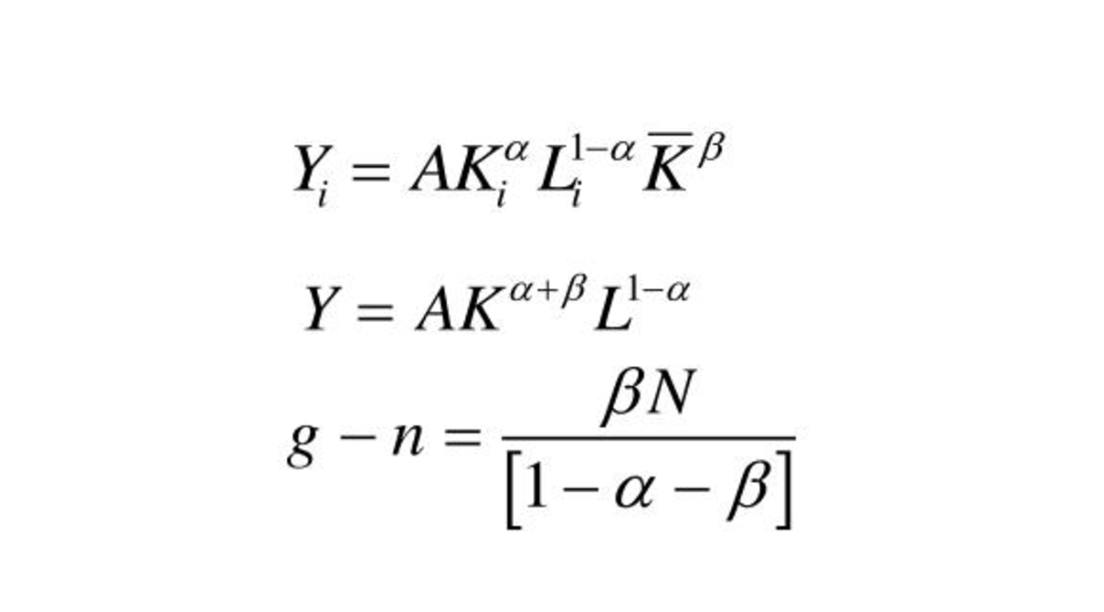
The new growth model starts with explaining the technological change within the model as an endogenous growth model where knowledge spillover effects play a central role.
According to Paul Romer (1986), knowledge creation is a byproduct of investment. As firms invest more in physical capital they learn simultaneously how to produce more efficiently. This process is called learning by doing.
The firms can also be engaged in research and development that creates ideas and innovation within the firms.
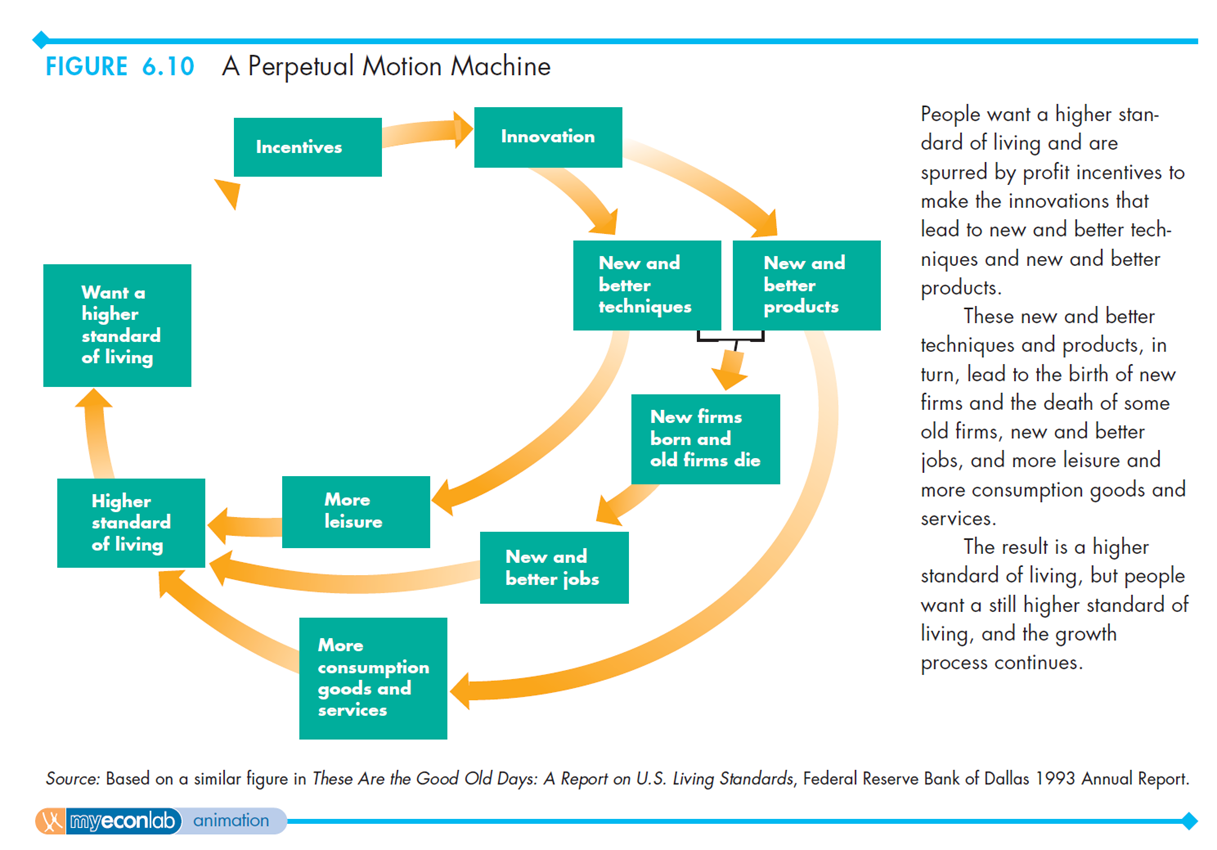
The engine of growth is the dynamic knowledge spillover. Unlike the other two theories, the new growth theory has no growth-stopping mechanism.
As physical capital accumulates, the return to capital—the real interest rate—falls. But the incentive to innovate and earn a higher profit becomes stronger.
So innovation occurs, capital becomes more productive, the demand for capital increases, and the real interest rate rises again.
Labor productivity grows indefinitely as people discover new technologies that yield a higher real interest rate.
The growth rate depends only on people’s incentives and ability to innovate.
■ Policies for Achieving Faster Growth
Growth theory supported by empirical evidence tells us that to achieve faster economic growth, we must increase the growth rate of physical capital, the pace of technological advance, or the growth rate of human capital and openness to international trade.
The main suggestions for achieving these objectives are
■ Stimulate saving
■ Stimulate research and development
■ Improve the quality of education
■ Provide international aid to developing nations
■ Encourage international trade