TRENDS (D1)
LESSON 1
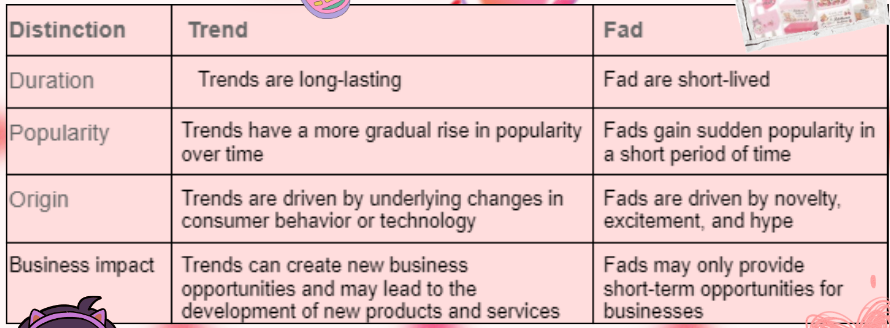
TREND AND FAD
Trend
It is a general direction or pattern of change in the market or industry practices.
Trends can emerge from various kind of change, such as technological shifts or new cultural norms.
products that are up to rise sales in markets due to their popularity and their general direction which continuously developing and changing
A trend is a general direction or pattern of change in the market or industry practices. Trends can emerge from various kinds of change, such as technological shifts or new cultural norms.
Fad
It is a short-lived phenomenon that shows a sudden surge in popularity before quickly losing momentum and fading away.
It typically arises from novelty or excitement around a new product, service, or idea, rather than a fundamental shift in market demand or industry practices.
A fad is a short-lived phenomenon that shows a sudden surge in popularity before quickly losing momentum and fading away.
Trend Analysis
a statistical tool that is used to predict the movement of the product and it’s future stocks
the widespread practice of collecting information and attempting to spot a pattern, or trend, in the information.
Type of Trend Analysis
Uptrends - increases popularity, increases its price and value.
Downtrend- seller increases and little demands, decrease price.
Sideway trend - a horizontal movement, when the product force of supply and demand nearly equal
Fad - is when a product became popular in a short period of time, in which
happens to fall fast and disappear too.
Difference between Trend and Fad
Spotting a Trend
Trendspotting
the process of predicting trends before they enter the mainstream while also analyzing whether or not the trend is relevant to your business
Trendspotter
a person who notices and reports on a new fashion, ideas, and activities that are becoming popular
How to spot a Trend
Get a sense of the landscape - Assess what information and data you need to understand the current state of affairs in your field, topic, or industry.
Monitor and analyze social data - Get the foundational metrics and patterns you need to be able to spot trends as they emerge.
Collect clues, samples, and signals - Now that you know more about norms over time, you can look out for information or data that deviates from it.
Detect and identify - With a collection of signs or signals at hand you can then dive further to learn more about what is relevant to your trendspotting search.
Zoom in and drill down - Drill down on the data to extract insights about the trend (like what is causing it and how it will develop) as well as intelligence about its audience (what about the trend appeals to them, how they are responding to it, what unites this segment, and what they will be looking for in the future).
Elements of a Trend
Basic Need - A particular trend may or will last a long time if it were to fulfill the basic needs of the common populace. Because the trend can be useful for the curent and future generation
Driver of change - A trend is one of the key features in humanity's improvement, it's also one of the main reasons why change is inevitable in our day-to-day lives. Because trends can change, modify or replace existing trends. Changes happen so it'll be more convenient for everyone.
Innovation - A trend provides a different option that suits the demand for the common populace, that is both better and convenient than the previous trend. Since technologies improve over time, there's bound to be a replacement for everything.
5 Characteristic of a Trend
Endurance Over Time - is the ability to continue with an unpleasant or difficult situation, experience, or activity over a long period of time.
Acceptability - the degree to which something is agreed or approved of by most people in a society
Cultural Roots - persists and continues because people have seen it as part of a society's culture.
Transitory Increase or Decrease - They find the next big thing and cool in the present while looking for something conventional.
Versatility - Describes having many different skills or qualities. Versatility allows you to adapt to many different situations.
LESSON 2
Trends, Network and Critical Thinking in the 21st Century
Identifying Emerging Patterns
Documentation
means being able to record your observations which you consider related to any trend.
Archive/Memory
is used to easily retrieved amy documentation you have kept
Analysis
the stage where examination and combination happens.
Presentation
presenting your findings for easy understanding as way of analysis
Stages of Emerging Pattern
Representation
this stage involves identifying and describing a pattern or trend that you observe in the world around you
Generalization
you try to understand why the pattern or trend is happening and what it means
look for commonalities among different examples of the trend and try to identify the underlying causes or motivations
Evaluation
final stage where you assess the pattern or trend and consider it’s implications
Adaptation
intermidiary stage between generalization and evaluation where we modify our understanding of the pattern or trend based on new information
involves adjusting and perception or behavior in the response to the pattern or trend
Types of Data Emerging Patterns
Trend
Linear Trend -
continuous increase or decrease in no. over time
Exponential Trend -
the graph will show a curved line
produces non-linear curved lines where the data rises or falls, not a steady rate, but a higher rate
Damped Trend
the line is curved line to show data values rising or falling initially and then showing apoint where the trend (increase or decrease) stops rising or falling
Seasonal
one can idemtify seasonality patterns when fluctuations repeat over fixed period of time and are therefore predictable and where those pattern do not extend beyond a one-year period.
seasonality can be caused by different factors like weather, vacation or holidays
Cyclical
patterns occur when fluctuations do not repeat over fixed period of time and therefore unpredictable and extend beyond a year
Ramdom/Irregular/Error
reveals fluctuations in a time series
these fluctuation are short and erratic and follow no regularity in the occurence pattern
LESSON 3
Strategic analysis, Intuitive Thinking, and Key Components of Strategic Analysis and Intuitive thinking
Strategic analysis
refers to an evaluation of an organization’s work envinronment
generally defines how the oraganization operates it’s business
Strategic Planning
process used by organizations to define long-term goals and develop a roadmap for achieving them
used to guide decision-making and resource allocation throughout the organization
Comprehensive procees that involves:
Settibg a Clear View
Understanding the current situation
Formulating Strategies
Develop action plans
Monitoring and Evaluation
Different Strategic Plans
Corporate-Level Strategy
This level of planning deals with the overall direction of the organization, such as whether to diversify into new markets or acquirenew businesses
Business-Level Strategy
Focuses on how to compete in a specific market, such as by developing a cost-leadership or differentiation of strategy
Functional-Level Strategy
Deals with how to manage individual functions within the organization, such as marketing, finance, and operation
Points to consider in Strategic Planning:
Flexibility and Adaptability
Business landscape is constantly eveloving, so your strategy should be flexible to adapt to unforeseen changes
Alignment with organizational culture
Ensure your strategic plan aligns with your organization’s core values and culture
Performance Measurement and Evaluation
Establish clear metrics to track progress towards your strategic plan
2 Types of Strategic Anaaysis
Internal Analysis
through this analysis the organization will look inwards or with the organization and identify the positive and negative points
commonly used SWOT analysis
this technique checks the full factor inside the organization or it’s projects amd determine how thing may suffer
External Analysis
one needs to know how the markets work and how the customers affected by certain marketing strategies, products, and services that competitors present out there
PESTLE analysis (Political, Economic, Legal, and Environmental)
commonly used external analysis
Network
can be thought of as any system where components are connected in some allowing for exchange or flow of information, resources, and other elements
3 UNMISTAKABLES IGNS THAT YOU ARE A STRATEGIC THINKER
Strategic Thinkers Make Better Decisions By Being More Reflective
Strategic thinkers understand and dig deeper with regards to analyzing processes, developing and applying performance metrics, collecting data and producing analytics to make more informed decisions.
Strategic Thinkers Advance Their Careers By Being Better Leaders
Strategic leaders go beyond the role of having and communicating a vision to fully understanding, planning and executing the necessary strategies to realize it.
They make better decisions as they have a more holistic view that includes the organization and the people inside and outside it.
Strategic Thinkers Demonstrate Organizational Value By Creating More Strategic Thinkers
Strategic thinkers are the ones in the organization who ponder and prompt questions that are designed to create even more strategic thinkers.
You can’t ignore strategy and be a strategic thinker. You can’t disregard the importance of delivering value as a leader and be a strategic thinker.
Intuitive Thinking
the ability to form an opinion or make a decision without thinking consiously or engaging in a process of analytical thinking
it is a combination of experience, emotion, subconscious process that allows allows people to trust their instincts about what’s right for them
Components of Intuitive Planning
Immediacy
refers to the timing in intuitive thinking
decision, actions, and solutions come up fast without planning
Sensing Relationship
One can focuson the big picture and theoretical possibilities, while can focus on details, the moment and to ensure the decision are practical and realistic
Reason
helps individuals break down problems into smaller, more manageable parts and find creative solutions to overcome obstacles