Erik Erikson
Definition (#f7aeae)
Important (#edcae9)
Extra (#fffe9d)
Psychosocial Stages of Development:
Epigenetic principle:
Human development is governed by a sequence of stages.
Depends on hereditary factors.
Development involves a series of conflicts and crises.
Crisis: Turning point faced at each development stage.
At every stage, the ego consists mainly of the positive attitude and will be balanced by some portion of negative attitude.
Basic strengths: Motivating characteristics and beliefs.
Derived from satisfactory resolution of the crisis at each stage.
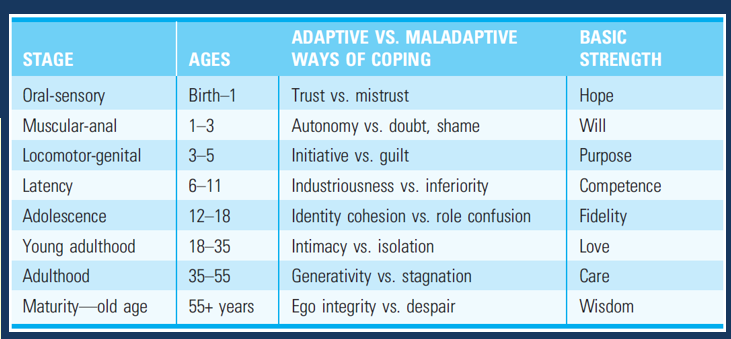
Trust vs Mistrust:
Mouth area is important.
Determined by the baby’s interaction with the mother.
Result of trust:
Expect consistency and continuity from others.
Result of mistrust:
Suspicious, fearful, and anxious.
Autonomy vs Doubt & Shame:
Children develop physical and mental abilities.
Includes the abilities to hold on and let go.
Toilet training: Attempt to regulate instinctual needs.
Result of autonomy:
Child learns to exercise independence.
Result of shame:
Self-doubt.
Initiative vs Guilt:
Desire to take initiative in activities:
Fantasies to possess the parent of the opposite sex may develop.
Result of initiative:
Awareness of permissible behavior.
Channeled toward realistic and socially accepted goals.
Result of guilt:
Self-directed activities are affected.
Industry vs Inferiority:
Child begins school and has new social experiences.
Sex stereotypes reflect in activities.
Result of industriousness:
Praise & reinforcement lead to feelings of competence/encouragement.
Result of inferiority:
Develops feelings of inadequacy.
Identity Cohesion vs Role Confusion:
Ego identity: Self image formed during adolescence.
Integrates what 1 is and what 1 wants to be.
Failure to achieve ego identity leads to identity crisis.
Result of strong sense of self:
Ability to face adulthood with confidence.
Intimacy vs Isolation:
Individual begins to function as a responsible and independent adult.
Results of intimacy:
Feelings of care and commitment.
Results of isolation:
Failure of intimacy, avoidance, aggression and rejection.
Generativity vs Stagnation:
Expression of generativity:
Teaching, mentoring, and guiding the next generation.
Failure results in stagnation, boredom and childlike behavior.
Ego Identity vs Despair:
Involves the evaluation of one’s life.
Ego integrity: Accepting one’s place and past.
Despair: Regretful of missed opportunities/mistakes.
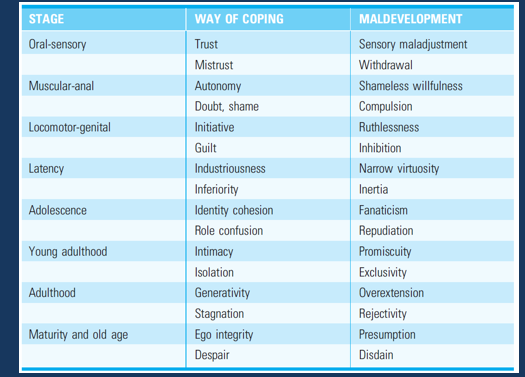
Basic Weakness:
Motivating characteristics from the unsatisfactory resolution of developmental crises.
Maldevelopment: When the ego consists of a single way of coping with conflict.
Maladaptive: When only the positive tendency is present.
Malignant: When only the negative tendency is present.
Human Nature:
Free will and determinism.
Nurture and nurture influence.
Focused on past and present.
Uniqueness and universality.
Growth throughout life.
Optimistic.
Assessments:
Techniques:
Play therapy:
Used while working with emotionally disturbed kids.
Involves observing how children interact with toys.
Form and intensity of plays reveals aspects of personality.
Psycho-historical analysis:
Application of Erikson’s lifespan theory and psycho-analytical principles.
Involves studying historical figures.
Assessments:
Psychological tests were developed based on:
Ego Identity Scale.
Ego Identity Process Questionnaire.
Loyola Generativity Scale.
Research:
Focus on case study method.
Play constructions.
Trust and security.
Psychosocial stages.
Adolescent development.
Identity.
Generativity.
Maturity.
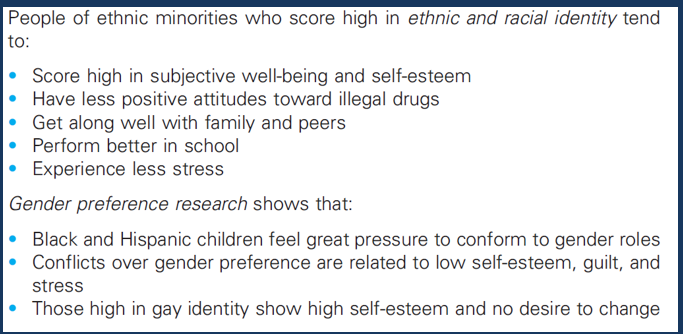
Ethnic identity.
Gender preference identity.
Research on children:
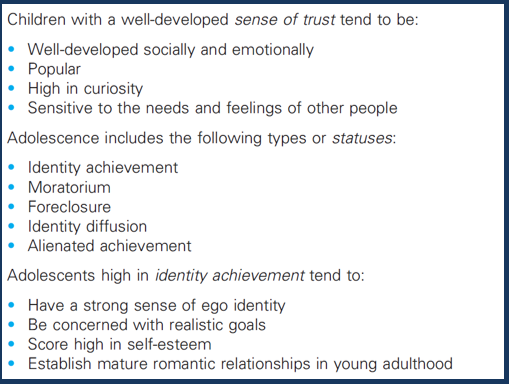
Research on Ego Identity:
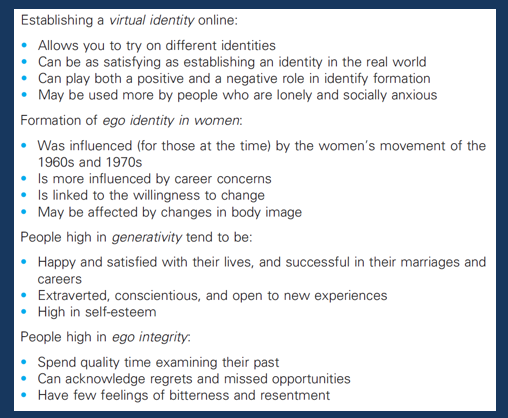
Research on Erikson’s ideas:
Reflections:
Contributions:
Personality develops through lifespan.
Concept of identity crisis in adolescence.
Recognition of cultural, social and historical influence.
Inspired fields life-span development psychology.
Play therapy.
Criticism:
Ambiguity in concepts.
Incomplete description of maturity.
Erikson’s position on sex differences.
Stages may not be applicable to all.