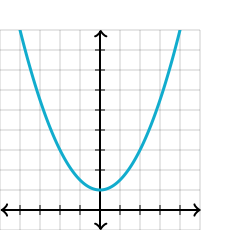
Definition 3.1. A graph is called concave up on an interval (a, b) if the graph looks like:
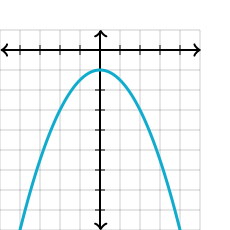
A graph is called concave down on an interval (a, b) if the graph looks like:
Remark 3.2 (Finding inflection points). For a function y=f(x). The point p is a possible inflection point if f(p)(2)=0 orf(2)(p) undefined. To test whether p is actually an inflection point, check whether f(2) changes sign at p (using a sign chart).
Example 3.3. Find the inflection points for f(x)=41x4−4x3+24x2
Step 1: Solve f(2)(x)=0 or und
f′(x)=x3−12x2+48x
f(2)(x)=33x2−24x+48=30 (Divide both sides by 3)
f(2)(x)=x2−8x+16=0
f(2)(x)=(x−4)(x−4)=0
f(2)(x)=x−4=0
f(2)(x)=x=4 (possible inflection point)
Step 2: Determine which of the possibilities is an IP
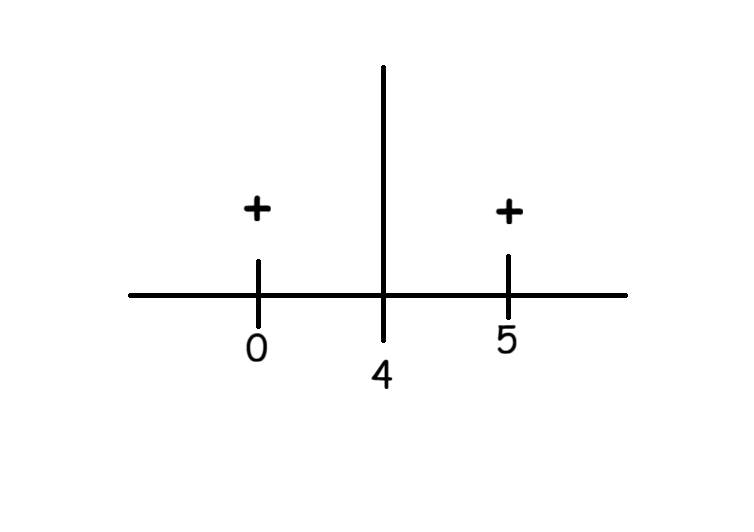
f(2)(0)=48
f(2)(5)=3
x=4 is not an inflection point
f(x) has no IP
Example 3.4. Find the inflection points for f(x)=xe−x
f′(x)=(1)(e−x)+(x)(e−x(−1))
f′(x)=e−x−xe−x
f′(x)=(1−x)e−1
f(2)(x)=(−1)(e−x)+(1−x)(e−x(−1))
f(2)(x)=−e−x−(1−x)e−x
f(2)(x)=−e−x−(e−x−xe−x)
f(2)(x)=−e−x−e−x+xe−x
f(2)(x)=2e−x+xe−x
f(2)(x)=(−2+x)e−x=0
−2+x=0
x=2
e−x=0
No solution
(−∞,2) Concave down
(2,∞) Concave up
We gave already seen the first-derivative test for local extrema, i.e.
How can we use concavity and the second derivative to test for local extrema?
Theorem 3.5 (second-derivative test). Let f(x) be a differentiable function.
If f′(p)=0 andf^{\left(2\right)}\left(p\right)>0 , then f(x) has a local minimum at p.
f(2)(x)=(x2−1)4(−2x)(x2+1)2−4x(1−x2)(x2+1) I
f f′(p)=0 andf^{\left(2\right)}\left(p\right)<0 , then f(x) has a local maximum at p.
If f′(p)=0 andf(2)(x)=0 , then the test doesn’t tell us anything.
Example 3.6. Determine the local extrema for f(x)=x2+1x
f′(x)=(x2+1)2(1)(x2+1)−(x)(2x)
f′(x)=(x2+1)2(x2+1)−2x2
f′(x)=(x2+1)21−x2
f′(x)=(x2+1)2(x2+1)21−x2=0(x2+1)2 (Multiply by (x²+1)² on both sides)
f′(x)=1−x=0
f′(x)=1=x2
f′(x)=±1=x
f(2)(x)=[(x2−1)2]2(−2x)(x2+1)2−(1−x2)(2(x2+1)2⋅2x)
f(2)(x)=(x2−1)4(−2x)(x−1)−4x(x2+1)(1−x2)
f(2)(x)=(x2+1)3(x−1)[−2x(x2+1)−4x(1−x2)]
f(2)(x)=(x2+1)3−2x(x2+1)−4x(1−x2)
f^{\left(2\right)}\left(1\right)=\frac{\left(-2\right)\left(2\right)-\left(4\right)\left(0\right)}{2^3}=\frac{-4}{8}<0 (max @ x=1)
f^{\left(2\right)}\left(-1\right)=\frac{\left(2\right)\left(2\right)+4\left(0\right)}{2^3}=\frac48>0 (min @ x=-1