Nursing as a Profession
The PATIENT is the center of your practice. Your patient includes:
· Individuals
· Families
· Communities
\n Patients have a wide variety of health care needs, vulnerabilities, and expectations, but this is what makes nursing both challenging and rewarding. Making a difference in your patients’ lives is fulfilling.
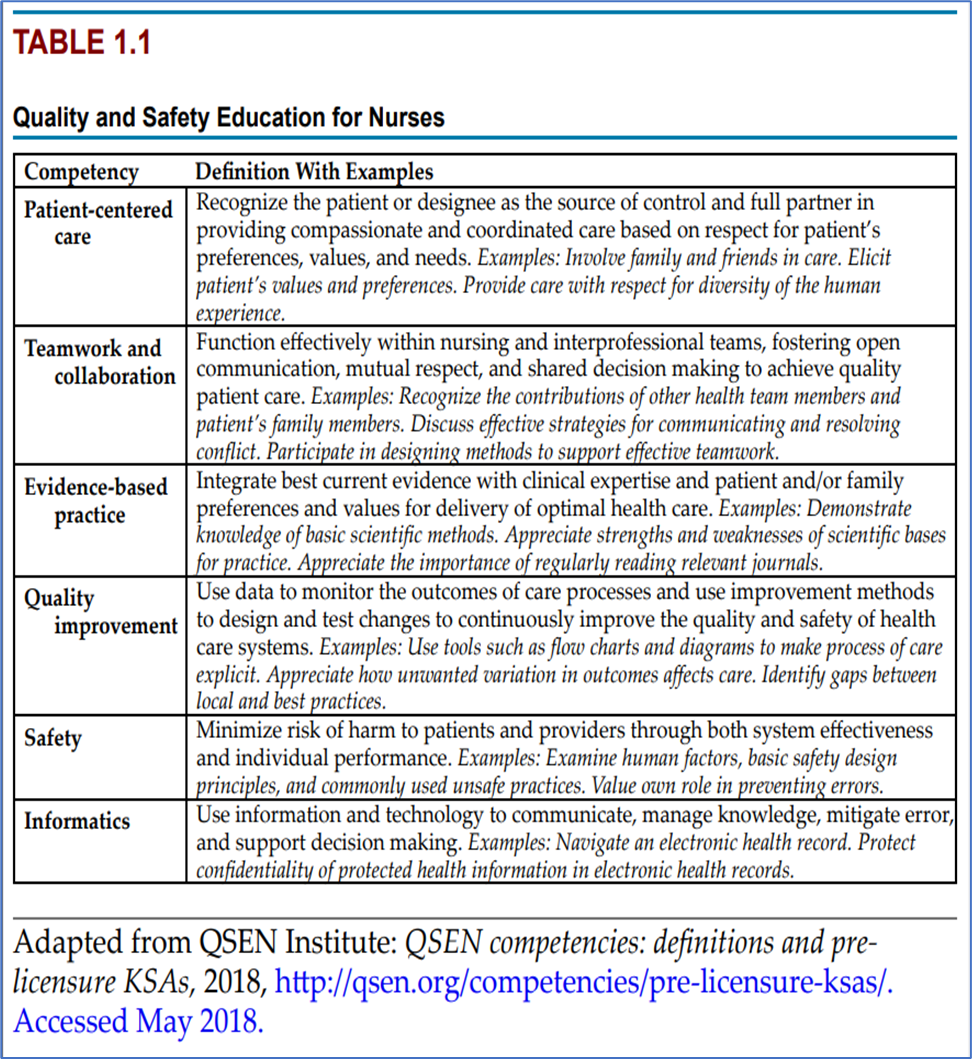
\ NURSING \n This is not simply a collection of specific skills, and you are not simply a person trained to perform specific tasks. Nursing is a profession. No one factor absolutely differentiates a job from a profession, but the difference is important in terms of how you practice. To act professionally, use your critical thinking skills to administer quality evidenced-based, patient-centered care in a safe, prudent, and knowledgeable manner. You are responsible and accountable to yourself, your patients, and your peers.
\ As a student, it is important for you to understand the scope of professional nursing practice and how nursing influences the lives of your patients, their families, and their communities.
\ SCIENCE AND ART OF NURSING PRACTICE
Because nursing is both an art and a science, nursing practice requires a blend of current knowledge and practice standards with an insightful and compassionate approach to your patients’ health care needs.
\ Your care must reflect the needs and values of society and professional standards of care and performance, meet the needs of each patient, and integrate evidence-based findings to provide the highest level of care.
\ Clinical expertise takes time and commitment. According to Benner (1984), an expert nurse passes through five levels of proficiency when acquiring and developing generalist or specialized nursing skills.
\ Nursing is the protection, promotion, and optimization of health and abilities; prevention of illness and injury; alleviation of suffering through the diagnosis and treatment of human response; and advocacy in the care of individuals, families, communities, and populations (ANA, 2015).
\
CODE OF ETHICS
The nursing code of ethics is a statement of philosophical ideals of right and wrong that define the principles you will use to provide care to your patients. It is important for you to also incorporate your own values and ethics into your practice.
\ Autonomy and Accountability
Autonomy is an essential element of professional nursing that involves the initiation of independent nursing interventions without medical orders.
With increased autonomy comes greater responsibility and accountability. Accountability means that you are responsible professionally and legally for the type and quality of nursing care provided. You must remain current and competent in nursing and scientific knowledge and in technical skills.
\
- CAREGIVER
As a caregiver you help patients maintain and regain health, manage disease and symptoms.
- ADVOCATE
As a patient advocate you protect your patient’s human and legal rights and provide assistance in asserting these rights if the need arises.
- EDUCATOR
As an educator you explain concepts and facts about health, describe the reason for routine care activities, demonstrate procedures such as self-care activities, reinforce learning or patient behavior, and evaluate the patient’s progress in learning.
- COMMUNICATOR
An effective communicator is central to the nurse-patient relationship. It allows you to know your patients, including their preferences, strengths, weaknesses, and needs.
\ CAREER DEVELOPMENT
· PROVIDER OF CARE
· ADVANCE PRACTICE REGISTERED NURSES (APRN)
· CLINICAL NURSE SPECIALIST (CNS)
· NURSE PRACTITIONER
· CERTIFIED NURSE-MIDWIFE
· CERTIFIED REGISTERED NURSE ANESTHETIST
· NURSE EDUCATOR
· NURSE ADMINISTRATOR
· NURSE RESEARCHER
\
HISTORICAL INFLUENCE
FLORENCE NIGHTINGALE
In Notes on Nursing: What It Is and What It Is Not, Florence Nightingale established the first nursing philosophy based on health maintenance and restoration.
\ TRENDS IN NURSING
Nursing is a dynamic profession that grows and evolves as society and lifestyles change, as health care priorities and technologies change, and as nurses themselves change. The current philosophies and definitions of nursing have a holistic focus, which addresses the needs of the whole person in all dimensions, in health and illness, and in interaction with the family and community. In addition, there continues to be an increasing awareness for patient safety in all care settings.
PROFESSIONAL REGISTERED NURSE EDUCATION
- PRELICENSURE Finishing of either an associate or baccalaureate degree program. The baccalaureate degree program usually includes 4 years of study in a college or university. NCLEX-RN - Graduates are eligible to take National Council Licensure Examination for Registered Nurses
- GRADUATE EDUCATION After obtaining a baccalaureate degree in nursing, you can pursue graduate education leading to a master’s or doctoral degree in any number of graduate fields, including nursing. A nurse completing a graduate program can receive a master’s degree in nursing. The graduate degree provides the advanced clinician with strong skills in nursing science and theory.
- DOCTORAL PREPARATION
Professional doctoral programs in nursing (DSN or DNSc) prepare graduates to apply research findings to clinical nursing. Other doctoral programs prepare nurses for more rigorous research and theory development and award the research-oriented Doctor of Philosophy (PhD) in nursing.
\ · Continuing education involves educational programs offered by universities, hospitals, state nurses associations, professional nursing organizations, and educational and health care institutions.
\ · In-service education programs are instruction or training provided by a health care agency or institution. An in-service program is held in the institution and is designed to increase the knowledge, skills, and competencies of nurses and other health care professionals employed by the institution.
\ NURSING PRACTICE
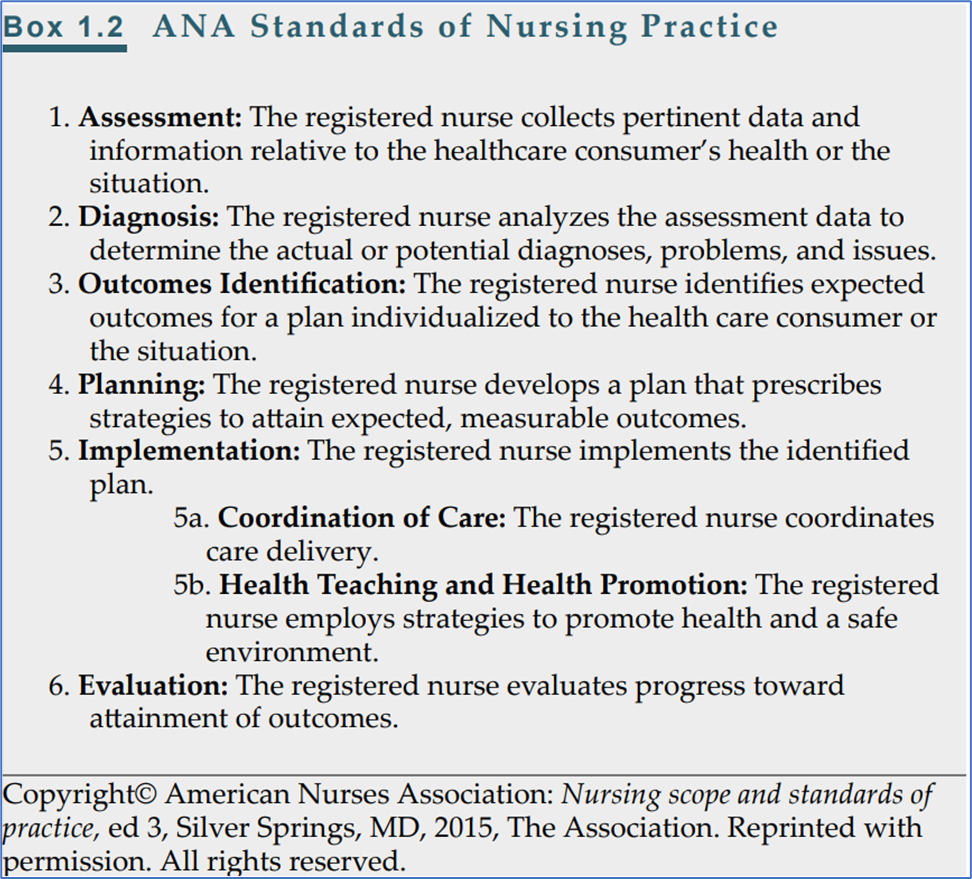
You will have an opportunity to practice in a variety of settings, in many roles within those settings, and with caregivers in other related health professions. The ANA standards of practice, standards of performance, and code of ethics for nurses are part of the public recognition of the significance of nursing practice to health care and implications for nursing practice regarding trends in health care.
\
LICENSURE AND CERTIFICATION
LICENSURE
In the United States all boards of nursing require RN candidates to pass the NCLEX-RN®. Regardless of educational preparation, the examination for RN licensure is the same in every state in the United States. This provides a standardized minimum knowledge base for nurses. Other requirements for licensure such as criminal background checks vary from state to state.
CERTIFICATION
After passing NCLEX-RN®, a nurse may choose to work toward certification in a specific area of nursing practice. Minimum practice and/or educational requirements are set, based on specific certification. National nursing organizations such as the ANA have many types of certifications to enhance your career, such as certification in medical-surgical or geriatric nursing. After passing the initial examination, you maintain your certification by ongoing continuing education and maintaining a set number of hours in clinical or administrative practice.
\ KEY POINTS
· Nursing responds to the health care needs of society, which are influenced by economic, social, and cultural factors.
· Changes in society affect the practice of nursing.
· Nursing standards provide the guidelines for implementing and evaluating nursing care.
· Advances in nursing’s scientific knowledge base and the application of evidence-based practice have improved nursing practice and patient outcomes.
· Nursing education programs must adhere to educational standards established by a nursing education accreditation body.
· A nurse may take multiple professional career paths, such as advanced practice, nurse educator, research, and administration, to advance within the discipline.
· Professional nursing organizations impact educational standards and certifications, specialty practice.
\