AP ST
konsepto at implikasyon
produksyon (how we create such)
shows the creation of products and services of peoples needs and wants
transformation
input, using raw material (feedback)se
process, making it with machines
output, going the consumers. (feedback)
commodity
the raw and natural items used for the creation of the products
things to follow
create products and services
meeting human needs
provide employment
generate income for the business and economy.
two types of products
goods
physical and can be held
ex. pencils, chairs
services
paying someone else to do something
ex. a massage. a doctor.
types of product depending on use
final product
a product that can be used like that solely, its journey is done
direct consumation
product with derived use (mapagkukunang gamit)
derived use, its final state is not the state it was presented with and often requires something else.
consumer goods
products that are consumed for a persons personal or familial needs.
1. convinience products
stuff that is often bought by the people
2. shopping products
stuff (most likely an appliance) that is bought by people to use.
not bought as often
3. specialty products
stuff that people buy for their own personal self?
luxury items
4. unsought products
products you didnt even need or bought til you needed it
ex. fire extinguishers or insurance
products with derived use
5. capital/industrial goods
most likely big machinery to produce products or something
factors of production
there are 4 types
lupa (land)
the resources needed to create the product.
lakas-paggawa (ability to create)
to create using the work of our hands, products and services
human capital - the knowledge/education honed from education and work.
capital (physical capital)
the strength a person has to create
entrepreneur (the people that helps manage and promote)
people needed to organize, manage, promote, and sell.
establishes the business
should be an innovator and a risk taker.
negosyo (negotiations) (1 person, usually small business.)
anything done through economy with a goal to get earn
isahang pagmamayari
it is a small business spearheaded by one individual, the money earned from the negosyo goes to the person solely
sosyohan (partnership) (2+ people)
2 or more individuals, to share and divide the earnings
general partnership
unlimited liability, personal assets may be used to pay debt.
limited partnership
limited, divided amongst how they contributed.
korporasyon (a business thats more serious, legal)
a business with legal personality
seperate from the people who own and operate it
must be registered with SEC (securities exchange comission)
led by 5-15 directors
kooperatiba (cooperative) (help likeminded people()
a voluntary group for those with similar interests.
help, save, build capital together.
supervised by the CDA (cooperative development agency)
pagkonsumo (how we use such)
pagkonsumo at matalinong mamimili
an economic activity where people use produces and services for their needs and wants
importance
satisfies the needs and wants
increases the demand
helps generate employment for the production
contributes to the country’s economy
things that effect consuming
kita (income)
some people may only buy what they can afford
afford using the money in their jobs
ex. the poor can only buy this instead of something more expensive
okasyon (occassion)
depending on the event, some items might be bought more for festivities and such
ex. buying flowers on valentines day
pag-aanunsyo (advertising, kinda like propaganda?)
a method by producers to get more people to engage or get their product
3 types of it
bandwagon (everybody does it)
seeing that others and many people do it, people get it
fomo
pagpapatunay/testimonial (famous person)
a famous person or celebrity advertises this product
wow this guy is cool and uses it, i should buy it too
pagpapakilala sa produkto (product promotion)
examples of this like free samples and pamphlets
going out of your way to advertise it basically
presyo (price)
the amount paid in services or products
depending on the price of the item, more or less people will buy it
pagpapahalag sa tao
the need, interests of the people, and wants
ex. diapers for children. luxury for adults
matalinong mamimili
it is a person who plans, researches, compares, price and quality and finds out what he truly needs.
characteristics
creates a list on what is needed
reads the product label, checking
research the product you want to buy
identify needs and the choices
know the consumer laws
return defective products
read about where to get the best bargains
be environmentally friendly
rights of a consumer
1. karapatan sa pangunahing pangangailangan (basic needs)
every person has a right to have basic necessities
ex. food, housing, education, health
2. mga karapatan maging maligtas(reading if safe)
read if the product is safe to use or consume
ex. reading if theres an FDA approved label.
3. karapatan sa tamang impormasyon (right info)
to know if the ingredients and expiration are accurate
ex. reading the nutrition labels and looking at exp date.
4. karapatang pumili (choice)
every consumer has a right to pick something freely as they wish
ex. this or that product
5. karapatan sa representasyon (free speech)
these people should have their opinions shown and the formulation of such laws.
ex. we should change this for the people
6. karaptan madinig at mabigyan ng bayad-pinsala (seek a replacement)
everyone has rights to replace, repair, or refund a defected product.
ex. my jar is broken, i want a new one
7. karapatan sa edukasyon bilang konsumer (learn about rights)
every person ahs the right to learn about what their rights are to not make uninformed decisions.
ex. my right is this.
8. karapatan sa malinis at maayos na kapaligiran (healthy environment)
everybody has the right to have and maintain a safe, clear, and clean environment.
responsibilities of a consumer
it is to discern, be active, concious socially and environmentally, and united,
5 types
maging mapanuri (critical awareness)
ask about the product or service
maging aktibo (action)
to see if pricing and much are fair.
mapagmalasakit as lipunan (social concern)
understand how consumption impacts the community]
magmalasakit sa kapiligiran (environmental awareness)
be aware of how the consumption impacts the environment
magkaisa (unity)
monitor and watch consumer interests as a group
supply and demand
demand
the WILLINGNESS of the people to be ABLE to buy products and services at different prices.
batas ng demand (law of demand)
it states that if price goes up, demand goes down (less people want it and only a few can afford, demand lowers)
it states in vice versa, if price goes down, demand goes up (more people want it since it cheap)
ceteris paribus
all other things remain constant, it assume that price is the only thing that effects everything else.
substitution and income effect
income effect
if you have a cheap income and you want to buy something, you often have to buy something else, a cheap alternative
substitution effect
you buying that knock off or different product is the substitution from another product to another due to price or something,
DEMANDS
demand schedule
a table that determines price and how much people buy it
PRICE AND QD

demand curve
shows the relation of price and quantity demanded through a line graph
it often shows a straight diagonal line or curve,
price being on the left. (always for this one)

demand function
the mathematical formula to determine the relation of quantity demanded and price
Qd = a - b(P)
qd, the quantity demanded
a, usually given (intercept)
b, slope
P, the price
(if you need to find price)
subtract Qd by A, then divide by B.

SUPPLY
the WILLINGNESS and ABILITY of the producer to provide the amount of product and service.
law of supply
supply is directly proportionate to price
if the price rises, supply rises
if the price lowers, supply lowers.
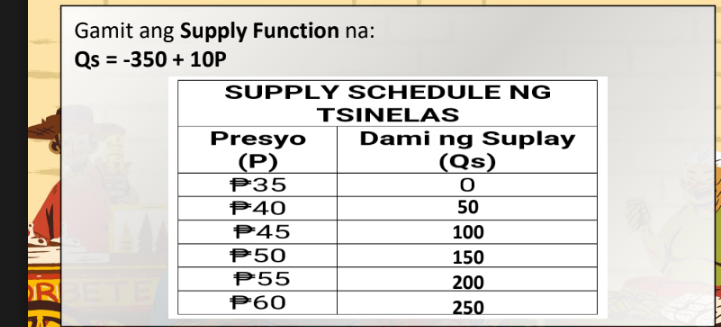
supply schedule
a table which shows the relationship of price and quantity (P AND Qs)
price the producer wants the consumers to buy at.

supply curve
a curve or straight line on a line graph that shows the relationship of price and quantity, price being at the right.

supply function
the mathematical formula/equation to show the relation between Qs and P.
Qs = a + b(P) (it is addition now)
Qs - quantity supplied
a - intercept (when 0) (no. always negative)
b - slope (which grows as price goes up)
P - price
market supply
the combined value of different supplies given on the table
or sold as a product or service

a