Introduction to Forensic Science (09-04-2026)
Beginning of the class we went over course outline
Said she was gonna add short answers to the exam
guest speakers
SLIDES
Slide 3: Forensic
Latin forensic or ‘forum’ - an open place such as a market or a public forum such as a court
It originally applied to the rectangiular shaped marketplace area in the centre of ancient Rome known as the Forum Magnum, or spimply the Forum
Slide 4: Forensic Science called criminalistics in the U.S
'“The application of scientific methods to analyze physical evidence associated with civil or criminal breaches of law
Slide 5/6/7/8/9/10/11 History of Crime Scene Investigation
Song Ci (1186-1249): Wrote Xi Yuan Ji Lu (Collected Cases of Injustice Rectified or “Washing Away of Wrongs”)
Flies attracted to blood on a scikle resulted in a murder confession
This book also offered advice on determining if a death was a suicide, murder, or accident
Slide 6
Medical - Coroner’s investigations or inquests were mandatory in China in 1174
1209 Pope Innocent III - authorized medical doctors to peform autopsies for legal purposes, reversing the church’s previous ruling on not violating a corpse
Medical Investigation tended to focus on the body (deceased) and not on the crime scene
Slide 7
Sir Robert Peel (1788-1850): Created a force known as “bobbies,” and defined the ethical requirements of police officers known as the “Peelian principles”.
Auguste Ambroise Tardieu (1818-1879): Preeminent forensic medical scientist of the mid-nineteenth century.
Allan Pinkerton (1819-1884): Appointed as Chicago’s first detective. This was the first known functional separation of investigations from patrol.
Slide 8
Toxicology
• Mathieu Orfila (1787 – 1853):
initialized the systematic toxicology investigation of human organs (1814)
moved the ‘body’ as the key focus of evidence to additional information obtained from the lab. (Anderson, 2004, p. 318)
Slide 9
Sir Arthur Conan Doyle (1859-1930)
Known for his advancement in the work of crime scene investigation
Creator of Sherlock Holmes, the fictional private detective
Slide 10
1859 - Professor Henry Croft testified in an Ontario court concerning the death of Sarah King, poisoned by her husband (Dr. William King)
This trial marked the first time forensic evidence was introduced into a Canadian court of law (Dalby, 2007, p. 29)
Slide 11
Hans (1847-1915): Author of the first dissertation concerning the application of scientific disciplines to the field of criminal investigation
1893 - GrossGross (Austria) published “Handbuch fur Untersuchungsrichter als System der Kriminalistik” translation of title “Handbook for examining magistrates as a system of criminology”
1906 - English publication in 1906 as “Criminal Investigation”
Slide 12
Shifted the medical-coroner’s body- centred approach of inquiry used in the morgue to include information from the scene & laboratory.
Strong advocate for application of the scientific method within investigations
Key importance - it defined the scene as a distinct analytical space with explicit (scientific) rules of practice.
Set the stage for further development of forensic science beyond the medical mind set of the ‘body’ as the scene.
Slide 13
Edmond Locard (1877-1966): In 1910 started first Police Laboratory in France.
Locard’s Exchange Principle – Whenever two objects come into contact with one another, there is a cross-transfer of evidence.
This process stated that every crime scene could be connected to a criminal, witness, and victim, and vice versa.
Slide 14
Paul Leland Kirk (1902 - 1970): Chemist and forensic scientist known for his work on blood spatter evidence
Sam Sheppard homicide case - inspires the movei and television series “The Fugitive”
Slide 15

Slide 16
Dr. Wilfred Derome (1877 – 1931) spent a year studying forensic medicine at the Sorbonne in Paris in 1907-1908.
When Locard established a Lab in France, (1910) Derome began work at the Montreal morgue.
He wanted to set up a system of forensic investigation similar to the one he had observed in France.
Slide 17

Slide 18

Slide 19
1942 in Ottawa
1957 in Sackville, NB
1963 in Vancouver
1967 in Edmonton
1970 in Winnipeg
1978 in Halifax
1979 Counterfeit and Document Examination Sections are established in Montreal
Slide 20
Location
Ottawa
Edmonton
Surrey (Vancouver)
Slide 21
Forensic crime laboratory: “a scientific laboratory that examines physical evidence in criminal matters and provides reports and opinion testimony with respect to such physical evidence in courts of law” (Dutelle, 2022, p. 101
Slide 22
Forensic scientist in Canada
Criminalist in the USA
Both work in laboratories
Both use the application of scientific methods to analyze physical evidence and provide conclusions, opinions, or interpretations about their findings
Slide 23
Investigate: to make a systematic examination or to conduct an official inquiry.
Crime: an act or the commission of an act that is forbidden by a public law and that makes the offender liable to punishment by the law (Dutelle, 2022, p. 3)
Slide 24
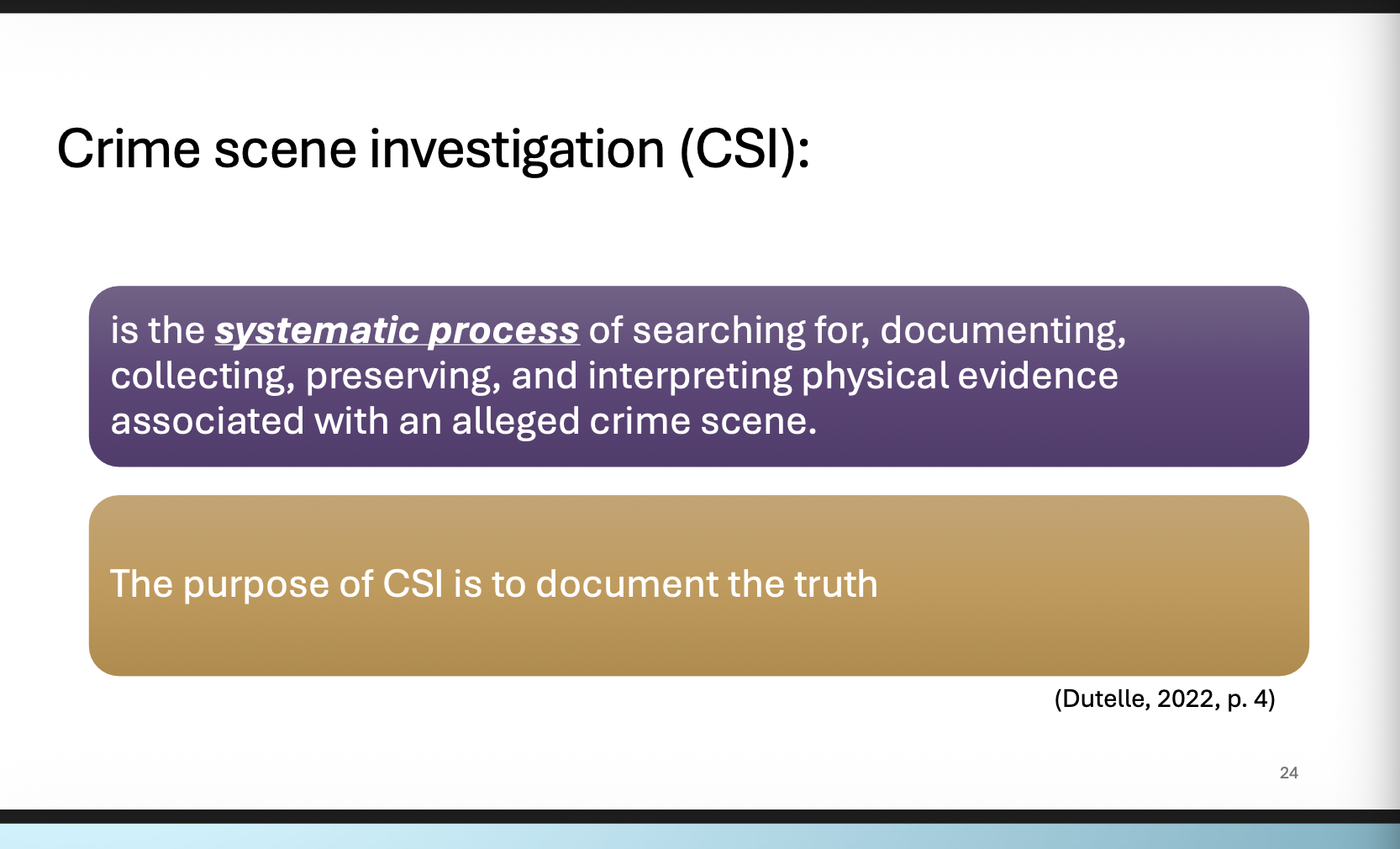
Slide 26 Objectives of Csi
Determine if a crime has been committed
Discovery and documentation of all facts
Identify and eliminate suspects by collecting physical and testimonial evidfence
locate and apprehend the perpetrator
Maintain aproper
Slide 25

Slide 27

Slide 28

Slide 29

Slide 30/31


Slide 35

Slide 36

Slide 37
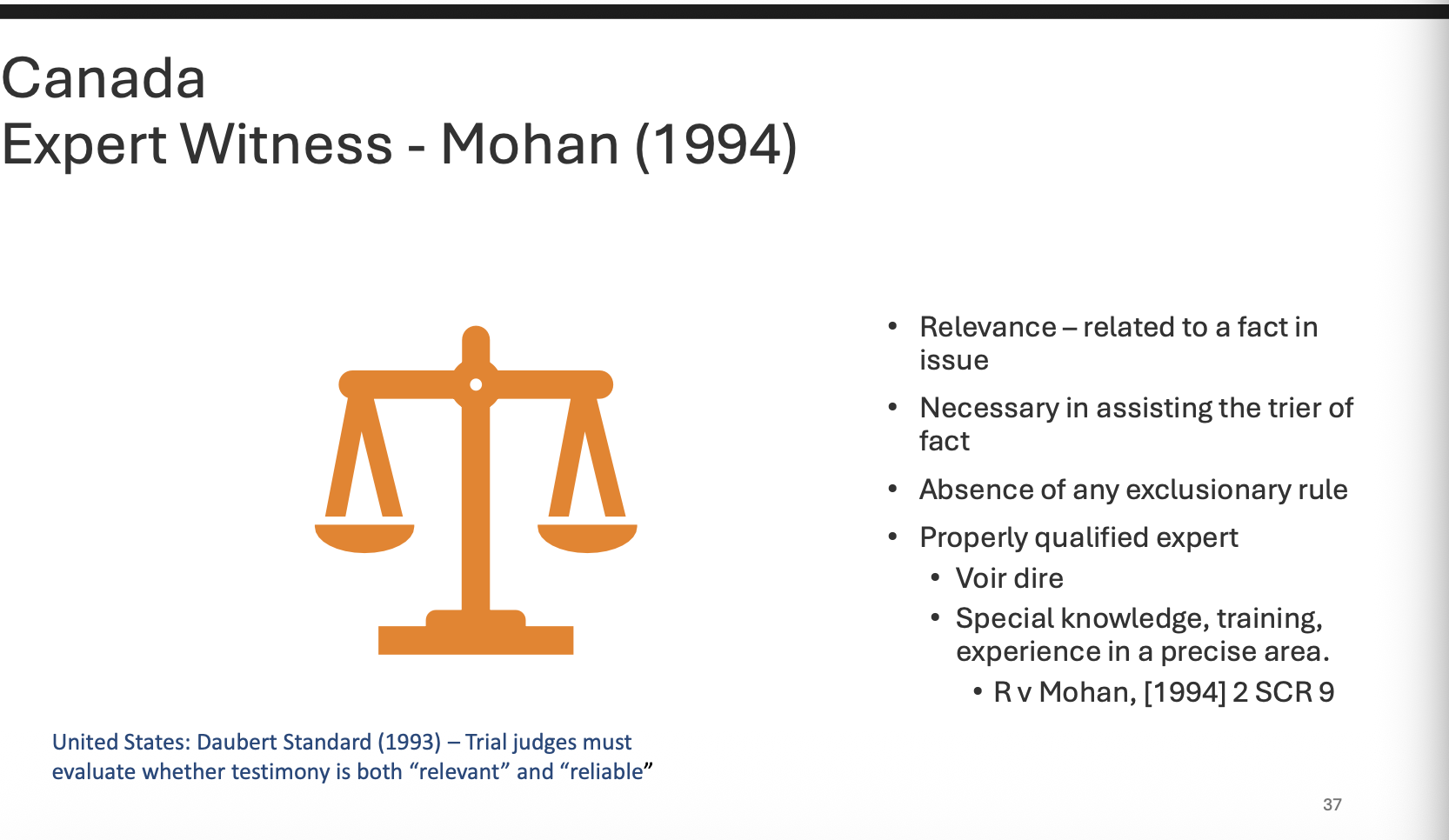
Charged with sexual assault
Put on trial
The first offence was pedophilia
the fourth sexual psychopath
case law came with rules that they meet in trials
know the requirements the case no
Slide 38

Evidence is based on weight
clean evidence - is evidence that is obtained that is uses correct protocols by the agency
continuity - the important piece of evidence where its been
know the three factors
Slide 39-40
