Comprehensive Study Guide on Quality of Life, Globalization, and Sustainability
Quality of Life: Conceptual Foundations and Core Dimensions
Definition of Quality of Life:
- Quality of life is defined verbatim as the standard of health, comfort, and happiness experienced by an individual or group.
- It reflects how livable an environment is and encompasses both subjective well-being and objective material conditions.
- Because individuals prioritize different aspects of daily existence, perceptions of what constitutes an acceptable quality of life vary significantly between communities, nations, and cultures.
Four Core Categories of Quality of Life Issues:
- Economic Issues: Complex problems that involve money, wealth, employment, or people's access to things they need or want in life.
- Social Issues: Complex problems that involve education, health, equality, population, and other factors that influence people's opportunities in society.
- Political Issues: Complex problems that involve how people make decisions in groups, encompassing government structures, laws, human rights, civic participation, and safety.
- Environmental Issues: Complex problems that involve people's interactions with the natural world, including land use, water use, energy production, resource depletion, and climate systems.
Wealth Versus Income in Shaping Living Standards:
- Income: Refers specifically to the money received or earned on a continuous basis as a result of work, employment, or investments.
- Wealth: Refers to the total accumulation of money, possessions, property, and assets gathered by a person over the course of their lifetime.
- Application to Essential Services (Healthcare):
- Financial resources permit individuals to relocate to geographic regions where specialized medical professionals, advanced hospitals, and comprehensive pharmacies are readily accessible.
- Wealth allows for the purchase of private health insurance covering preventative medicine, prescription pharmaceuticals, optometry, and specialized dental care.
- At a societal level, greater personal wealth and higher income generate higher tax revenues, enabling governments to invest in public medical infrastructure, modern medical technology, clinical research, and competitive wages for healthcare practitioners.
- Application to Public Safety (Crime Reduction):
- Higher personal and community financial capacity allows for private security measures (such as alarm installations, surveillance, and gated architecture).
- Municipal tax bases fund professional policing, judicial apparatuses, community outreach programs, and crime-deterrence infrastructure.
Measuring Quality of Life: Indices and Development Models
Empirical Comparison of Livability:
- Evaluating quality of life requires empirical indicators to compare the livability of different geographic locations.
- Using a broad combination of indicators yields a more reliable and accurate assessment of living conditions than relying on a single metric.
The Quality of Life Index:
- This composite index is generated using direct survey and observational data gathered from the general population rather than purely official government statistics.
- It calculates overall livability based on seven core factors:
- Safety and crime rates.
- Healthcare quality and accessibility.
- Consumer prices.
- Purchasing power of citizens.
- Traffic commute times and public transit efficiency.
- Pollution levels (air, water, and environmental cleanliness).
- Property price-to-income ratio (housing affordability).
The Human Development Index (HDI):
- Developed to measure development through human capability rather than financial productivity alone.
- Core Metrics:
- Life Expectancy Index: The average age an individual is expected to live based on current mortality rates.
- Access to Education: Measured through adult literacy rates, school enrollment ratios, and expected years of schooling.
- GDP per Capita: The total monetary value of all goods and services produced in a country over one year divided by its total population, reflecting average wealth production per person.
- Scoring Scale and Tiers:
- Scores range between and , with higher values indicating superior quality of life.
- No country registers an absolute score of , as all nations maintain baseline levels of health, literacy, and commerce.
- Very High Human Development: Scores between and .
- High Human Development: Scores between and .
- Medium Human Development: Scores between and .
- Low Human Development: Scores between and .

Sample HDI Country Rankings and Scores:
- Iceland: ()
- Norway: ()
- Switzerland: ()
- Denmark: ()
- Germany: ()
- Sweden: ()
- Australia: ()
- Netherlands: ()
- Hong Kong: ()
- Belgium: ()
- Ireland: ()
- Finland: ()
- Singapore: ()
- United Kingdom: ()
- United Arab Emirates: ()
- Canada: () (historical table lists Canada at )
- Liechtenstein: ()
- Comparative scores across diverse regions: Poland (), Malaysia (), Philippines (), Iran (), Bangladesh (), Zambia ().
Additional International Quality of Life Indicators:
- Freedom House Rating: Measures the status of political rights and civil liberties enjoyed by individuals within a state.
- Infant Mortality Rate: Measures the number of infants who die before reaching age one per live births.
- Oil Consumption per Capita: Measures annual individual energy consumption ().
- Internet Users: Measures access to digital communications, news, and services per people.
The Economic Model: MEDCs, LEDCs, and the Global Divide
Structural Classifications:
- More Economically Developed Countries (MEDCs): Characterized by high industrial capacity, diversified service economies, substantial material wealth, and strong standards of living.
- Less Economically Developed Countries (LEDCs): Characterized by agricultural or primary-sector dependence, lower capital reserves, weaker economic institutions, and depressed living standards.
- The North/South Divide: The geographical observation that the majority of MEDCs are located in the Northern Hemisphere, whereas LEDCs are concentrated in the Southern Hemisphere.
Core-Periphery Analytical Framework:
- Old Core: Highly industrialized, historically dominant nations with longstanding wealth (e.g., Canada, Germany).
- New Core: Rapidly industrializing nations with growing global influence and modernizing infrastructure (e.g., Poland, South Korea).
- Near Core: Developing nations showing economic growth but constrained by structural or social disparities (e.g., Indonesia, Philippines).
- Periphery: Economically vulnerable nations with limited capital, high poverty, and severe resource exploitation (e.g., Bangladesh, Zambia).
Comparative Demographic and Socio-Economic Metrics:
- Birth Rate: MEDCs exhibit low rates ( births per population); LEDCs exhibit high rates ( births per population).
- Death Rate: Low in MEDCs due to modern medicine, sanitation, and nutrition; high in LEDCs due to infectious disease outbreaks, malnutrition, and healthcare deficits.
- Rate of Natural Increase: Under in MEDCs; ranges between and (or higher) in LEDCs.
- Infant and Child Mortality: Infrequent in MEDCs, where very few children die before age five. In LEDCs, an acute proportion die before age five, with approximately infants dying every day globally from malnutrition, waterborne contamination, and lack of medical intervention.
- Doctor-to-Patient Ratio: MEDC populations have broad access to primary and emergency physicians. In LEDCs, medical access is restricted to the wealthy or urban elites.
- Housing Conditions: MEDCs provide insulated housing with connected electricity, plumbing, and potable water. LEDCs feature widespread informal settlements and shanty towns lacking running water, power grids, or structural stability.
- Literacy Rates: High in MEDCs via universal, publicly funded primary and secondary schooling. Low in LEDCs due to prohibitive school fees, child labor requirements, and deficits of trained educators.
- Gross National Product (GNP): High-income MEDCs generate GNPs exceeding per capita (predominantly across North America, Europe, Australasia, and Japan). The poorest LEDCs report GNPs below per capita (predominantly across sub-Saharan Africa and South Asia).

Historical and Projected GDP Per Capita Data (Visual Capitalist / IMF):
- Year 2000 Baselines: Luxembourg (), Japan (), Switzerland (), Norway (), United States (), Iceland (), UAE (), Denmark (), Qatar (), Sweden (), Great Britain (), Bahamas (), Netherlands (), Ireland (), Hong Kong ().
- Year 2026 Projections: Luxembourg (), Ireland (), Switzerland (), Iceland (), Singapore (), Norway (), United States (), Denmark (), Netherlands (), Macao (), Australia (), Sweden (), Israel (), Qatar (), Austria ().
Historical Innovations and Quality of Life:
- Throughout history, technical innovations and societal concepts have systematically altered human survival and daily well-being.
- Medical Innovations: Scientific discoveries such as mass-produced vaccines (for example, the calf-lymph-derived Dryvax smallpox vaccine) eradicated lethal pathogens and increased global life expectancies.
- Complex Scientific Innovations (The Manhattan Project):
- A massive, wartime research and development enterprise that engineered the first nuclear weapons.
- Intended Purpose: Accelerate the swift conclusion of the Second World War.
- Negative Consequences: Unprecedented physical devastation of targeted populations, prolonged geopolitical existential terror, and nuclear arms proliferation throughout the Cold War.
- Positive Spin-offs: Technological breakthroughs in nuclear power generation, medical radiation diagnostics, and industrial radioisotope applications.

Globalization: Conceptual Framework and the Five Dimensions
Definition of Globalization:
- The expansion of global interconnectedness resulting in a more unified world.
- Characterized by greater interdependence, trade, and exchange among the world's peoples, economies, and political systems.
The Global Village:
- A conceptualization of the world as a singular community where advances in telecommunications, transit, and commerce have collapsed distance and dismantled geographic isolation.
- As nations interact regularly, cultural, commercial, and operational practices harmonize, producing shared ways of life.

The Five Dimensions of Globalization:
- 1. Cultural Globalization:
- The gradual homogenization (blending) of world cultures into uniform practices and shared lifestyle habits.
- Frequently threatens local, ancestral traditions as standardized Western consumer attitudes, fast-food chains, entertainment media, and fashion are adopted globally.
- Linguistic Homogenization (English Worldwide, 2026 Projections):
- Around people speak English as either a first or second language.
- Approximately speak English as their primary native tongue.
- English holds official legal status across sovereign nations and non-sovereign entities.
- countries mandate English within their core educational curricula, while additional nations offer it as an elective course.
- 2. Economic Globalization:
- The structural integration of international economic networks, financial markets, and production circuits.
- Facilitates frictionless cross-border mobility of commodities, manufactured consumer products, capital investment, labor, and industrial raw materials.
- Interlinks national equity markets and foreign exchange networks, synchronizing economic expansions and recessions across borders.
- Global Supply Chain Integration: Illustrated by common consumer goods assembled via multilateral inputs (e.g., T-shirts made in India, Mexican dining franchises operating globally, Japanese optical cameras, Korean headwear, East Timorese fair-trade coffee, Australian leather belts, Belgian confections, Finnish telecommunications devices, Chinese textiles and backpacks, Italian leather boots, and American entertainment software).
- 3. Environmental Globalization:
- The alignment of international attitudes, conservation policies, and legal frameworks targeting resource management and ecological crises.
- Involves multilateral agreements that recognize ecological issues as borderless phenomena (e.g., the United Nations Paris Climate Agreement).
- Manifests through transnational environmental movements and youth climate strikes demanding cohesive decarbonization policies.
- 4. Political Globalization:
- The adoption of comparable governing systems, diplomatic institutions, and collective decision-making protocols across sovereign boundaries.
- Fosters multilateral forums (such as G7, G20, and UN summits) where international leaders coordinate economic, trade, and defense regulations.
- Involves cross-border political discourse and alignment between ideological factions (e.g., international party coordination and diplomatic visits, such as U.S. political figures meeting European party leaders to discuss shared stances on free expression and coalition building).
- 5. Technological Globalization:
- The rapid proliferation of digital communication networks, computing power, and information architectures across the globe.
- Driven by widespread internet access, satellite communications, mobile smart devices, and social media ecosystems, enabling real-time international information transfer.
- 1. Cultural Globalization:
Case Study: The Hyper-Globalization of Dubai:
- Dubai represents an accelerated transition from an isolated regional trading post into a premier global commercial, logistical, and architectural metropolis.
- Strategic transformation centered on establishing free trade zones, world-class aviation hubs, luxury tourism infrastructure (such as the Burj Al Arab and Burj Khalifa), and finance centers to deliberately reduce dependency on oil extraction.
Analyzing Perspectives, Bias, and Stakeholder Interests
Stakeholder Perspectives on Global Issues:
- Perspective: A particular attitude toward or way of regarding an issue; a subjective point of view.
- Appraising the consequences of globalization requires examining how policies affect diverse demographic groups.
- Key Factors Shaping Perspective:
- Socio-Economic Status: An individual's ranking within a society, determined by educational attainment, income brackets, parental occupation, and place of residence.
- Lived Experiences: The cumulative background of an individual, including age, gender, ethnic identity, geographic residence, travel history, schooling, and personal exposure to conflict or cooperation.
Case Example: Proposed Diamond Mine in Northern Canada:
- Local Resident Perspective: Views mining operations favorably because the industrial investment creates employment, elevates household wages, and generates localized economic growth.
- Environmentalist Perspective: Expresses acute concern regarding ecosystem disruption, landscape scarring, water contamination, and destructive impacts on wildlife migration corridors.
- Indigenous Community Perspective: Expresses concern over cultural displacement, territorial encroachment, and the permanent disruption of ancestral hunting grounds.
Differentiating Fact, Opinion, and Bias:
- Fact: Knowledge that is certain, objective, and verifiable through direct empirical observation, data collection, or measurement; facts cannot be distorted by personal feelings.
- Interpretive Variance: While a fact remains objectively fixed, opposing stakeholders can interpret it to reach conflicting conclusions.
- Example: "The human population is approximately people and is expanding at an annual rate of ".
- Environmentalist Interpretation: Mass starvation and resource collapse are inevitable because arable cropland is nearly exhausted.
- Agricultural Scientist Interpretation: Emerging biotechnological breakthroughs and precision farming will continually scale yields to feed the growing population.
- Opinion: A judgment, interpretation, or belief that is not grounded in proof or absolute certainty; inherently subjective and derived from personal beliefs, lived experiences, and internalized morals.
- Values: The fundamental moral principles, ethical baselines, and philosophical standards that guide an individual's behavior and decisions.
- Bias: A systematic preference, partiality, or prejudice for or against an idea, individual, group, or policy.
- Bias distorts information by omitting inconvenient evidence, exaggerating select points, or presenting subjective arguments as settled objective reality.
- Fact: Knowledge that is certain, objective, and verifiable through direct empirical observation, data collection, or measurement; facts cannot be distorted by personal feelings.
Analytical Checklist for Detecting Bias:
- Identify the author or publishing entity and determine their underlying motives or financial interests.
- Determine whether the author had close personal, institutional, or ideological proximity to the event.
- Examine if the narrative relies solely on one-sided evidence while dismissing counter-perspectives.
- Be skeptical of proposed solutions that oversimplify complex systemic problems.
- Identify manipulative emotional appeals designed to provoke fear, anger, or sympathy.
- Check for the presence of derogatory stereotypes or sweeping cultural generalizations.
- Evaluate whether equal analytical weight and charity are applied to opposing arguments.
The Globalization Debate: Systemic Trade-Offs
Economic Domain:
- Benefits: Proliferation of international trade agreements; lower consumer prices for manufactured goods; expanded aggregate wealth; wider consumer variety; expanded employment in manufacturing and logistics sectors.
- Challenges: Systematic labor exploitation in LEDCs lacking workplace regulations; erosion of national sovereignty over domestic raw materials; prevalence of hazardous, sweatshop working conditions; domestic job losses in MEDCs via industrial outsourcing; diminished viability of local independent businesses facing multinational retail conglomerates.
Environmental Domain:
- Benefits: Establishment of unified environmental priorities; execution of multilateral climate treaties (such as the Paris Agreement); cross-border research and sharing of conservation techniques; collective focus on ecological sustainability.
- Challenges: Weakening of environmental regulations by developing governments competing for foreign industrial investment; elevated carbon emissions from transoceanic freight; large-scale soil, air, and marine pollution; depletion of potable freshwater reserves; unsustainable resource consumption to satisfy global energy demands.
Political Domain:
- Benefits: Structural harmonization toward representative governance; multilateral cooperation that reduces military hostilities between economically intertwined nations; expansion of civil rights frameworks and anti-discrimination laws.
- Challenges: Persistence of illegal child labor within international export supply lines; political disenfranchisement of sovereign governments dominated by multinational corporate pressure; expanded organizational capabilities for international extremist networks and state-sponsored cyber warfare.
Social and Cultural Domain:
- Benefits: Transfer of modern clinical healthcare standards and disease treatments to developing regions; international dissemination of academic curricula and scientific research; access to digital educational and communications software.
- Challenges: Accelerated erosion of indigenous traditions, linguistic diversity, and regional heritage; high financial costs of building modern public sanitation systems; failure of LEDCs to implement modern technologies due to deficient electrical and telecommunications infrastructure.
Sustainability and Environmental Worldviews
Defining Sustainability:
- Sustainability is defined as the ability to meet our own current needs without compromising the ability of future generations to meet their own needs.
- Philosophical Underpinning (Aldo Leopold): "We don’t inherit the earth from our parents - we borrow it from our children."
- This ethic asserts that humanity acts as custodians of the biosphere, obligated to return planetary systems in an uncompromised condition to future generations.
Worldview:
- A comprehensive collection of attitudes, values, narratives, and expectations regarding the world, which unconsciously informs every human thought, evaluation, and action.
- Determines how an individual or culture processes philosophical debates, political decisions, ecological management, and religious doctrines.
The Anthropocentric Worldview:
- A human-centered philosophy asserting that human beings are the rightful owners, managers, and controllers of the natural world.
- Non-human organisms, habitats, and materials possess no intrinsic worth; their value is determined exclusively by their utility to humans.
- The Expansionist View: An aggressive branch of anthropocentrism asserting that the systematic exploitation of nature is justified because it creates wealth and drives economic growth.
- Expansionists hold that ecological limits and resource scarcities are minor issues that can be resolved through technical innovation and market-driven managerial improvements.

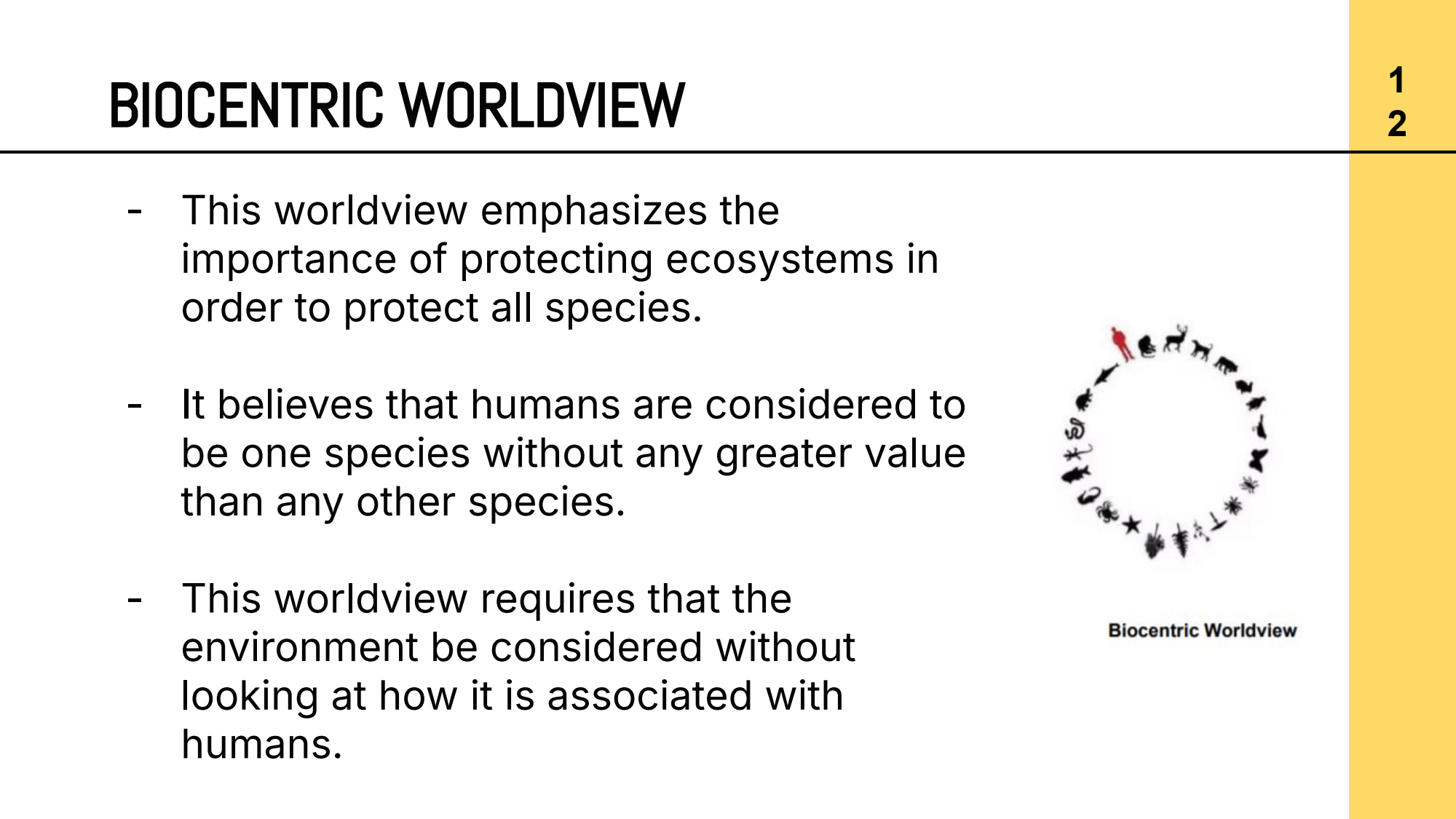
- The Biocentric Worldview:
- A life-centered philosophy asserting that all living species hold intrinsic value regardless of their usefulness to human beings.
- Human beings are viewed as one species among many within an interconnected ecological network, possessing no superior moral claim to planetary resources.
- Mandates that ecosystems must be evaluated and protected on their own merits rather than for human exploitation.
- The Ecological View: A branch of biocentrism holding that nature must be preserved, revered, and defended against exploitation and subjugation.
- Support for the ecological worldview has expanded due to mounting scientific evidence surrounding global climate change and biodiversity loss.
- The Pragmatic Dual Reality:
- Most individuals do not adhere exclusively to a purely anthropocentric or biocentric philosophy; instead, they navigate an operational compromise between the two.
- Everyday Example: An individual may conscientiously practice home recycling and commute via bicycle to minimize emissions, yet simultaneously support regional resource extraction (such as petroleum drilling or timber operations) to safeguard local employment and maintain community tax bases.
The Three Pillars of Sustainability
Interdependence of Systems:
- True sustainability extends beyond simple ecological preservation; it requires balance across three mutually dependent pillars: environmental, social, and economic.
- If any single pillar fails, the broader socio-economic structure collapses, rendering long-term sustainability impossible.
1. Environmental Sustainability:
- Governs the prudent extraction and management of both renewable (timber, fisheries, freshwater) and non-renewable (fossil fuels, minerals) natural assets.
- Requires that humans avoid depleting ecological reserves beyond natural regeneration rates, ensuring that these resources and their ecological services remain available indefinitely.
2. Social Sustainability:
- Governs how individuals, families, and communities organize daily life, civic choices, and cultural practices.
- Requires individuals to make difficult lifestyle adjustments (such as repurposing goods, decreasing waste streams, and curbing consumerism) for the collective good.
- Demands that every human being has equitable access to the basic necessities of life, including nutrition, potable water, safe shelter, healthcare, and human dignity.
3. Economic Sustainability:
- Focuses on balancing conservation initiatives with economic health, ensuring that green policies do not cause widespread financial collapse.
- Involves restructuring markets to pursue sustainability while preserving employment, maintaining stable consumer pricing, and supporting the industrial development of economically depressed regions.
Planetary Boundaries: Scarcity, Ecological Footprints, and Biocapacity
Resource Scarcity:
- Occurs when critical, finite resources (such as potable water, arable soil, crude petroleum, or minerals) become increasingly difficult to locate, extract, and distribute.
- Systemic Consequences of Severe Resource Scarcity:
- Sharp reductions in global industrial productivity and real economic contraction.
- Erosion of human rights standards as states compete for remaining assets.
- Resurgence of aggressive nationalism, protectionism, and border militarization.
- Spreading civil unrest, political polarization, and armed regional conflicts.
- Escalating cost-of-living expenses and higher taxes for citizens of MEDCs, lowering their standard of living.
- Forced societal momentum toward alternative energy sources and sustainable development.
Ecological Footprint:
- An environmental accounting tool that measures the total impact of human activity on the biosphere.
- Calculates the total surface area of productive land and water required to produce all the resources an individual or population consumes and to absorb all the waste generated.
- Core Component Subcategories:
- Cropland footprint (production of human food and fiber).
- Pasture footprint (grazing livestock for meat, dairy, and leather).
- Forest products footprint (harvesting timber, pulp, and fuelwood).
- Fisheries footprint (harvesting marine and freshwater organisms).
- Carbon footprint (forest area required to absorb anthropogenic greenhouse gas emissions).
- Built-up land footprint (soil covered by physical infrastructure, transit lines, and housing).
Biocapacity:
- The biological capacity of an ecosystem, nation, or the planet to generate a continuous supply of renewable resources and absorb human-generated wastes (especially carbon dioxide emissions).
- The Global Ecological Imbalance: Current human consumption rates far exceed the biosphere's regenerative limits.
- Consumption Example: If every human consumed resources at the average Canadian rate, humanity would require to supply the inputs and absorb the associated waste.
Earth Overshoot Day (EOD):
- The specific calendar day each year when humanity's aggregate ecological resource demand exceeds the planet's total biological regenerative capacity for that calendar year.
- For the remainder of the calendar year past this date, humanity operates in an ecological deficit by liquidating resource stocks (depleting fisheries, cutting forests, extracting groundwater) and accumulating atmospheric carbon dioxide.
Sustainable Development and the UN 2030 Agenda
The Concept of Sustainable Development:
- Defined as meeting human development goals while preserving the capacity of natural ecosystems to provide the resources and ecosystem services upon which society and the economy depend.
- Informally translated as "living life while also saving for a rainy day."
- The Development Paradox: True sustainability cannot be attained globally unless developing nations experience economic expansion to alleviate poverty. However, if the entire global population adopts the resource-intensive consumption standards of MEDCs, the biosphere faces ecological collapse.
The United Nations 2030 Agenda for Sustainable Development:
- Adopted unanimously by all United Nations Member States in 2015 as a shared blueprint for international peace, human well-being, and planetary stability.
- Establishes that eradicating severe poverty and social deprivations must be pursued alongside policies that expand education, improve healthcare, address inequality, and grow economies, all while confronting climate change and protecting marine and terrestrial ecosystems.
Historical Precursors: The Millennium Development Goals (MDGs):
- An earlier development agenda composed of 8 central targets:
- 1. Eradicate extreme poverty and hunger.
- 2. Achieve universal primary education.
- 3. Promote gender equality and empower women.
- 4. Reduce child mortality.
- 5. Improve maternal health.
- 6. Combat HIV/AIDS, malaria, and tuberculosis.
- 7. Ensure environmental sustainability.
- 8. Develop a global partnership for development.
- An earlier development agenda composed of 8 central targets:

- The 17 Sustainable Development Goals (SDGs):
- Goal 1: No Poverty: End poverty in all its forms everywhere.
- Goal 2: Zero Hunger: End hunger, achieve food security and improved nutrition, and promote sustainable agriculture.
- Goal 3: Good Health and Well-Being: Ensure healthy lives and promote well-being for all at all ages.
- Goal 4: Quality Education: Ensure inclusive and equitable quality education and promote lifelong learning opportunities for all.
- Goal 5: Gender Equality: Achieve gender equality and empower all women and girls.
- Goal 6: Clean Water and Sanitation: Ensure availability and sustainable management of water and sanitation for all.
- Goal 7: Affordable and Clean Energy: Ensure access to affordable, reliable, sustainable, and modern energy for all.
- Goal 8: Decent Work and Economic Growth: Promote sustained, inclusive, and sustainable economic growth, full and productive employment, and decent work for all.
- Goal 9: Industry, Innovation, and Infrastructure: Build resilient infrastructure, promote inclusive and sustainable industrialization, and foster innovation.
- Goal 10: Reduced Inequalities: Reduce inequality within and among countries.
- Goal 11: Sustainable Cities and Communities: Make cities and human settlements inclusive, safe, resilient, and sustainable.
- Goal 12: Responsible Consumption and Production: Ensure sustainable consumption and production patterns.
- Goal 13: Climate Action: Take urgent action to combat climate change and its impacts.
- Goal 14: Life Below Water: Conserve and sustainably use the oceans, seas, and marine resources for sustainable development.
- Goal 15: Life on Land: Protect, restore, and promote sustainable use of terrestrial ecosystems, sustainably manage forests, combat desertification, halt and reverse land degradation, and halt biodiversity loss.
- Goal 16: Peace, Justice, and Strong Institutions: Promote peaceful and inclusive societies for sustainable development, provide access to justice for all, and build effective, accountable, and inclusive institutions at all levels.
- Goal 17: Partnerships for the Goals: Strengthen the means of implementation and revitalize the global partnership for sustainable development.