4. Social integration
Slides
How to measure it?
attitudes: e.g. social distance (would you accept [group] as close relative/ friend/ neighbor etc)
reported interethnic contact in different situations
outcomes e.g. intermarriage
(inter-faith marriages are more difficult)
Interethnic partnership
Partner choice shaped by:
Preferences - cultural similarity, shared lifestyles, lang and mutual understanding of certain issues
Third parties - group identification and sense of belonging // group sanctioning of undesirable behav (by family/ church/ community)
said to oppose intermarriage to maintain internal cohesion and homogeneity of group
2 main mechanisms
social control (group pressure and sanctions)
group identification and internalization of group norms
Opportunity structure - occasions to meet members of dif groups
2nd gen face competing push&pull pressures
family tries to keep kids tied to ethnic/ religious communities through parental control and primary socialization (modelling/instruction)
exposure to host society facilitates cultural assimilation and adoption of values
→ integration may come at the cost of strained rel. w. parents!
Song (2009) - Is intermarriage a good indicator of integration?
intermarriage is said to be indicator of integration and signal lessening of social distance bet. groups
must also consider interethnic dating & cohabitation
marriage is regarded as a mechanism for the transmission of ethnically specific cultural values and practices to the next generation, intermarriage may fundamentally affect the boundaries and distinctiveness of ethnic minority group
If rates of intermarriage continue to rise (such as between Asian Americans and White Americans), then the identifiable ‘monoracial’ populations may decline and be absorbed in the mainstream an outcome which may meet with mixed feelings on the part of both the White majority and the minority
intermarriage is constrained by factors like group size, segregation, socioeconomic and cultural barriers
intermarriage is facilitated by opportunity structres
2nd gen minority are more likely to intermarry than their immigrant parents
Education and class
Robert Merton - exchange theory
educated African Americans tried to maximise their gains through marriage: ethnic minorities who married majority (White) members effectively traded their high socio-economic status (as indicated by educational attainment) for the social status attached to a White marriage partner.
minority spouses would possess higher levels of education or occupational status than their White spouses
college-educated [minority] men and women are more likely to marry interracially than those with less education
the growth of the African American middle class signalled the declining significance of race for many middle-class Blacks*that those with college educations and professional jobs were less likely to encounter overt racism, in comparison with working class Black Americans
intermarriage is more likely among the middle class, for Whites and for minorities, and that intermarriage (e.g. between White and Black Americans or between White and Asian Americans) does not appear to involve tradeoffs of socio-economic status for race or ethnic status
Spouses tend to marry others with similar educational levels, whether within or outside their group - view based on the belief that, because college education promotes greater tolerance for difference and facilitates contact among groups that may not have had previous contact (e.g. in racially segregated neighbourhoods), college and higher education are consistent with higher rates of intermarriage
rates of intermarriage vary according to different opportunity structures in meeting co-ethnic potential partners → regional differences in ethnic composition are key
members of an ethnic group are less likely to intermarry if they have a large selection of co-ethnic dating partners
“I think this emphasis upon a pool of co-ethnic partners who differ by nativity*a second-generation Chinese American, for example, partnering with a newly arrived Chinese immigrant*is questionable, given the differences in outlook between new immigrants and their second- or thirdgeneration co-ethnics, some of whom may view new immigrants (even co-ethnic immigrants) as very different to themselves“
Residential integration and segregation
where do people live and how diverse are the neighborhoods
Gender
for both native- and foreign-born Asian Americans, women are much more likely to intermarry (especially with White men) than their Asian American male counterparts
The opposite pattern is shown by African American men, who 336 M. Song partner with White women at much higher rates than African American women
The link between intermarriage and integration
The criteria by which a union is counted as ‘intermarriage’ can vary across states → what is intermarriage then?
Studies across countries lack a standardisation of methods in recording and describing patterns of intermarriage
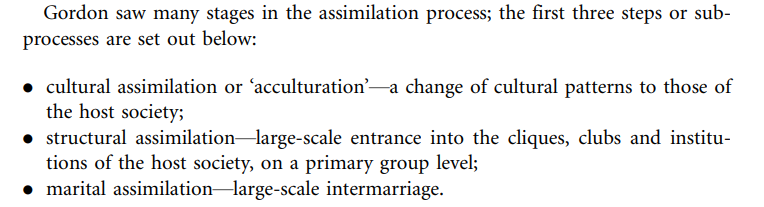
Gordon (1964) assumes that structural assimilation will either accompany or follow cultural assimilation (‘acculturation’) but, as argued in ‘segmented assimilation’ theory (Portes and Zhou 1993), acculturation and upward economic mobility can be de-coupled. One can achieve upward mobility on the basis of limited acculturation (the deliberate retention of ethnic traits, practices and ties).
It is also often implied that intermarriage leads to fuller integration for the minority spouse. This argument, though, is largely speculative, and simply assumes a kind of wholesale cultural assimilation of the minority spouse into the White mainstream.
So while intermarriage may be said to herald a form of structural assimilation in terms of one’s status and formal inclusion in certain families and social networks and institutions, we cannot assume that minority individuals (or couples) who have intermarried necessarily feel welcomed, or that they ‘belong’, in many mainstream settings. Nor should we assume that an interracial partnership is automatically devoid of prejudice or racism within the couple relationship or the wider family network (or indeed the wider society)
+ just as marriage into a White mainstream family does not guarantee a warm welcome and social acceptance, the experiences of ‘mixed race’ offspring may be highly variable, with some experiencing their mixedness in predominantly positive ways, while others may perceive prejudice and various barriers because of their mixed ancestry
Intermarriage (with White people) is assumed to mean a loss of cultural distinctiveness by the minority group.
Some couples may practice a hybrid family culture, with a principled commitment to valuing both heritages; in some cases the culture of the minority spouse may even be dominant (at least in the home)
low rates of intermarriage have often been interpreted as an indicator of the maintenance of strong ethnic identities
Conclusions
We should be careful about interpreting high rates of intermarriage (with Whites) as an indicator of a minority group’s ‘success’ and inclusion. It seems that intermarriage, while revealing the declining social distance between the majority and certain minority groups, can also entail a complex co-mingling of economic and social integration and marginalisation.
rising intermarriage rates may suggest racial boundaries are weakening
The growth of interethnic marriages, in which Korean Americans may, for example, marry Chinese Americans, is also likely to be of growing importance (Tuan 1998). There is some evidence that second- and third-generation Asian Americans feel a great deal of commonality with one another, based on their common racialisation (and treatment) as ‘Asian’ in the wider society → are they integrated? probably yes, even w/o a white partner