Ch. 3:
Rate: Carrier’s charge
Transportation regulation at its peak; use “rate”
Found in the rate book
Regulation
Before the 90s, all traffic was published by law
Changing a rate required regulatory approval
Rate is made carrier costs only and not by market
Post-deregulation, prices are driven by market price
Carrier cost still a major force
Between customer demand and carrier supply conditions
No more regulations
Market Considerations
Behaviour
Number of competitors
Degree of prod. differentiation
Barriers to entry
Principal models
Perfect (Pure) competition: large range of sellers, no influence over prices/supply, unrestricted, homogeneous product.
Monopolistic Market: One seller, no alts, restricted entry, max profits
Oligopoly market: Few large sellers, alts, competitor reaction
Transportation in general, but modes varies
Monopolistic Competition: few small sellers, some differentiation, single firm can’t control market
Airlines
Mix of pure and oligopoly
Contestable (challenge it)
Market Areas
Mode-specific
Route-specific
Commodity-specific
Shipment size-specific
Pricing
Cost of Service Pricing: Customer covers all costs, seller has degree of prices (to max profit), only one group of customers with similar service, transport service output is homogeneous
Don’t really consider
Value of prod
Risks
Marginal Cost: producing each unit of output, not good for small quantities, may fluctuate
Average: Cost divided by total output, common costs are high

Value of Service Pricing
According to product value
: Lambo vs Toyota
More risk
Understand between market and demand
AKA third degree price discrimination and differentiation pricing
Same service, but separation because of value of goods

Segmentation: By commodity, time (season), place and individual person (legal)

Rates Making in Practice
Class:
Geographic locations
Proximity, distance
Interstate Commerce Commission
Commodity: Similar characteristics assigned to classification/rating
ICC: develops rate per dollar per hundred weight
Classification factors
Prod density
Handlng
Liability
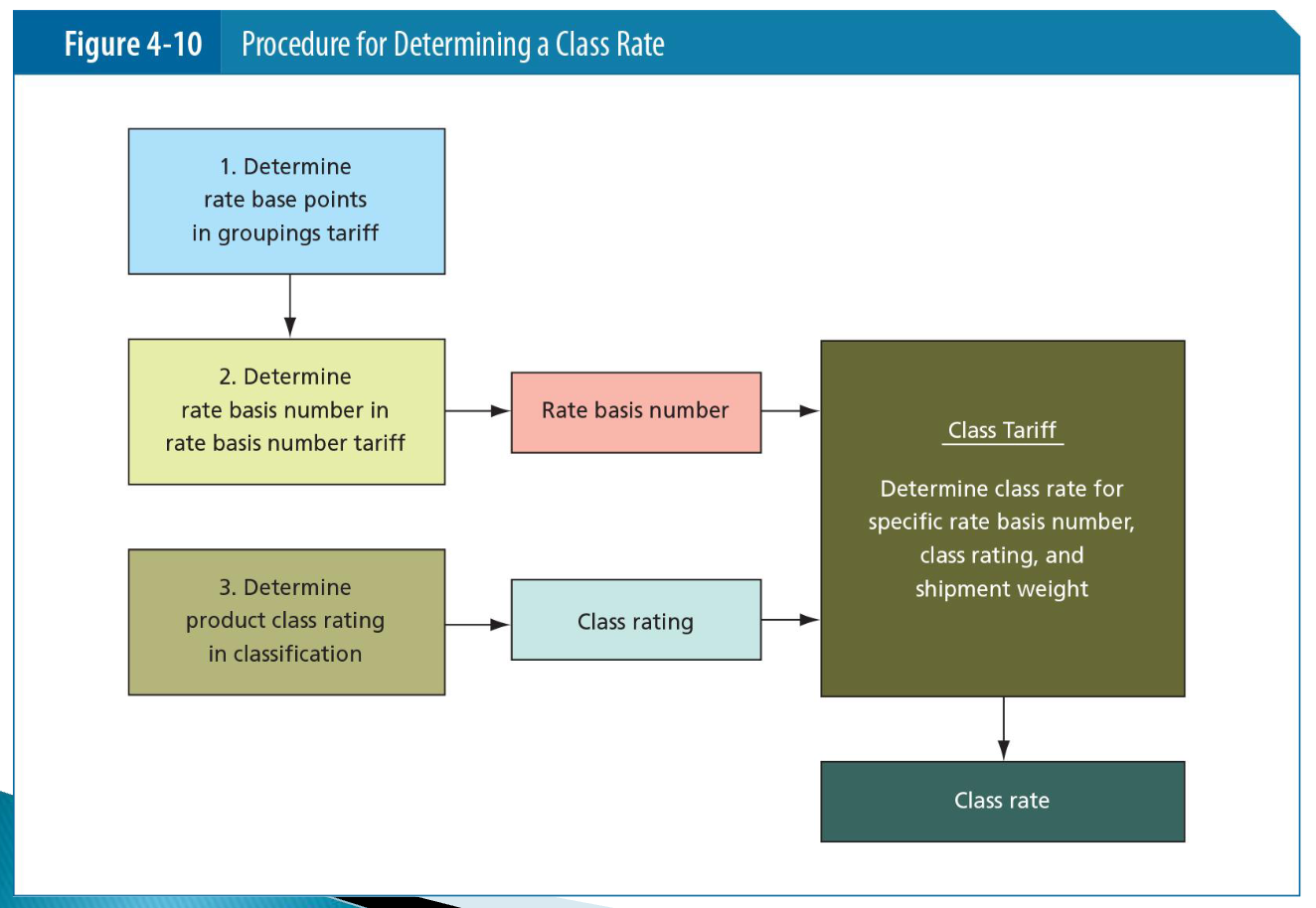
Class Rate:
1. Determine rate basis points for origin/destination
2. Determine rate basis number (rate basis number tariff)
3. Determine commodity classification rating
4. Determine rate from class rate tariff
5. Multiply class rate by shipment weight in cw
So the computation for the total shipping charges as follow:
Shipment weight per 100 weight (cwt)=11,000/100 = 110 cwt
Shipping charges at class rate= $8.46/cwt x 110 cwt = $93.06
Exception Rate: Individual carriers modifies national class based on diff factors
Competition, prod specification
Commodity Rate: Most common for frequent large volume route
Not part of commodity classification system
Takes precedence over class and exception rates
Other kinds of rates
Zip code
Mileage
Character of Shipment Rates
LTL/TL Rates (motor carriers)
Multiple-Car Rates (rail carriers)
Incentive Rates (usually apply only to weight or units loaded over and above the normally shipped quantities)
Unit-Train Rates (often used by rail carriers for trailer on flatcar [TOFC] or container on flatcar [COFC] movements)
Per-Car and Per-Truckload Rates
Any-Quantity Rates (usually found with large, bulky commodities)
Density Rates (common in air container shipments)