P5 (1844-1877)
13th Amendment: abolished slavery → caused sharecropping system
14th Amendment: everyone is a citizen & equal protection of rights of citizens
15th Amendment: african american males can vote/black male suffrage
America Party/Know Nothing: anti immigrgant anti catholic party
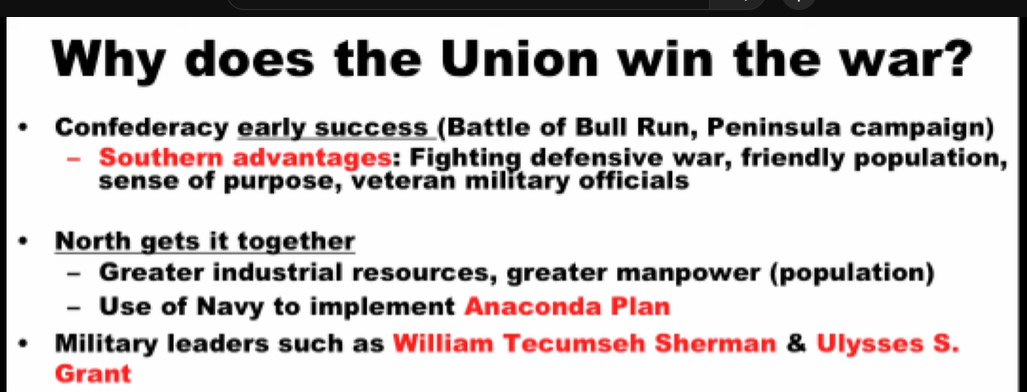
Anaconda Plan: north uses navy to blockade and strangle south to submission in civil war
Annexation of Texas: Manifest Destiny, James Polk expanded into this and Oregon → Led to Mex-Am war, annexed by john tyler
Antietam: 1862, prevent foreign intervention (on side of confederacy) & emancipation announced → war about ending secession AND slavery
Battle of Gettysburg: 1863, stop confederate attack on union soil
Battle of Little Big Horn: 1876, Sioux tribe (sitting bull) kill custer and men in 7th Cavalry (custer’s land stand)
Battle of Vicksburg: 1863, ulysesses grant wins control of mississippi river
Bessemer Process: method for producing steel by blowing air to remove impurities, mass production of steel, enabled faster infrastructure
Black Codes: after civil war, guarantee stable labor supply now that black people were emancipated, sharecropping system → prohibited af-am to buy land, forced to sign labor contracts, penalty for breaking contract, can’t vote or be on jury
Bleeding Kansas: pro slavery vs antislavery forces engage in mini civil war. sack of lawrence. pottwatomie creek. Topeka (free soil) vs lecompton (pro slavery)
California Gold Rush: 1848-1850s, gold brought thousands of settlers westward, more shops & facilities westward
Carpetbaggers and Scalawags: Southern democrats used to describe politilcal opps (northerners & republican southerners) in reconstruction
Charles Sumner Canning of Senator Brooks: Sumner beat up by Brooks over slavery issues in Congrerss
Chinese Immigration: driven by gold rush and railroad labor, western states, faced discrimination
Civil War: union vs confederacy, bloodiest domestic war, freed 4 million enslaved Af-Ams, Second American Revolution
Clipper Ships: allow for faster travel and boost US trade with asia
Comstock Lode: 1859, nevada silver and gold deposits → encourage westward expansion
Compromise of 1850: california free state, no slave trade in DC< popular sovereignty decided slavery elsewhere, strict fugitive slave law
Compromise of 1877: informal unwritten deal over Republican Rutherford B Hayes and Samuel Tilden democrat presidential election due to electoral fraud. Hayes won. ended reconstruction as troops removed in south
Confederacy: 7 southern states that seceded to preserve slavery, fought defensive war against union & lincoln, king cotton, generals Robert E Lee & Stonewall jackson
Decimation of Buffalo: impacted by westward expansion, undermines native american resistance, make way for railroads, demand for buffalo hides
Dred Scott v Sanford (1857): african-ams not citizens. slaves are property (cant be taken away without due process, 5th amendment), congress could not ban slavery
Election of 1844: Manifest Destiny election, James Polk beat Henry Clay campaigning on 54 40 or fight
Election of 1860: Lincoln wins even though no southern state voted for him, platform against spread of slavery→ caused secession
Emancipation Proclamation: lincoln announces emancipation, changes purpose of war (against secession and slavery), help keeps europe away, union gains new african american soldiers, moral cause of north
Ethnic Communities: irish settled in cities, tightknit Catholic laborers. German settled in midwest/urban, established bars, diverse. Chinese: west, mined gold and worked railroad, Chinatowns. Mexican: Southwest, had rights but were ignored, laborers
Failure of Reconstruction: southern white resistance, waning northern will, compromise of 1877 ended it
Free Soil Party: political party with purpose of stopping expansion in slavery in western territories. “free soil, free labor, free men” free homsteads
Freedman’s Bureau: reconstruction act, welfare agency towards black people and poor white, education
Fugitive Slave Act of 1850: controversial in north. mandated all escaped slaves to be returned to masters even in free states. free states protect slaves
Gadsden Purchase: land purchased in southwest from mexico in 1853 for building railroad (modern New Mex & Arizona)
German Immigrants: diverse, northwest, tightknit, alcohol
Gettysburg Address: Lincoln Speech redefining civil war as a struggle to preserve union and declare true equality and freedom for all
Grandfather Clauses: post reconstruction, southern mechanisms to disenfranchise african american voteers → age test, literacy tests, poll taxes, intimidation
Harriet Beecher Stowe's Uncle Tom's Cabin: 1852, fueled northern anti-slavery movement
Homestead Act: 1862, offers public land to any person who farms it for 5 years → ppl move west
Homefront Opposition: domestic opposition towards mex-am war (whigs against) and civil war (peace democrats, rich man’s war)
Impeachment of Andrew Johnson: first impeached. removed secratary of war in 1968, put on trial, house immediately voted
Irish Potato Famine: caused irish immigration towards American cities, irish worked in laborer jobs, democrats
Jim Crow Laws: segregation in south
John Brown's Raid on Harpers Ferry: sparks slave revolt in 1859 by seizing federal arsenal on ship, south fear & secession
Kansas Nebraska Act: 1954. slavery would be decided by popular sovereignity. repeals missouri compromise, potentially opening up slavery north of 36,30. opposed in north
Know Nothing Party: group of american nativistfs, advocate for immigration restrictions
Ku Klux Klan: white supremacy group, resist reconstruction govt., violence against African Americans
Lee's Surrender at Appomattox Courthouse: 1865, General E Lee confederacy surrendered to Union Ulysses S Grant after fall of richmond. end of confederate war effort
Lenient vs. Harsh Penalties for South: “heal” and unite nation: Lincoln’s 10% Plan vs Reconstruction Acts (military oversee South), Enforcement acts, amendments
Lincoln-Douglas Debates: Illinois senate race, lincoln lost but gained national fame & eloquency
Lincoln's House Divided Speech: took public stand against slavery expansion, gained Northern interest, warn nation would either be fully slave or fully free
Lincoln’s Ten Percent Reconstruction Plan: state could rejoin union when 10% of voters pledged allegiance & abolished slavery
Manifest Destiny: it was america’s destiny to conquer and civilize entire continent, built upon white superiority ((civilize others)
Mexican American War: caused by border disputes (Mex nueces riveer vs polk rio grande) → General Zachary Taylor moved towards rio grande. war fought oveer mexican territory.
Mexican Cession: US took possession of California & New mex for $15mil → party of treaty of guadalupe hidalgo
Moderate Republican: lincoln’s moderate views restoring union & basic civil rights
Morill Tarriff: high protective tariff used to raise revenue for union and protect northern industry
Mormon Migration: 1847. From NY, brigham young brings mormons seeking religious refuge
Nativists: against immigrgants, take job from “native-born” americans, view immigrants as Catholics & drunks, would get outvoted
Northern Conscription Act: first federal draft in US history, male citizens drafted in union army → class conflict
Oil Drilling: birth of oil industry in 1850s, industrial revolution
Oregon Treaty 1846: 49th parallel, (54’ 40 or fight), take over oregon territory
Ostend Manifesto: Secret plan by southerners to buy cuba from spain and turn it into slave states, opposed by free soilers
Pacific Railway Act: authorized building of transcontinental railroad alon a northern route, connected USA → provided subsidies by fed govt.
Plessy v. Ferguson: 1896, segregation was constitutional as long as it was “separate but equal”
Pony Express: mail service bridging communication gap in USA, Manifest Destiny & westward expansion
Positive Social Good Proslavery Argument: necessary evil, gave necessities to enslaved people, civilized Africans, treated better than northern factory workers
Radical Republicans: advocated for immediate abolition of slavery, full civil rights for formerly enslaved, harsh penalties for southern states
Reconstruction: unionize and reform country after civil war, marked with conflict, lenient & harsh punishment
Reconstruction Amendments: 13th, 14th, 15th
Reservation System: federal system confining native american tribes to specific isolated lands and forcing assimilation
Sand Creek Massacre: 1864, Colorado militia attack and kill over 100 natives (2/3rds native and women)
Secession of Southern States: 7 southern states leave office
Second Party System: Whig Party & Know Nothing collapse under kansas-nebraska act. republican party (sectional) opposed to slavery in North & Midwest
Sharecropping: use land in exchange for giving percent of crop to owner of land, exploited African Americans in South after 13th amendment, own only labor
Sherman's March to the Sea: 1864, Sherman (union) leads march of deliberate destruction throughout south. strategy: destroy southern environment & infrastructure → surrender
Southern Secession: 11 southern states secede due to elction of Abraham Lincoln in order to protect instutitional slavery. SC, MS, FL, AL, GA, LA, TX (Deep south) and then VA, AR,NC,TN
Tammany Hall: patronage, Boss Tweed, tight group of politicans in NYC that controlled votes, city jobs, and municipal contracts
Tenant Farming: Reconstruction era agricultural system, enslaved ppl or poor whites would own land and items in exchange for crops, more independence than sharecropping
Transcontinental Railroad: national railroad built by immigrants, funded by fed govt to connect USA and expand markets
Treaty of Guadalupe Hidalgo: ends Mexican American War 1848 → mexico loses california, new mexico, & southwest to usa. hispanic residents of California were guaranteed property & citizenship rights
Treaty of Wanghia (1844): diplomatic agreement between USA and China Qing Dynasty. Caleb Cushing, President John Tyler. US expand foreign policy & commerce into Asia, access to five major chinese treaty ports, proper treatment of shipwrecked sailors. missionaries go to china to spread christanity
US v Cruikshank (1873): ruled 14th amendment prohibited states, not individuals, from violating civil rights. after colfax massacre where white militia killed black men.
War Democrats and Peace Democrats: supported Lincoln’s war vs anti war/negotiation with confederacy
Wilmot Proviso: Mexican-American war effect, attempt by Northerners to ban slavery in any territory gained from war, rejected by southerners
Writ of Habeas corpus: suspended by lincoln in 1863 (unconstitutional) during civil war, growth of federal power; why? protect union in civil war by allowing military to arrest enemy ACTUAL FUNCTION: protected against unlawful imprisonment
54th Regiment: one of first african american units in US history, led by massachusetts governor, frederick lee douglas, assaulted Fort Wagner