carbohydrates - lecture 2
glycolysis- starts with glucose ends with purvate
know -
many of the enzymes are reversible so thermondynamically neutral
control points - hexokinase step phoso-fructokinase step purvate kinase step - these steps are not reversible - these enzymes are rate limiting - they act as the controlers
2 activation steps for glucose
glucose transporter is usually reversible so you need to do something to hold it in the cell - add a phosphate
the second phosphate creates a high energy molecule so you can split it in two
this means 2 atp are required in the beginning steps
phosphoglycerine kinase and the purvate kinase both yield an atp molecules
for every glucose u get a yield of two atps and nadh which is recycled
alot of enzymes also use nad
the redox ratio of this is important
too much nadh - glycolysis will slow down
purvate is a three carbon molecules looks alot like amino acid alanine except its missing the amino group - this can be controlled by amino acid supply - link between amino acid consumption and glycolysis
you cannot make glucose from fats only from three carbon molecules
glycolysis
1 hexokinase this reaction is in the forward direction - the phosphate gets put on the sixth position of the hydroxyl - the phosphate is tranfered from atp - keeps the glucose in the cell
glucokinase - an issoenzyme of hexokinase - will not slow down very insenstive to glucose-6-phosphate levels - levels can build way up and this reaction wont stop
this enzyme is controlled by insulin and glucagon
regulator of this enzyme - transcription factor called - hypoxia inducable factor (1, alpha ) thsi enzyme controls the production of these enzymes in glycolysis
rearrangment in glycolysis - from six member ring to five member ring - phosphoglusoeisomerase
start with gluose -6- phosphate
change to glucose 6-phosphate- open ring form
change to fructose 6 - phosphate - open ring form
finally get fructose -6-phosphate in the ring from
u started with pyran ring end with a furano ring
this is a nessacary step before the ring is split
fructose -6- phosphate + atp (phophofructosekinase)→ reversibly - fructose 1,6-biphosphate - this is Second Key enzyme in control of glycolytic flux- this enzyme is activated by fructose 2,6- biphosphate
phosphofructose kinase PFK is composed of four indivdual subunits - it has binding sites which are not within the active site of the enzyme which either slow this reaction down or speed it up
PFK is an allosteric enzyme- controlled by ATP, Fructose -2,6-biphosphate( from a side reaction), citrate- also senstive to insulin and glucagen ratio and HIF
check slides - understand charts
step 10 of glycolysis
Third Key enzyme in control of glycolytic flux – pyruvate kinase
(i) Covalent modification (less active phosphorylated)
(ii) Product inhibition (immediate and longterm)
(iii) Allosteric modulation (e.g. activated by fructose-1,6-bisphosphate ie. a positive feed forward for this)
(iv) Abundance sensitive to insulin/glucagon ratio and HIF
it is inhibited by atp because if the cell has lots of energy there is no need to make more glucose
phosphrulation important in controlling this enzyme - inhibts the enzyme
high glucise → de phosphurlation
low glucose → phosphuraltion
problems with nad
if u have lots of glyclysis in the cell ur going to have mostly the reduced form of nad - nadh and ur going to have too much nadh
glycolysis then stops at the step - phosphate dehydrenase step
best way to keep this going is to metabolise the purvate making nadh→ nad +
yeast do this by making ethanol
humans make lactate instead
this reaction is as follows in yeast :
pyruvate( pyruvate decarboxlase) → acetaldyde(alcohol dehydrogenase) → ethanol
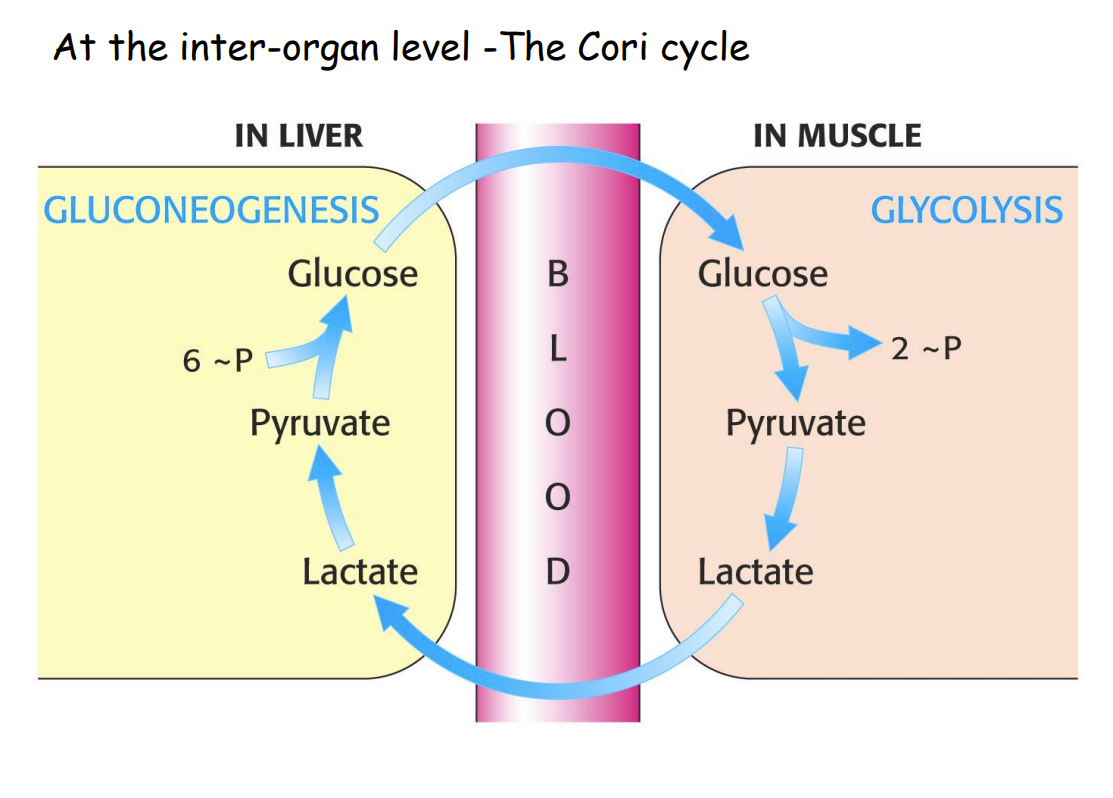
hypoxia - the state of low oxygen - occurs during exercise - relies on gllucose fro energy - the production of lactate replenishes the nad + levels in the body
trasncription factor - HIF 1, alpha - controls the abundance hexokinase phospho fructose kinase purvate kinase- it is a hypoxia inducing factor - it controls the glucose consumption
factors effecting glycolysis
insulin
HIF 1, alpha
kinetic mechansims - hexokinase has a low v max
these reactions are none equilibrative
because these are atp consuming steps they are hard to reverse
compartmentalisation
stravation
adrenaline
glucokinase - a liver specific enzyme
Factors that effect control of Glycolytic Flux
1. Enzyme abundance: Hormones/Transcription/Translation
e.g. insulin:glucagon ratio; HNF’s; HIF
2. Enzyme kinetics: allosteric enzyme e.g. phosphofructose kinase,
e.g. Hexokinase low Vmax, non-equilibrium reactions
3. Thermodynamic favourability e.g. hexokinase/ATP consumed,
essentially irreversible = committed step and gives directionality
4. Covalent modification e.g. phosphorylation of pyruvate kinase
insulin:glucagon ratio on enzyme activity
5. Compartmentalization e.g. cytosol versus mitochondria
6. Redox state e.g. NAD+/NADH2
7. Physiological situation: e.g. starvation or adrenalin
8. Isoenzyme e.g. glucokinase
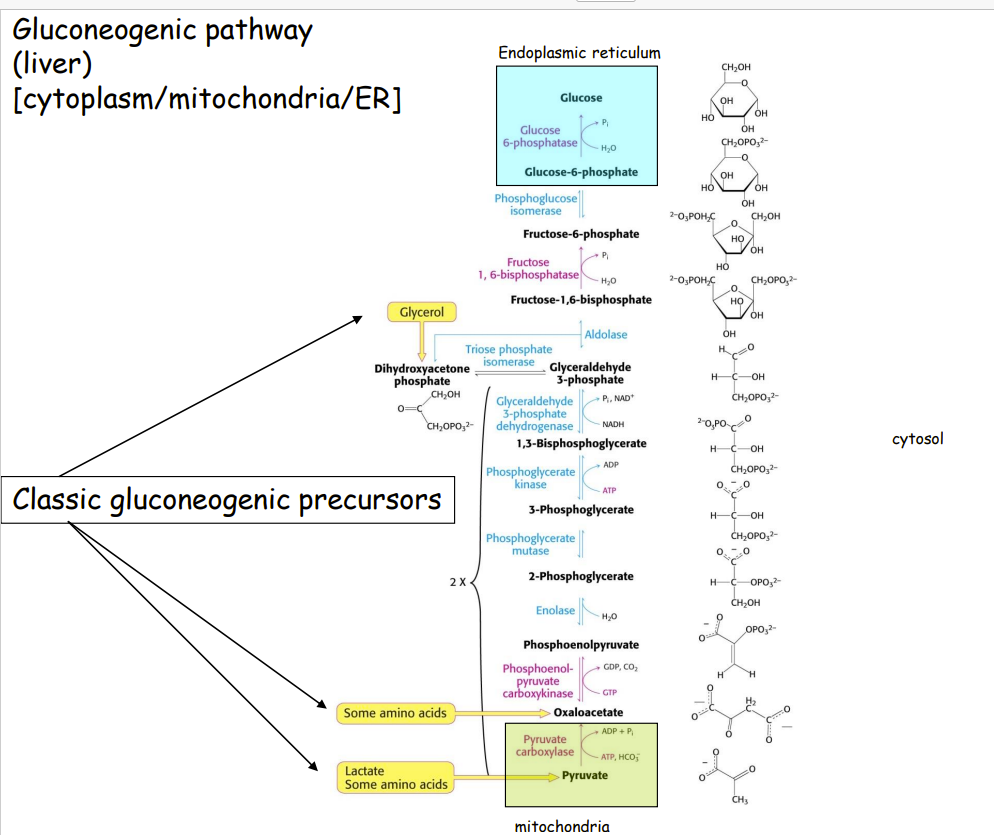
gluconeogenisis - synthesis of glucose
the opposite of glycolysis
hypoxia → HIF-1 activated→ blood vessel growth / metabolic adaption increase in glycotic enzymes
red blood cells and brain cells rly need glucose
7 of the ten step of glycolysis are conserved
purvate carboxylate instead of - kinase
fructose 1,6- phosphotase
glyco-6-phosphotase
lacate and amino acids can be used to make sugar
this is a very energy dependent pathway - uses energy from the fats
substrate cycling - you dont have to change much for a massive change in end point
rapid response mechanism important flux stragedy
fats
fats provide glycerol - from the triacylglycerides (TG)
glycerol( glycerol kinase) → glycerol phosphate → glycerol phosphate dehydrogenase)→ dihydroxyacetone phosphate
TG’s are the storage form of fat in white adipose tissue
this final step occurs in the endoplasmic reticulum
even small amounts of fructose 2,56 biphosphate can cause glycolysis
Which enzyme catalyzes the transfer of a phosphate group to the sixth position of glucose during the initial steps of glycolysis?
A) Glucokinase
B) Hexokinase
C) Phosphofructokinase
D) Phosphoglycerine kinase
What is the primary role of fructose-2,6-bisphosphate in regulating glycolysis?
A) Inhibition of pyruvate kinase
B) Activation of phosphofructokinase
C) Inducing hexokinase activity
D) Inhibiting glucose transporters
Which enzyme's activity is primarily influenced by insulin and glucagon levels?
A) Phosphoglycerine kinase
B) Glucokinase
C) Pyruvate kinase
D) Phosphofructokinase
During intense exercise, what metabolite is produced in muscle cells to regenerate NAD+ levels under low oxygen conditions?
A) Ethanol
B) Acetaldehyde
C) Lactate
D) Pyruvate
What is the fate of pyruvate in yeast during anaerobic conditions?
A) Converted to acetaldehyde
B) Converted to lactate
C) Converted to ethanol
D) Converted to acetate
Which factor influences the rate of glycolysis by controlling the abundance of key glycolytic enzymes?
A) Insulin only
B) Hormonal factors
C) Redox state
D) Kinetic mechanisms
What does the abbreviation "HIF" stand for in the context of glycolysis regulation?
A) Hormonal Inducing Factor
B) Hypoxic Inhibition Factor
C) Hypoxia Inducible Factor
D) High Insulin Feedback
Which enzyme is liver-specific and part of the initial steps of glycolysis?
A) Hexokinase
B) Phosphofructokinase
C) Glucokinase
D) Pyruvate kinase
How does glucokinase differ from hexokinase?
A) It is inhibited by glucose-6-phosphate levels.
B) It is sensitive to insulin and glucagon.
C) It has a high Vmax and is insensitive to glucose-6-phosphate levels.
D) It primarily functions in muscle cells.
Which situation is likely to decrease the rate of glycolysis?
A) Increased insulin to glucagon ratio
B) Elevated levels of NADH
C) Activation of HIF-1 alpha
D) Increased abundance of pyruvate kinase
What is the end product of glycolysis?
A) Pyruvate
B) Acetyl-CoA
C) Lactate
D) Fructose
What role does lactate play in glycolysis during hypoxic conditions?
A) It replenishes NAD+ levels.
B) It activates hexokinase.
C) It inhibits phosphofructokinase.
D) It enhances glucose transport.
Which step in glycolysis is regulated by covalent modification through phosphorylation/dephosphorylation?
A) Phosphofructokinase
B) Pyruvate kinase
C) Hexokinase
D) Phosphoglycerine kinase
How does the redox ratio (NAD+/NADH) affect glycolysis?
A) Higher NADH accelerates glycolysis.
B) Lower NADH slows down glycolysis.
C) Equilibrium in redox ratio enhances glycolysis.
D) NADH levels have no impact on glycolysis.
What does HIF-1 alpha primarily regulate in glycolysis?
A) Hexokinase activity
B) Phosphofructokinase abundance
C) Pyruvate kinase levels
D) All key enzymes involved in glycolysis
How is glucose transported into the cell before glycolysis?
A) Through reversible glucose transporters
B) By converting glucose to fructose
C) By adding a phosphate group to glucose
D) By activating glucokinase
During gluconeogenesis, what molecule can be used to synthesize glucose?
A) Pyruvate
B) Glycerol
C) Lactate
D) Acetyl-CoA
Which enzyme is liver-specific and catalyzes the final steps of gluconeogenesis?
A) Fructose-1,6-phosphatase
B) Glycogen phosphorylase
C) Glucose-6-phosphatase
D) Phosphofructokinase
What role does substrate cycling play in glycolysis regulation?
A) It slows down the process.
B) It amplifies the end-point change.
C) It maintains constant ATP levels.
D) It inhibits pyruvate kinase activity.
Which metabolic pathway contributes glycerol for glycolysis during lipid metabolism?
A) Lipolysis
B) Beta-oxidation
C) Triacylglycerol synthesis
D) Lipogenesis
Certainly! Here's the answer key for the previously provided multiple-choice questions on glycolysis:
B) Hexokinase
B) Activation of phosphofructokinase
C) Pyruvate kinase
C) Lactate
C) Converted to ethanol
B) Hormonal factors
C) Hypoxia Inducible Factor
C) Glucokinase
C) It has a high Vmax and is insensitive to glucose-6-phosphate levels.
B) Elevated levels of NADH
A) Pyruvate
A) It replenishes NAD+ levels.
B) Pyruvate kinase
B) Lower NADH slows down glycolysis.
D) All key enzymes involved in glycolysis
C) By adding a phosphate group to glucose
B) Glycerol
C) Glucose-6-phosphatase
B) It amplifies the end-point change.
A) Lipolysis