orgo ch. 5
•Know all the different types of isomerism
constitutional isomers: same molecular formula but different constitution/connectivity of atoms
stereoisomers: same molecular formula and constitution but different spatial arrangement of atoms
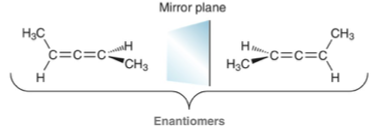
enantiomers: mirror images but not superimposable, same physical properties
diastereomers: not mirror images, not superimposable, different physical properties
cis-trans isomers
compounds w/ multiple chiral centers:
2 chiral centers = 4 possible diastereomers (2 pairs of enantiomers)
3 chiral centers = 8 possible diastereomers (4 pairs of enantiomers)
general rule: when there are n chiral centers, there are 2n diastereomers
only some chiral centers are switched
•Understand, know the definition and be able to identify enantiomers and diastereomers
•Be able to draw the enantiomers and diastereomers of a given compound (are all isomers for a given molecular formula, including stereoisomers)
•Be able to identify chiral centers
chiral center: a carbon atom that is bonded to four different groups, resulting in non-superimposable mirror images
a compound is chiral if:
only one chiral center
no plane of symmetry (usually, but exceptions)
•Be able to designate chiral compounds as R/S
assign priorities to all 4 groups: higher atomic number = higher priority, highest priority is numbered 1, lowest is 4
if groups are similar, priority is determined on first point of difference
double bonds = 2 single bonds (atom counted 2x)
triple bonds = 3 single bonds (atom counted 3x)
rotate molecule so the lowest priority is on a dash: 2 consecutive switches (switch lowest priority with dash, then switch other 2 groups)
determine R and S: look at sequence 1-2-3 (4 at back)
rotate clockwise = R
rotate counterclockwise = S
if lowest priority is on a wedge: look at sequence 3-2-1; clockwise = R, counterclockwise = S
if lowest priority is in the plane: use double switch trick so that lowest priority is on a dash
IUPAC name: configuration of chiral center is indicated at the beginning of the name, between brackets, italicized, and including locant (if necessary)


•Be able to designate alkenes as cis/trans or E/Z (as appropriate)
cis/trans: use if there is a like group on each carbon of the alkene
cis: like groups are on the same side
trans: like groups are on opposite sides
E/Z: use for molecules with different groups attached to the C=C double bond
prioritize groups attached to C=C double bond based on atomic number
if the top priority groups are on the same side of the C=C double bond, it is Z; if the top priority groups are on opposite sides, it is E
•Be able to identify symmetry in molecules and its relationship with chirality (meso compounds)
meso compound: a compound with chiral centers, but is achiral because of symmetry
•Know the different ways of separating enantiomers
‘manual’ separation (Louise Pasteur method): different enantiomers form different shaped crystals, separated by hand using tweezers (doesn’t work for most pairs of enantiomers)
chiral resolving agent: a chiral chemical that can react with the enantiomers to form diastereomers, which have different physical properties and can be separated more easily (distillation, recrystallization, chromatography); can be removed after separation by acid or base
chiral chromatography: column material can be changed to a chiral material, so that it will interact differently with each enantiomer and the enantiomers will not move down the column at the same speed, so they can be separated
•Know how to characterize chirality and enantiomeric excess (optical rotation)
enantiomers will rotate the plane of light to equal degrees but in opposite directions
•Be able to calculate specific rotation and enantiomeric excess


if one enantiomer is present in excess relative to the other, then the mixture will have an optical rotation that is less than the pure enantiomer; remaining rotation is determined by the enantiomeric excess (ee):
ee = % major enantiomer - % minor enantiomer
for unequal amounts of enantiomers, % ee can be determined from the optical rotation:

•Know how to draw and interpret Fisher projections
Know the different types of stereoisomerism that do not have chiral centers
atropisomers: stereoisomers that would be interchangeable through the rotation of a sigma bond, but because the bond is unable to rotate, the different conformations are “stuck” and not interchangeable; have an “axis of chirality” instead of chiral centers
allenes: compounds that possess two adjacent C=C double bonds
if the two groups on each end of the allene are different, then it will be a chiral compound