PSYC1101
PSYC1101 - Foundations of Psychology
January 9, 2025 - Milgram Experiment (1963)
Mantra of Social Psychology: Rather than judging a person for the way they’re acting; Instead, try to understand the power of the situation.
Outgroup Homogeneity Effect - people tend to see members of groups they are not part of as more similar to each other than members of their own group
Design
TOLD: “this is an experiment on ‘the effects of punishment on learning’
ACTUALLY STUDIED: obedience to authority; how much show would a normal person give to an innocent stranger, purely because they are unstructured to do so by an authority figure
Procedure
Teacher/Participant
in control of shock, increasing voltage per incorrect answer
Learner/Confederate - the “lie” of the experiment; acts like a participant but is an actor
assigned to memorize work pairings; connecting to shock device
Results
65% of participants went all the way to 450 volts/XXX
All participants went to at least 300 volts
No identified personality trait; gender not moderator
Alterable Factors
Proximity to authority figure (same room - 65% obedience)
Proximity to learner (put learner’s hand on plate - 30% obedience)
Setting/ Uniform
Social Support (other teachers refused to obey - 10%)
Personal Responsibility (reminded of actions’ consequence - 0% obedience)
January 13, 2025 - Myths
What Psychological Science is Actually For:
Figuring out mental shortcuts and tendencies that are common to virtually all healthy humans. Using knowledge of these tendencies to optimize ourselves and our society.
Meta-Analysis: Type of research that statistically analyzes data from a ton of different empirical studies of the same phenomenon; uses statistical outcomes as data points; one of the strongest forms of scientific evidence.
(A statistical analysis of several prior studies on the same topic)
Contralateral Processing - Example
Left Brain: production and recognition of words
Right Brain: speech prosody and visual processing
Split brain research on patients with severed corpus callosum - Show split face and respond different answers when asked to “Describe vs. Point to Who They See” (Contralateral processing vs hemispheres of brain)
Myths
Birth Order
Astrology
Barnum/Forer Effect - Human characteristics apply to everyone; susceptible for confirmation bias and self-fulfilling prophecy
Mental Illness and Violence
Except for…
persecutory delusions & command hallucinations
grandiosity delusions; mania (increase entitlement; decrease empathy)
Antisocial personality traits (i.e., psychopathy)
Learning visually, audially, physically
January 15, 2025 - Myths & Evolution
Detecting Bullshit… You must think:
Who is telling me this?
How do they know it?
What do they have to gain?
Forer’s Experiment (Barnum/Forer Effect):
Participants took personality test with “personalized results”
All received the same personality description that could apply to anyone
Most rated their description as “highly accurate”
Evolutionary Mismatch: Our cognitive-behavioral instincts evolved to optimize survival of prehistoric living.
Example: We have evolved to avoid being stabbed (vaccinations)
January 16, 2025 - Psych
What is Psychological Science?
Psychology is the scientific study of behaviors (observable) and mental processes (private)
|
William James “The Father of Modern Experimental Psychology” (1842-1910)
Functionalism: psychological processes are best understood by their functional purposes…especially as the purpose pertains to natural selection.
Psychologists are scientists who try to form theories about predictable patterns of human behavior and mental processes
Types of Psychological/Empirical Research (Descriptive, Correlational, Experimental)
1. Descriptive Research: Cannot establish cause and effect relations between variables, but can give insight into new experimental ideas.
Includes:
Naturalistic Observation
Surveys
Case Study (research on one individual; Phineas Gage)
2. Correlational Research
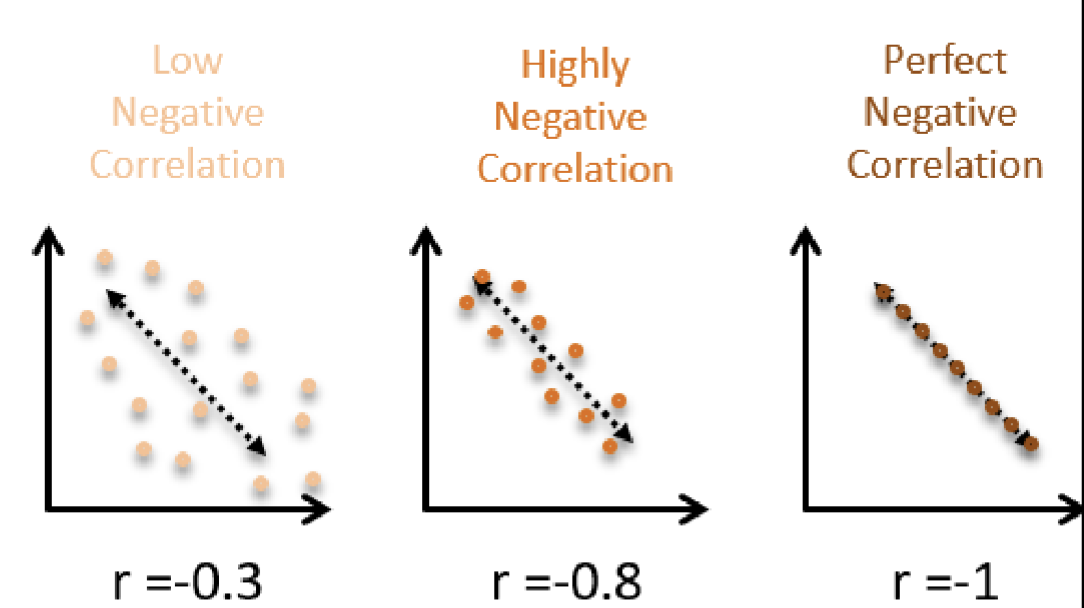
Third Variable Problem: When a secret third variable influences both of the two variables that are significantly correlated
Illusory Correlation: When a real, significant correlation between two variables gives the illusion of a causal relationship between the two variables.
Benefits of Correlational Research
Easy to collect large amounts of data
For some cases, it’s the only option (cancer vs. optimism can’t be assigned)
Offers “hints” about causal relationships, which are assess further with True Experimental Design
3. Experimental Research (True Experimental Design)
One type of study that can determine causality.
Conditions held identical, except for independent variable
January 27, 2025 - Memory
Rest - Primacy Effect (First thing is more memorable than others)
Bed
Nap
Sleep - Never said; this is a “confabulated memory: a memory error that involves creating false memories”
(Deese–Roediger–McDermott Paradigm: a cognitive psychology technique used to study false memories)
Doze
Drowsy
Velociraptor - Pop Out Effect (Dissimilar to other things, so is more memorable)
Blanket
Dream - Recency Effect (Most recent is most memorable)
Slumber
Awake
Repressed Memory: Idea that memories have be repressed in the brain to protect oneself and one’s ego (not 100% proven, as negative emotion queues the survival instinct to remember traumatic memories)
Encoding: the process of committing information to memory (works best when deliberative)
Double-decker BED → Bunk
Money → Bank
Priming: Stuff in memory is brought to the forefront of your mind by a related concept (or triggering in marketing)
Related to…
Associative-Network Model of Memory
Ex. Spreading Activation Theory
psychological theory that explains how the brain stores and retrieves memories
describes the brain as a network of nodes and connections, where activating one node activates related nodes
Levels of Processing Theory of Memory:
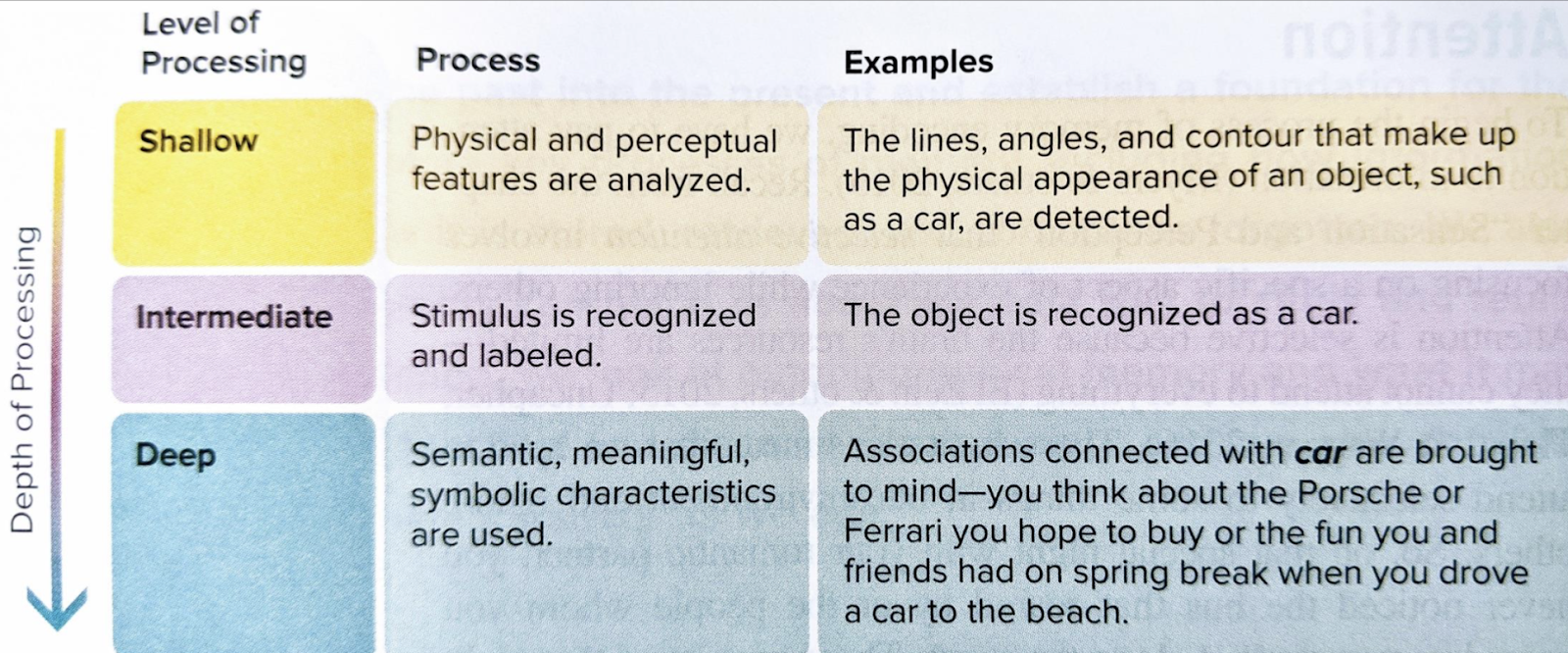
The more deeply we process information, the better we remember it
Self -Reference Effect: One of most effective ways to memorize something is to tie it to long-term memories that relate to The Self
“The brain just wants to keep you alive and get you laid” - Professor John Adams (2025)
January 29, 2025 - Memory
Memory: How You Get It
Parietal Lobe - Perry the Platypus couldn’t be touched
Touch perception, body orientation and sensory discrimination
Occipital Lobe - Occipital Eyes
Sight, visual perception and visual interpretation
Frontal Lobe- Front of the group
Problem solving, speech production, motor control
Temporal Lobe- Temporary
Memory, language comprehension, auditory processing
Brainstem- Movement stems from this
Involuntary Movement
Cerebellum- Double l’s balanced
Balance and Coordination
January 30, 2025 - Memory
Two Types of Long Term Memory
Encoding Specificity (Types)
(Context Dependent Learning)
Scuba study
Two groups memorized a list of words - one group above ground, a second group underwater in scuba gear
Groups recalled more words in the environment they originally memorized in
Couple Fights
When a toxic relationship occurs and arguments happen within one house/location, this location may trigger frustrated feelings and arguments more frequently
(State Dependent Learning)
Adderall
If you study on adderall, you may score better when taking the test on adderall
Couple Fights
When arguing and frustrated, past memories of frustration with your partner will be brought forward
Types of Inference
Proactive Interference: Past information interferes with new information
Ex. You once played golf but now play baseball, and your golf swing now interferes with your baseball swing.
Retroactive Interference: New information interferes with old information
Ex. You once played guitar but are now learning to play piano. Your piano skills now interfere with your ability to play guitar.
NOTE: To remember which is which, the prefixes indicate the direction the arrow is pointing (retro=backwards, pro=forward).
Clap Song Demonstration
(Professor Adams will clap a song rhythm and we have to guess the song without saying anything, and volunteers were shown the song titles beforehand, and then guess the percentage of class that will guess right)
My guesses…
Old Town Road
I don’t know
I don’t know
Actual answers…
Old Town Road 7/80 = 9%
All Star (Shrek) 16/80 = 20%
Party in the USA ???
Result: Volunteers guessed percentages much higher than the actual percentages of the class.
Naïve Realism (one of most important psych concepts)
Constant error in our perception of reality; by default, our brain mistakenly assumes that its subjective perception is a perfect representation of objective reality
*Our perception of reality is not the perception of reality
In context: The songs were obvious to the volunteers having read the titles beforehand, and they believed it would be obvious to the others listening.
Ex.
Psychiatric patients may feel everyone hates them, and naive realism makes this their subjective reality
We may be worried everyone will notice a stain on our shirt, but in reality everyone is worried about themselves and their issues.
February 3, 2025 - Memory
Memory Can’t Really Be Trusted
February 5, 2025 - Bio Psych
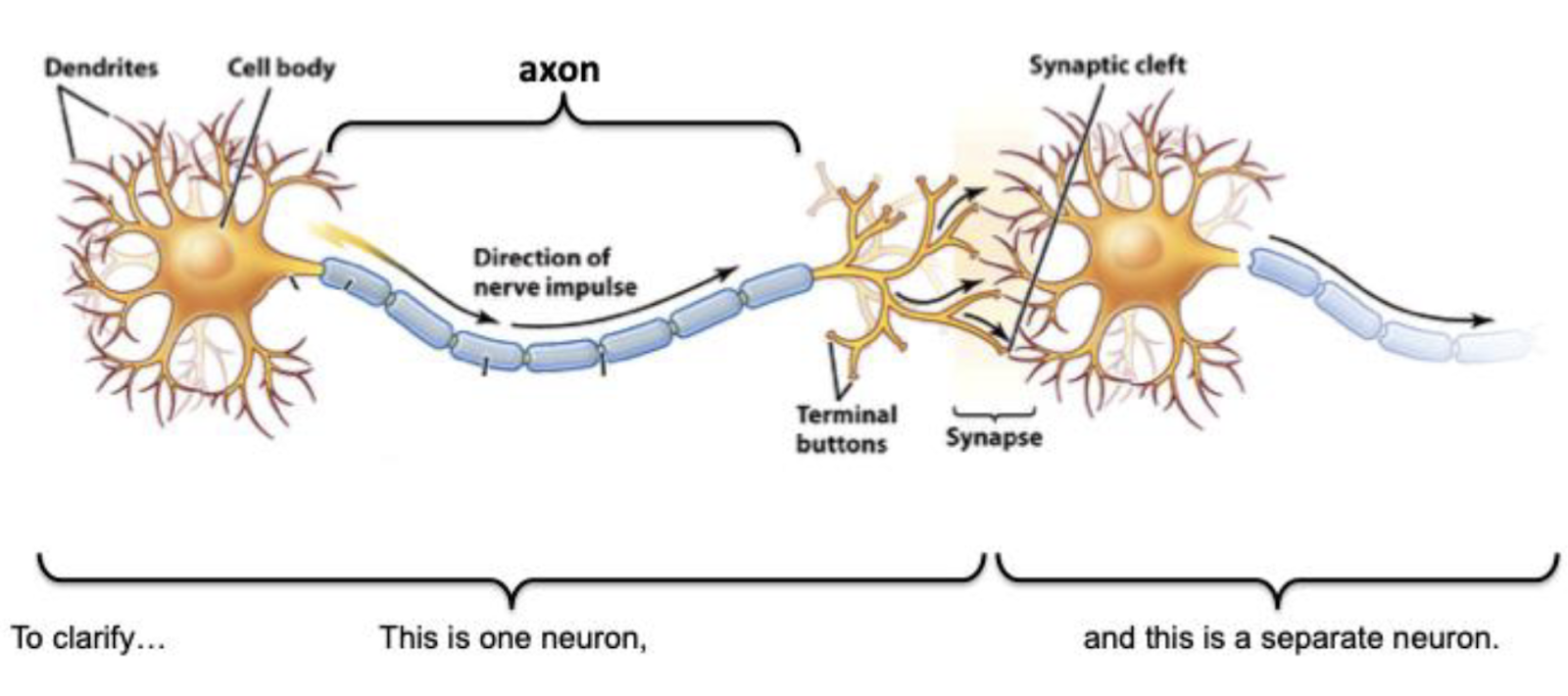
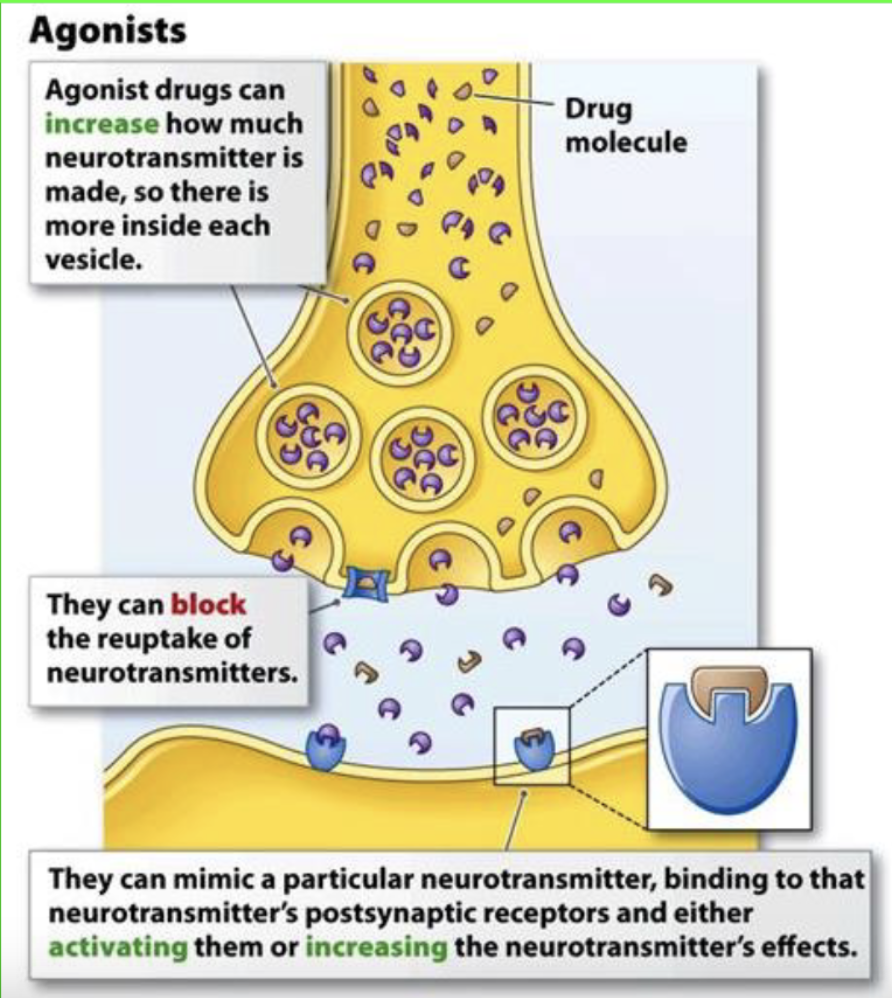
Drugs
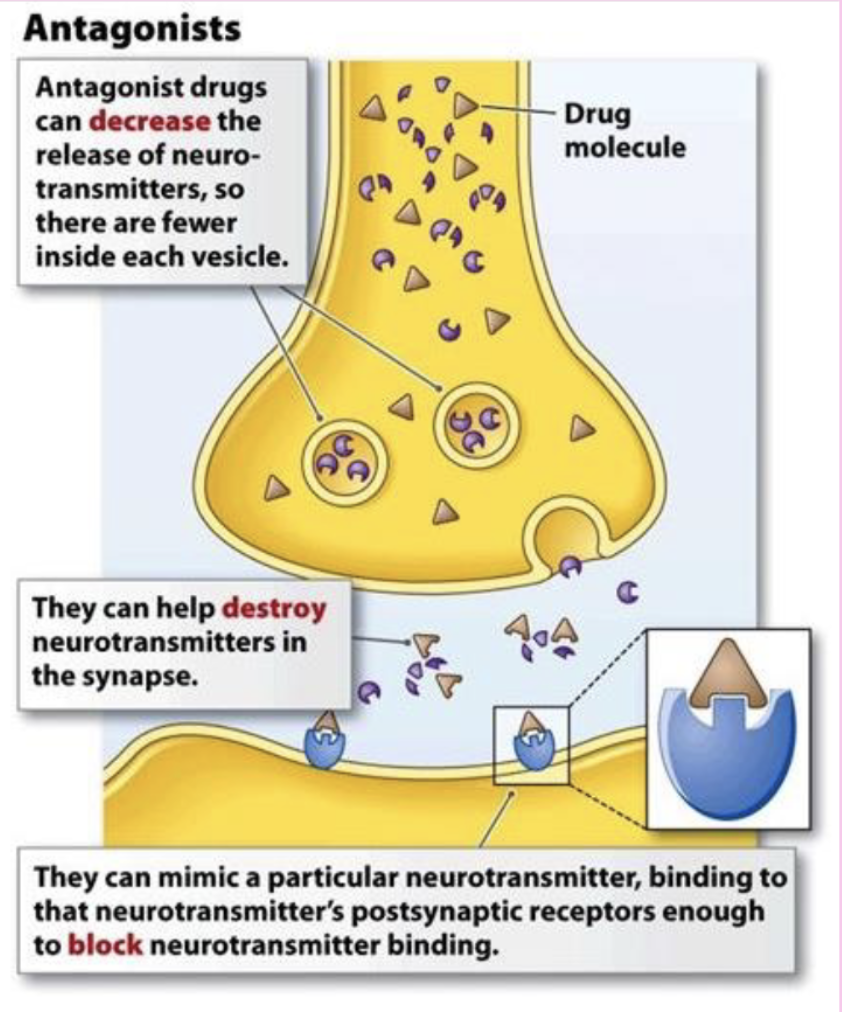
Agonist: A type of drug that increases the effects of a certain neurotransmitter
Antagonist: A type of drug that decreases the effects of a certain neurotransmitter
February 6, 2025 - Brain Function
Brainstem: Consists of several smaller areas, Midbrain, Pons, Medulla Oblongata, and Reticular formation
Responsible for: Breathing, heartbeat and blood pressure, swallowing (Automatic survival processes)
Cerebellum: Regulates the way we move
Responsible for: Balance, movement coordination
Cerebrum
Cerebral Cortex: Outer layer of the cerebrum is 80% of human brain mass
Wernicke’s Area: Specifically for language comprehension
Wernicke’s Aphasia
Inability to comprehend language
Words are pronounced correctly but misused
“Please get me some milk from the air conditioner”.
Broca’s Area: Specifically for language production
Broca’s Aphasia
Inability to produce language, but can understand others
“cot” instead of “clock” … “non” instead of “nine
“tan tan tan tan”
Also affects the ability to write
Limbic System: Middle of the brain, and is composed of several structures involved with mood, emotion, and bodily regulation
Amygdala - emotion center
Responsible for: Experiencing fear and anxiety, reward and punishment in learning, and mood
Hippocampus - major memory center of the brain, involved with creation and retention of memories
Responsible for: Memory, mood, navigation, orientation
Hypothalamus - regulates primal urges
Responsible for: Hunger, thirst, sleep, sex, body temp regulation, and mood
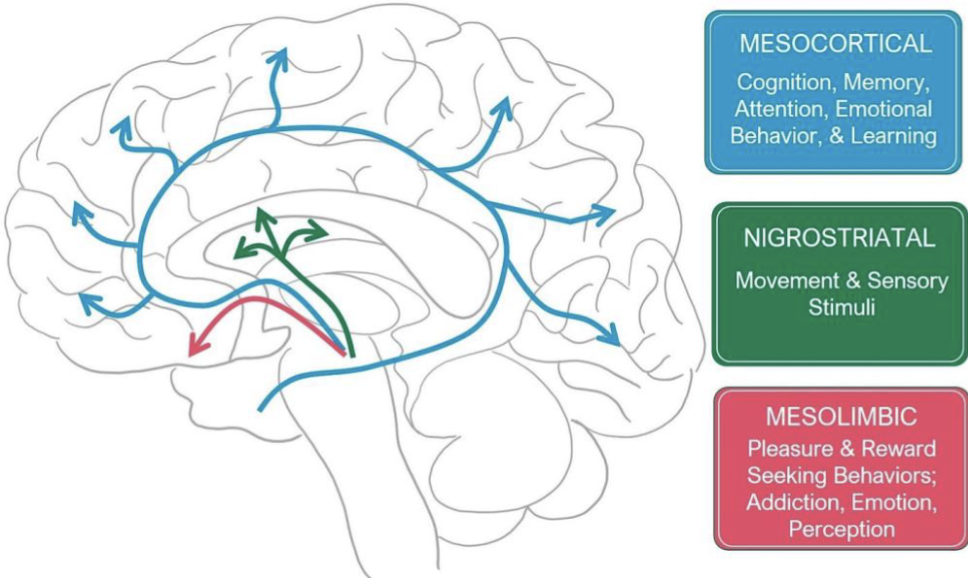
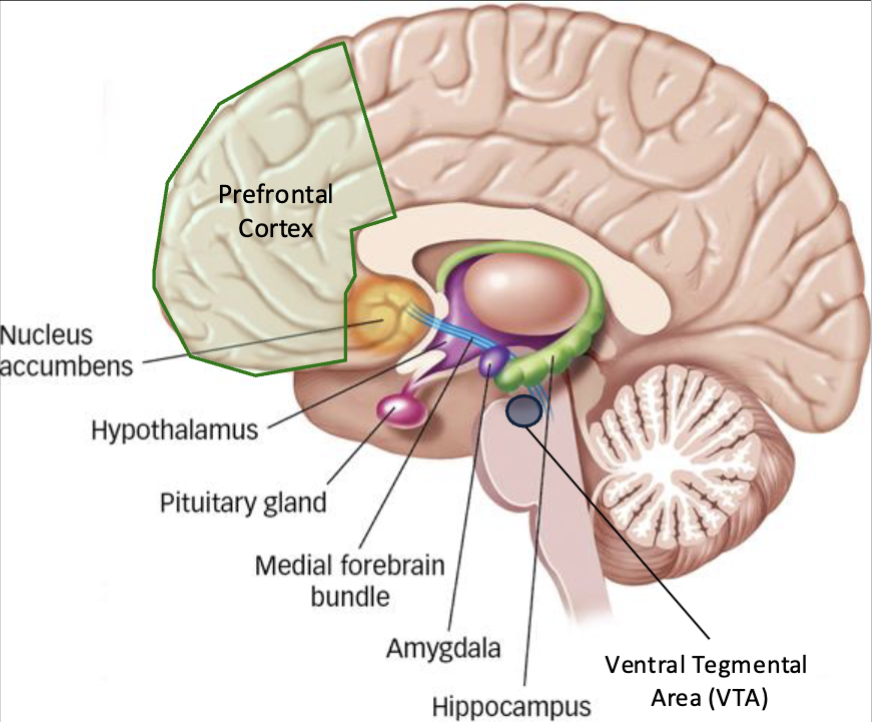
Dopaminergic Reward Pathway
Ventral Tegmental Area (VTA)
(origin of dopamine signals)
Nucleus Accumbens (NAcc)
(reward processing center)
Medial Forebrain Bundle (MFB)
(dopamine “superhighway”)
Olds and Milner Experiment (1954)
Rigged a lever in rat’s cage that when pressed, will stimulate an
electrode implanted into it’s MFB
Rat pressed lever until it passed out, no eating or sleeping
In hottest streak, rat pressed lever 2,000 times per hour for 24 hrs
Prefrontal Cortex
(decision making, impulse control)
Amygdala & Hippocampus
(integrate emotions and memory into reward learning)
Pituitary Gland
(regulates hormones that influence dopamine, stress, & motivation)
Anhedonia: psychological symptom characterized by a reduced ability or inability to experience pleasure and interest in activities that were previously enjoyable
February 10, 2025 - Sensation and Perception
Sensation: The PHYSICAL process of detecting environmental stimuli through your sense organs
Transduction: The conversion of physical energy (light, sound, pressure, chemicals) into neural signals
Example: Light waves stimulate the retina, where photoreceptor cells (rods and cones) convert light into neural signals, which are sent through the optic nerves to the brain’s visual processing center
Cornea: Fixed lens on the outer surface of the eye
Pupil: Just a hole
Iris: Adjusts pupil size to let in more/less light.
Lens: Fine tunes light focus for projection to the retina.
Retina: Where light waves are transduced into neural signals by RODS and CONES
Fovea: Focal center of the retina. All cones. No rods.
Absolute Threshold: Minimum stimulation for a stimulus to be detected
Vision: A candle flame on clear, dark night can be detected at 30 miles
Just Noticeable Difference (JND): Least additional stimulus that you’d just barely notice (Smallest detectable change)
Sensation and Perception are Sensitive to…
Proportional (not absolute) differences (Weber’s Law)
Weber’s Law: Our sensory system is sensitive to detecting proportional differences, not absolute difference
Ex.
Two jars with weights varying by a few quarters made distinguishing the heavier nearly impossible
A 2in height difference looks greater on shorter people than taller people
Saving $300 seems greater when it’s 50% off vs. 1% off.
Changes in stimuli and environment
Sensory Adaptation: Sensory receptors stop physically responding to constant stimulus
Sensory level: receptors in eyes, skin, ears, etc.
Not easily reversible; receptors physically stop responding
Ex. Your eyes adjust on a sunny day. You no longer hear a loud fan after time.
Habituation: The brain stops noticing a repeated stimulus
Cognitive level: attention and learning in the brain
Reversible; you can refocus on stimulus
Ex. You stop noticing a billboard on your commute. You tune out background noise in a coffee shop.
Contrast
Cones: photoreceptors in center of retina (the fovea) that process fine detail and color
We have blue, green, and red cones (Trichromatic Theory - we see full color spectrum)
Opponent Process Theory: When our system is overstimulated in one direction, it becomes hypersensitive to opposting stimuli as it attempts to regain its balance
Ex.
After a scary movie, hypersensitive to relief
Dopamine rush, hypersensitive to joylessness
After strenuous exercise, endorphin rush and relaxation hits
Shortcuts, Top-Down Processing
Perception: The psychological process of organizing, interpreting, and making sense of sensory information
Ex.
You see your roommate’s face in a crowd
You perceive mint-chocolate ice cream instead of separate sensations
Prone to illusions!!
Top-Down Processing: Sensory input is organized according to our prior knowledge and expectations about the universe.
Bottom-Up Processing: Perception is built from raw sensory input, with meaning emerging gradually as the brain processes details without relying on prior knowledge
Ex.
We don’t have a “normal script” for upside down faces, so we analyze them in parts, so the mouth and eyes being right-side up makes it less upsetting
Newborns are overwhelmed and exhausted as they are building top-down shortcuts from scratch
February 12, 2025 - Sensation and Perception
To judge an object's distance… we use
Sensation (bottom up): binocular disparity
When an object is closer, our eyes point more sharply inward
The brain processes this angle and uses it to process depth perception
Perceptual (top-down) cues for depth perception - “Monocular cues”
Ex. parallel lines converge in distance
Relative size: smaller objects = further
Interposition: objects block others = closer
The Hermann Grid
Lateral Inhibition: Nearby neurons suppress each other’s activity to enhance contrast
When you focus on a white dot, nearby white/brightness neurons are suppressed to enhance contrast
(Helps us see details/edges in dimly lit conditions)
The McGurk Effect
Multisensory Integration: When your brain integrates conflicting signals - e.g. hearing “ba” while seeing “fa” - you perceive a cross between the two: “da”
In Music
Synchresis: The brain’s automatic fusion of sound and sight (the video will seem like it fits the music
Rubber Hand Illusion
Brain prioritizes visual input, and you start to “feel” the fake pain
Real-Life Integration: Mirror-box therapy for phantom limb pain
The Double-Flash Illusion
Crossmodal perception: you brain perceives a second beep to match the (more ambiguous) sight to the clearer sound
February 13, 2025 - Impairments
Vision Impairments
Hearing Impairments
The Effects of Refined Sugar
Our bodies evolved to crave sugar like it’s a life-saving miracle because sugar was found in fruit and honey in limited quantities.
Today, we are not evolved to process the virtually limitless supply of pure sugar
Since 1975, both obesity and sugar consumption has tripled
Recommendation: Women should consume fewer than 25g sugar/day and men 36g sugar/day.
REFINED SUGAR: mimics the reaction of regular recreational drug use
Increased impulsivity
Poor self-regulation
Lower resting dopamine levels
Irritability from sustained sugar abstinence
Strongly activates the reward pathway in the brain
Drug addicts’ brains show increased sensitization to their drug of choice
Drug presence causes abnormally high dopamine spikes
Cross-sensitization occurs when high dopamine spikes are also caused by or formed in response to alternative sources
Sugar addicts suffer from dopamine sensitization and are prone to cross-sensitization - once you’re addicted to sugar, you’re more prone to other addictions
February 24 & 26, 2025 - Developmental Psych
Behavioral genetics: The study of how genetic factors influence behavior, traits, and psychological characteristics
Nature: Outcomes heavily influenced by genetics
Nurture: How you are raised and your life experiences also influence the type of person you become
From research in behavioral genetics, it’s approximately 50/50 split.
Determinism: Free will is an illusion; genetics are cause for failure or success, not your own choices.
“Between groups variability is always miniscule in comparison to within - groups variability.


Piaget’s Stages of Cognitive Development
Sensorimotor Stage (Birth → 2 years)
Learning through sensory/motor touching
Infants develop object permanence
Preoperational Stage (2 → 7 years)
Development of symbolic thought
Learn to use language and images to represent objects
Learn to use one object to represent another
Animism: attributing life to inanimate objects
Poor perspective taking (egocentrism), followed by development of
Theory of Mind (ages 4-5): the ability to have a theory about what’s going on in the mind’s of others (perspective taking)
False Belief Task (Sally and Anne block in box)
Appearance Reality Task (Play-doh container with orange)
Difficulty understanding rules of conservation
Centration: Overly focusing on one dimension (stretched out does not equal more)
Concrete Operational Stage (7 → 11 years)
Emergence of thinking about concrete objects and events
Mastery of conservation
Formal Operational Stage (11+ years)
Ability to think abstractly and reason hypothetically
Development of deductive reasoning and systematic problem solving
Capacity for cognitively grappling with abstract concepts, such as justice, love, or hypothetical scenarios
Erikson’s Psychosocial Stages of Development
(a central conflict/crisis must be resolved, and the outcome influences future development)
Trust vs. Mistrust (Infancy 0 → 1 years)
Core Conflict: The infant develops trust when
caregivers provide consistent care and affection.
If unreliable and neglectful, child may develop
mistrust.
Autonomy vs. Shame and Doubt (1 → 3 years)
Core Conflict: As toddlers explore, they strive for independence. Successful experiences foster autonomy, while excessive criticism or control leads to shame and doubt about their abilities.
Initiative vs. Guilt (3 → 6 years)
Core Conflict: During this stage, children assert themselves through initiating activities and interacting with others. When their initiatives are encouraged, they develop a sense of purpose; if not, they may experience guilt over their needs and desires.
Industry vs. Inferiority (6 → 12 years)
Core Conflict: Children develop skills and competencies through school and social interactions. Success leads to a sense of industry, while repeated failures or a lack of recognition can result in feelings of inferiority.
(You begin to realize your skillset and weaknesses)
Identity vs. Role Confusion (12 → 18 years)
Core Conflict: Adolescents explore different roles and ideas to develop a clear sense of self. Success results in a strong identity; failure or confusion can lead to uncertainty about one’s place in society.
Adolescents with strong identity resolution exhibit greater intimacy, generativity, and integrity in adulthood
Adolescents with identity confusion are more likely to engage in aggression, crime, substance abuse, self-injury, and academic failure
Intimacy vs. Isolation (18 → 40 years)
Core Conflict:
Young adults seek to form deep, committed relationships. A successful resolution leads to strong bonds with others, while failure may result in isolation and loneliness.
Correlation vs. Causation Issue: Drugs and Twinkies can fill this void. Loneliness is not always due to lack of relationship.
Generativity vs. Stagnation (40 → 65 years)
Core Conflict: During middle adulthood, individuals focus on contributing to society, achieving a sense of generativity. A lack of such contributions may lead to stagnation.
Ego Integrity vs. Despair (65 years +)
Core Conflict: In later years, individuals reflect on their life. A sense of fulfillment and integrity comes from viewing one’s life as well-lived, whereas regret and bitterness may lead to despair
This integrity comes as a result of Erikson’s trajectory of development. Individuals who successfully resolve early life stages are more likely to develop this integrity.
Erikson’s Model is an Example Of:
Narrative Fallacy: Despite most things being caused by a dizzying array of thousands of factors; we have an innate tendency to explain complex outcomes with a simple story
March 10, 2025 - Absent
Narrative Fallacy: explaining complex things with a simple story (is a huge contributor to why erikson's psychosocial stages of development is still being believed because humans like a simple explanation)
This will probably be on the exam because he is talking about this a lot
None of the nature or nurture is a guarantee about their personality (can help to predict but doesn’t mean correlation = causation)
Nurture:
Environmental factors that are most impactful on psychological and life development =
Parental mental health: parents with mental problems often leads to the children experiencing similar problems (depressed parents more likely to be neglectful)
Also partially nature: cause genetics could carry over from parent to child
High-conflict homes: children more likely to externalize (be aggressive) or internalize (anxiety and depression) symptoms
Interparent conflicts increases these symptoms in children (if saying staying together for the kids but then arguing the whole time then it might actually just hurt the kids)
Increased coping mechanisms (show greater fear and avoidance)
Family - wide conflict = worse outcomes for children than marital conflict alone
High-conflict divorce = emotional neglect (mental health issues similar to that of physical abuse)
Neighborhood safety: higher violence = lower self-competence, more distrust of authority
Hearing about violence near you can also have similar effects to witnessing it (mainly if it's like a person got shot down the block from you)
Have biological stress markers (telomeres are the ends of DNA strands that protect against aging)
How much your parent talks to you / and related effect of background TV
THIS IS AN IMPORTANT ONE
Background TV = reduces how much the parent talks to the child
TV is on = don't talk to people as much
All of these findings are the same for smartphones (basically everyone is addicted to their phone)
Corporal punishment: higher stress responses, more substance use, increased aggression, higher anxiety
Children look up to adults who model: so if adult models solving problems with violence that is what the kid is probably going to do
Corporal punishment is still used today because (why it's so compelling) : have a bad outcome don't want to do the thing you were doing (kids can ignore yelling but much harder to ignore getting smacked)
Spanking effective for immediate response of stopping in the moment
Sleep quality / household noise/chaos:
not enough sleep = lower cognitive abilities
Food insecurity/ food desert
Makes you stressed and anxious all the time
Overconsumption of refined sugar: makes you sadder and dumber (his exact words)
Air pollution / toxins: impacts mental health/ cognitive development
Linked to neurodevelopmental disorders
Parental praise type : want to praise process more than the trait (basically encouraging a growth vs a fixed mindset)
Don't just say wow your so smart and then give them the false thinking that they don't have to work hard to get that since they just grew up thinking no matter what they are smart
Praise the ways to become great and not just the end result
Preschool attendance: (unfair since expensive but very helpful)
Family Dinner
Household clutter
Screentime
Authoritarian parenting
Definition: Moral internalization = learning a lesson from whatever wrong doing you did (not developing a moral code but instead just doing something to avoid physical punishment)
March 12-13, 2025 - Behaviorism
Two Types of Conditioning
Classical Conditioning
Reflexive, involuntary bodily responses
Ex. flinching, fear, HR increase, mouth watering, needing to pee
Unconditioned = innate; causes involuntary bodily response without any prior conditioning.
Unconditioned Stimulus - Smell of Pizza
Unconditioned Response - Mouth Watering
Conditioned Stimulus - Dinner Bell (Originally neutral stimulus but repeated presented with the unconditioned stimulus)
Conditioned Response- Mouth Watering
— — — — — — — — — — — — — — — — — — —
Acquisition - The process of associating the US&UR with the CS&CR
Stimulus Generalization - When a similar-but-different stimulus causes the same response as the Conditioned Stimulus
Ex. Jimmy flinches in response to Carl’s ringtone (instead of his own)
Extinction - The process of disassoociating the US&UR with the CS&CR
Spontaneous Recovery - Long after extinction, the Conditioned Stimulus randomly triggers Conditioned Response
Vicarious Conditioning - Developing a conditioned association based on others’ experience/empathy
Operant Conditioning
Conditioning of deliberate behaviors
FOUR TYPES
Reinforcement: Encouraging the target behavior
Positive Reinforcement (Positive (+): by adding something)
Negative Reinforcement (Negative (-): by taking something away)
Punishment: Discouraging the target behavior
Positive Punishment
Negative Punishment
Positive Reinforcement: Clap when student walks towards the shoe
Positive Punishment: Boo when student talks
Negative Reinforcement: Boo when student isn’t walking
Negative Punishment: Taking child’s Ipad, take talking student’s chair to build silent classroom, taking license away to discourage drunk driving
Examples:
Negative Punishment: When student skips studying, turn off wifi to the house
Positive Punishment: Laugh when student asks a question
Negative Reinforcement: Take away a child’s dinner until they do chores
Alarm rings and you get up to turn it off
Classical Conditioning: Turning onto a main street when you always got shots as a child, the child will freak out
March 17, 2025 - Schedules
Conditioned Taste Aversion (Biological Preparedness)
When a negative physical reaction follows a food, we are likely to not want to eat it again, which is biologically logical
Severe Punishment - punishment that causes extreme negative affect (emotion)
Ex. Screaming at a person, berating with insults, physical violence
Severe punishment is extremely effective for getting a behavior to stop immediately, but not long-term
The learner might avoid the teacher instead of the behavior
Encourages lying
Creates fear & anxiety (hinders learning)
Punishment for failure encourages opting out of trying things
Models aggression
“Skinner Box” - Named for BF Skinner
When the lever is pushed…
Food might come out
Food might be taken away
Floor may be electrified
Positive Reinforcement - When rat presses a lever, food drops.
Negative Reinforcement - When rat presses lever, floor turns off electric floor.
Positive Punishment - When rat presses lever, floor is electrified.
Negative Punishment - When rat presses a lever, food is taken away.
Schedules of Reinforcement
Continuous Reinforcement - reward for every instance of behavior
Fixed-Ratio Reinforcement - reward at every Nth instance of behavior (free quesadilla for every ten orders)
Variable Ratio Reinforcement - reward at random instance of behavior (slot machines; video games)
Fixed-Interval Reinforcement - reward after X amount of time doing the behavior (hourly wages)
Variable Reinforcement - random rewards while engaged in the behavior (random free drinks at a casino)
Skinner Box Example
Continuous - Every push of button gets food or turns off floor
Fixed Ratio - Rat would press button slower, knowing food drops after certain number presses
Variable Ratio - Rat would spam the button, not knowing at what random press would get food
Fixed Interval - Rat would press slowly to pass the perceived amount of time to get reward
Variable Interval - Rat would spam button, not knowing how long to go until reward
March 19, 2025 -
Variable-Ratio Reinforcement
Dopamine surges typically occur before the reward; it is released in response to the cue for the reward
The cue becomes a conditioned stimulus for dopamine release
(highest when reward is given 50% of time)
Social Interaction activates the dopaminergic reward circuit (reward pathway)
Digital social interactions work the same way - apps deliberately manipulate when and how we receive notifications
Unconditioned stimulus - Social interaction
Unconditioned response - Feeling you need to check notification
“giddy anticipation of reward”
Conditioned stimulus - Sound or buzz of a notification
Conditioned Response - Feeling you need to check notification
March 26, 2025 - Social Psych
Social Influences
Normative Influence - going along with others as a means of being accepted by the group
Informational Influence - going along with other because you assume they know more than you
Asch (1951)
When participants’s turn was preceded by 3+ confederates saying ‘B”, roughly 33% of participants conformed and also said “B”
When allowed to answer privately, 98% answered correctly, thus Normative Social Influence occurred (not informative)
Error Size?
It doesn’t matter. Conformity was approximately equal because no matter how different the line sizes are, the rate of conformity was the same.
Social Desirability Bias - wanting to be agreeable to do the societally accepted thing (Ex. ChatGPT)
Does conformity relate to being liked?
Johnny Rocco Study (Schachter, 1951)
Group discussion about punishment for “Johnny Rocco” (juvenile delinquent)
8 participants per group
5 participants
3 defiants
Deviant (argued against common belief; very disliked by crowd)
Slider (switches sides halfway)
Mode (goes along with crowd)
Examples of Power of Conformity:
Hitler’s inner circle
Watergate coverup
Challenger explosion
Groupthink - when consensus is the primary decision-making outcome, which leads to maladaptive decisions being made
O rings do not function in freezing temperatures, and icicles were found outside the launch structure.
“Take off your engineering hat and put on your management hat.” They launched anyway because of space race pressure, and lost it all
Chameleon Effect - people automatically mimic others’ behavioral mannerisms; people like others who subtly mimic their own body language.
Social Learning - learning by observation
The tendency to mimic others is greater than operant conditioning (kids with colored balls example)
March 27, 2025 - Norms
Descriptive Norms: what most people do
Injunctive Norms: what people ought to do
Perception of norms is an extremely powerful influence on behavior
Reactance: the motive to do the opposite of what we are told
Aronson & O’Leary (1983)
Condition A - sign requiring 3 minute shower (<10% of public followed)
Condition B - one confederate modeling this behavior (49% of public followed)
Condition C - two confederates modeling this behavior (67% of public followed)
Latane & Rodin (1969)
“Oh, my God, my foot… I can’t move it. Oh, my ankle… get this thing off me!”
Condition A: Participant sitting alone (70% acted)
Condition B: Participant sitting with a stranger (20% acted)
Bystander effect: the tendency to be complacent when surrounded by other doing the same

Darley and Latane (1968)
Participant ostensibly has a seizure…
Diffusion of Responsibility:
As the number of witnesses increases
the likelihood they react goes down dramatically
Darley and Batson (1973)
Theology students were told to give a speech about the Good Samaritan
They were told to change buildings last minute and when arriving had to step over a man struggling in the doorway
Depending on their timeliness,
many did not help if running
late, but would stop if early
Piliavin et al., (1969)
Confederate collapses on the NYC subway - received help 95% of time
Why?
Sharing a common fate and inescapable guilt by staying in train car
Face-to-face situations
Unambiguous situations
March 31, 2025 - Social Psych
Mere Exposure Effects - “If you’ve seen it before, it hasn’t killed you yet”
Humans tend to like things that are more familiar because we know them as safe
Examples
We prefer our own mirror-image photos, but our friends’ regular images
Illusory-Truth Effect (The Reiteration Effect)
Repeated statements receive higher truth ratings, regardless of actual truthfulness
Hasher et al. (1977)
Participants read statements marked as either TRUE or FALSE
Participants returned to the lab days later and rated the truthfulness of several statements.
Statements from the prior session were rated as more truthful, regardless if they were marked TRUE or FALSE prior
Underlying Mechanism: Processing Fluency (The Fluency Heuristic)
the easier information is to process, the more we believe it
Belief Perseverance
Clinging to your initial conclusion , even after the underlying facts have been discredited
Ross, Lepper, and Hubbard (1975)
Participants tried to identify real vs fake suicide notes
Participants were given fake feedback either
You got 24/25 correct
You got 10/25 correct
They were told the feedback was fake
Result: Group A thought they were more skilled at the task, even after feedback was fake
April 2, 2025 - Persuasion Techniques
Just World Hypothesis - Cognition is motivated, such that people are disproportionately likely to evaluate random/chaotic outcomes at “fair”
Lerner and Simmons (1966)
Participants watched women (confederates) solve puzzles; when incorrect they received a shock
The longer they watched, the more negative they rated the confederate’s character
The more painful the shock, the more negatively the rating
When Ps were told confederates would be financially compensated, participants DID NOT rate them negatively
Lerner (1980)
Participant observed two people work on a task, where one was randomly rewarded chosen by coin flip
On average, the participant rated the randomly rewarded worker (confederate) as having worked harder
Inherited Wealth: Having money DOES NOT relate to hardworking-ness, nor does being poor mean you don’t work as hard.
Population of Boston Demonstration
Less than 5 million
Estimate: 4.5 million
Anchor and Adjust Bias: Having an anchor number/prize that further beliefs are based off
Examples: iPhone or car sales (expensive anchor), selling a house (set your own anchor)
Persuasion Techniques
Low Ball
Buyers: Making a crazy-low initial offer (setting the anchor from the start)
Sellers: After the lower deal is accepted, the deal is altered (increased fees, excludes tax, etc.)
Foot-in-the-Door
Small request precedes large request to increase compliance with the large request
Freedman & Fraser (1966)
Request: Can we send a survey team of 5-6 people to catalog your house products?
Initial: Half of participants were called a few days earlier, asked to answer a few questions about household products.
53% of those asked questions said YES to final request, while of those not asked, 22% said YES
Consistency Bias: Once you’ve agreed to one thing for a certain cause, you are more likely to go along with other things for the same cause.
Example In Today’s News
Elon Musk cannot pay American voters to vote for a candidate. But, he found a loophole.
Ahead of 2025 election for Wisconsin Supreme Court, Musk offered voters $100 to sign a petition against “activist judges”
Ahead of 2024 presidential election, Musk incentivized signing petitions entering voters in a sweepstakes for 1 million dollars
Foot in the Door and Consistency Bias Effects
Bait-and-Switch
Amazing deal is advertised, but at the store, deal is no longer available
Commitment Bias: people are biased towards committing to decisions even after conditions leading to the decision has changed
(Sunk Cost Fallacy)
Labeling
“You look like a smart guy”
“You look like the type of kid who thinks ____”
Adults told they were “above average citizens” were more likely to vote
Legitimization of Paltry Favors
“Even a penny helps” doubled donations to the American Cancer Society (size of donations didn’t change)
Door-in-the-Face
Initial BIG request makes smaller subsequent request seem more reasonable
Miller et al. (1976)
Initial Request: Will you volunteer for us for two hours?
Subsequent Request: Will you volunteer two hours per week for two years?
76% of those asked both questions said YES to second request, while of those not asked, 29% said YES
That’s Not All!
Burger (1986)
DV: $1 for a cupcake. Want it? (yes/no)
IV Initially, the cupcake price was $1.25... “But WAIT it’s Actually, $1” (that’s not all condition; 55% buyers)
Control Group I: “Only $1 now. Earlier they were $1.25” (25% buyers)
Control Group II: $1 for a cupcake (20% buyers)
Scarcity Principle
People assume scarce = valuable
Limited Number
Limited Time / Fast-approaching deadline
Pique Technique
Santos et al. (1994)
Researchers dressed as panhandlers asked the following questions
“Do you have any spare change?” (23% donated)
“Do you have 17 cents?” (37% donated)
Social Proof
Portraying the desired behavior as normative
“Over 2 million copies have sold”
Side Note: The Halo Effect means more attractive people are more persuasive (seen as more competent or trustworthy)
April 3, 2025 - Disorders
Abnormality: you quality for an abnormality if you have two or more of the following
Non-normative, or violating social norms
Experiencing an unusual amount of discomfort
Unable to function in society
Dangerous to self or others
DSM-5: Legally, universal diagnostic manual; often determines insurance disbursements
Parsimony: searching for the simplest possible explanation
Self-Fulfilling Prophecy: one’s expectations lead to behaviors that confirm those expectations
David Rosenhan (1973)
Pseudopatient Experiment
Eight pseudo-patients faked auditory hallucinations to be admitted to mental institutions
Once admitted they acted completely normal, and were given medication and only 6.8 minutes of psychiatric treatment
Normal behaviors were documented as symptoms and they were inhumanely treated
Non-Existent Imposter Experiment
Hospital was warned of pseudo-patients being admitted
41 of 193 were considered imposters and 42 were suspected, all falsely identified
"Any diagnostic process that lends itself too readily to massive errors of this sort cannot be a very reliable one".
Phobias
Symptoms - dizziness, trembling, increased heart rate, breathlessness, nausea, sense of unreality, fear of dying, preoccupation with the fear object
Specific Phobia - Around 9% of population have some specific phobia
HIGHLY TREATABLE - Exposure therapy (client is under control in a very predictable, measured series of baby steps. (65% cured after four years)
Social Anxiety Disorder (aka “social phobia” or an intense fear of being judged socially)
Anxiety Disorders
Panic Disorder
Recurring panic attacks
Generalized Anxiety Disorder (GAD)
Excessive worrying
Contains common cognitive biases:
Magnification vs. Minimization - Failures are magnified and successes are minimized.
Catastrophizing - Obsessing over worst-possible interpretation or worst possible future outcome, no matter how likely
Overgeneralization - Interpreting a single event as a never-ending pattern. (Failing one exam means a failure of a student.
Jumping to Conclusions; Mind Reading - Using minimal evidence to conclude that others evaluate you negatively (Sitting alone → Nobody likes you)
Splitting/All-or-Nothing Thinking - Events are “black or white” - everything that happens is either pure success or failure (One bite of ice cream ruins a diet, so they eat an entire gallon)
“What the Heck Effect” - break in self-regulations leads to binge
Trait Anxiety vs. State Anxiety
Trait - anxious nature as a natural state
State - feeling anxious because of your
circumstance
April 7, 2025 - Disorders
Schizophrenia
Heterogeneous clinical syndrome with the following symptoms
At least six months of at least two symptoms
Onset late-teens to 20s for men; 20s to 30s to women
Comorbidity - the extent to which one illness tends to accompany others
Substance use disorder is more common among schizophrenics
Anxiety disorders, OCD, diabetes, health issues are more common
Positive Symptoms
Types of Delusions
Persecution - someone is out to harm you
Reference - TV is speaking directly to you
Influence - people are trying to control you
Grandeur - believe you are an important figure in a past/future life (past life pharaoh or future coming of Christ)
Thought Broadcasting - some entity can read your mind
Thought Withdrawal - someone is stealing your ideas and thoughts if you forgot something
Hallucinations
Disorganized Speech (“word salad”)
Disorganized Behavior - doing extra, unhelpful things
Negative Symptoms
Affective Flattening - reduced emotional expression
Alogia - poverty of speech or speech content
Anhedonia - inability to experience pleasure
Apathy - lack of interest
Asociality - lack of interest in social relationships
Avolition - lack of motivation for goal-directed behavior
(More treatment resistant; earlier onset and severity of negative symptoms means worse prognosis)
Treatment
Effective, but tend to have rough side effects
Tardive Dyskinesia: involuntary movement of mouth and tongue
50-75% discontinue taking medications
Cognitive Behavioral Therapy (CBT) teaches to recognize unhelpful patterns of thought
Diathesis-stress Model - Schizophrenia symptoms are strongly correlated with experiencing stress