Resouces & Consumption
Vehicle Fuel Deficiency 20 Model Year
Vehicle | L/100km | x worse |
|---|---|---|
Nissan Leaf | 1.8 | — |
VW Jetta TDI | 6.2 | 3.48x |
Ford Expedition | 16.1 | 8.9x |
GM Yukon XL | 22.1 | 13x |
2021 Tesla Model 3 - 24kwh/100 miles
Current Manitoba hydro price - 90 cents/100km
Carrying Capacity
Brown - 1954/35 Billion (90 Billion)
Challenge of Man’s Future
Clark - 1956/12 Billion
Economics of Undevelopment
Revelle - 1976/40 Billion
Scientific American
Feed; Whole output is JUST food
Gilliand - 1983/7.5 Billion
Population & Development Review
Resources
Anything that we used in, or obtained from, the environment to meet a human need
Types of Resources
Perpetual - Sun
cannot be exhausted, regardless of their rate of use
Renewable - Depleted in short run but will renew self if not damaged
Ex: fish, trees
Non-renewable - fixed amount
Ex: Crude oil in planet Earth, but another exception is Aluminum where there is a fixed amount but it can be recycled
Use of Resources
Use of resources has accelerated in the MDC’s
As “quality of life” increases so does resource use
MDC’s - 15% of population, use 70% of world’s energy & minerals
USA - 4.8% of population, 22% of world GDP, 33% of ALL energy, 30% of all pollution releases
Ex: An object was made elsewhere (pollution is counted in that place) but not when it’s sold in America
India - 18% of population, 5% of energy
Canada - 0.5% of population, 4% of energy
Due to large land mass, transportation requires a lot of energy
Energy
Energy Source | Timeline |
|---|---|
Fire | ~millions of years ago |
Animals | ~ 10 000 years ago |
Waterwheel | ~ 3000-4000 years ago |
Windmill | ~ 1000 years ago |
Coal | 150 years ago |
Oil (gasoline is derived from this) | 100 years ago |
Natural Gas | 90 years ago |
If a force, F, is applied to an object of mass, m, the object will be observed to undergo acceleration, a
F = ma
Base unit is kg m/sec² called a newton N
Energy is the product of a force, F, operating through a distance, d
A newton over a m is the base unit of energy - called joules J
Units of Energy
1 joule - 10^7 dyne-cm - physics
= 0.239 calories - chemistry
= 2.39 × 10^-4 calories (kilocals) - nutrition
= 9.48 × 10^-4 BTUs - energy
= 2.78 × 10^-7 kilowatt-hours - E-Engineering
= 9.48 × 10^-19 quads - economics
= 10^-18 exajoules - economics
1 quad = 10^15 BTUs
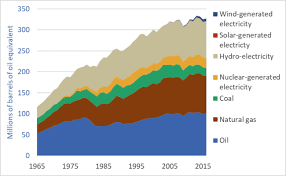
Energy Use Per Person
Canada 239 000 Kcal/person/day
Northern Europe 125 000 Kcal/person/day
Finland, Norway, Sweden
India 11 000 Kcal/person/day
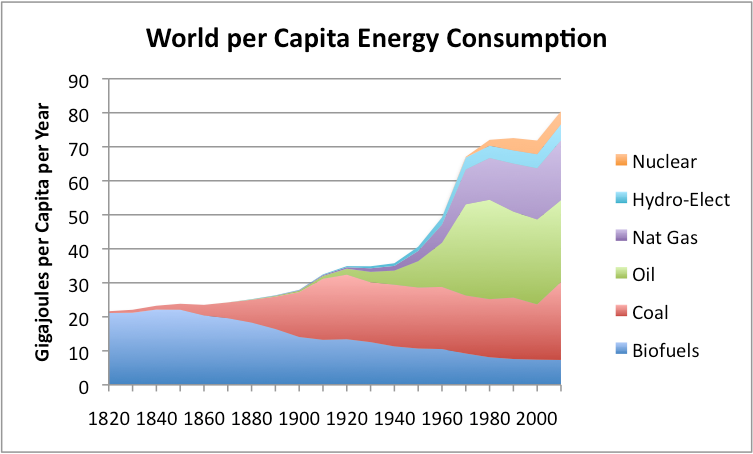
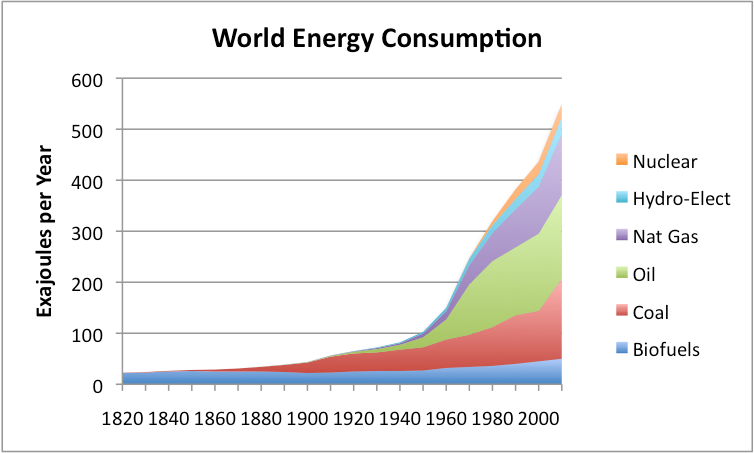
Comes from 3 main sources; needs to be carbon-neutral by 2050
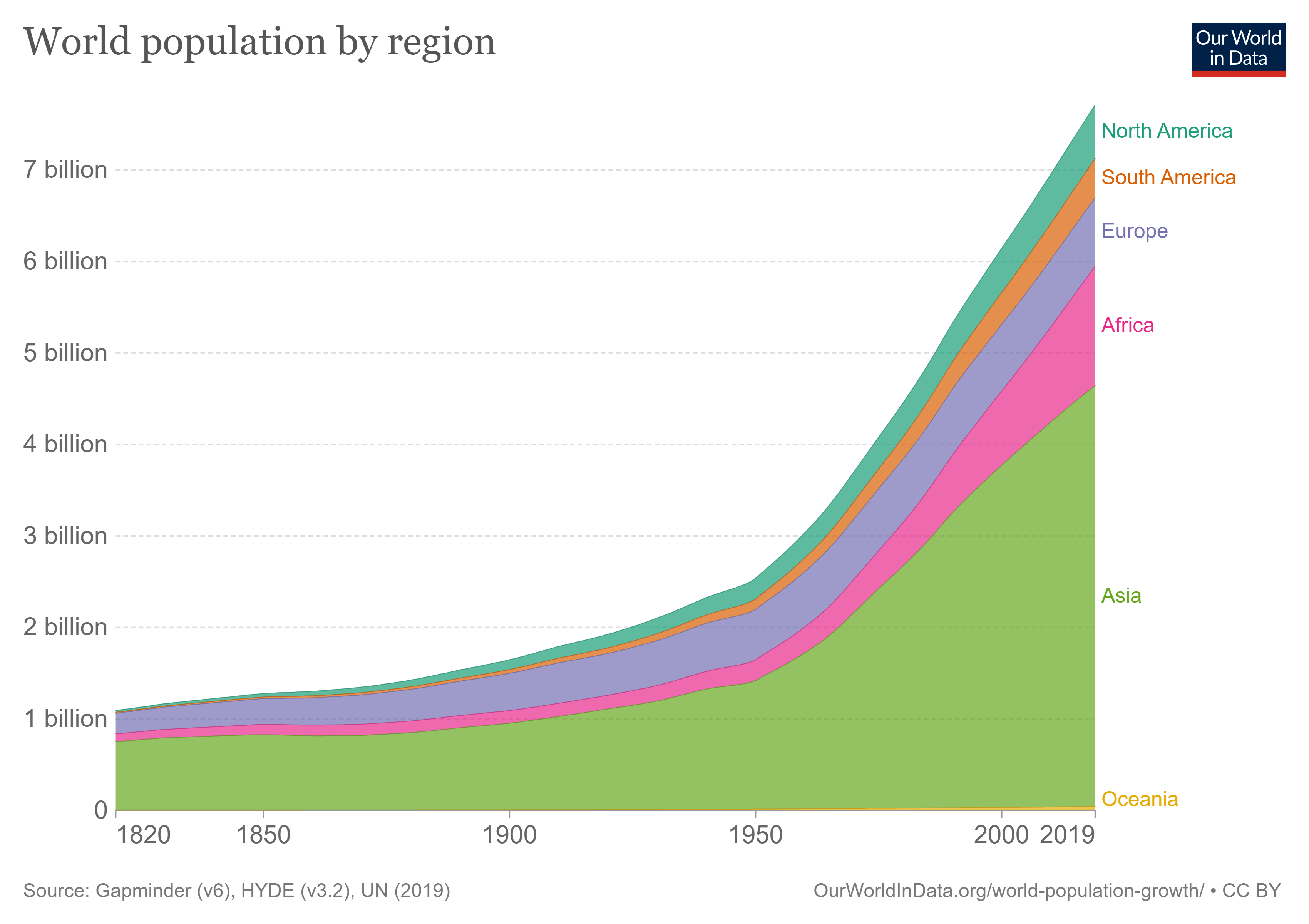
Fossil Fuel Supplies - 2016
Conventional Oil
BoO - Barrels of Oil
Proven Reserves - 1.6 × 10^12 BoO
Ex: Company drills out layers of Earth; oil is found
UnProven Reserves - 0.5×10^12 BoO
Ex: Company drills & finds oil; then figures out geographically that there might be oils in another place but have yet to find it
Years of Supply - 52 years
Some math about Supply
If you have 1 million u(?) of supply of something & you use 1 per year, how long until your supply last?
1 million years
v(?)
926 years
Hard Paths & Soft Paths
Hard Path: Advocates support the devlopment of large power generating systems liek coal & nuclear electricity generating plants that we see springing up around the world
Rely primarily on non-renewable resources
Soft Path: Advocates the use of renewable resources & serious conservation programs
Hydropower, solar-heating, solar photovolitaries bromass, w(?) & tides
Gnerated in 3 ways:
Hydro
Natural Gas=Brandon & Selkirk
Diesel Fuel
Manitoba Hydro Dams
15 operating dams
4 areas
WInnipeg river - 1920
HVDC-High Voltage Direct Current (1960s) transmitting electricty in hudresds of km w/out much energy loss
Nelosn RIver & Grand Rapids
Largest Built in 50-60s, 2010 & 2020 (Keeyask-695 MW)
Laurie River -1950(two smaller near saskatcheran)
total generating capacity: 6400 MW
Future Operating Dams
Conowapa, 1390 MW
Gillam Aisland, 1000 MW
Gull 550 MW
Birthday 560 MW
Production & Sales 2021-2022
Manitoba Sales $1865 Million
Electriity to Manitoba - 22,573 Million kWh
Average 7.8 cents kWh
Exports sales $585 Million
Electricity sold - 6205 Million kWh
Average 10 cents kWh uninterrutptable
Average 3 cents kWh interruptable
can be turned off (depending on wet/dry year) - given to neighbouring locations
INterruptable pwoer & uninteruptable wpoer
Natural Gas TCPL
only distributed within 30k mof the pipeline
about 70% of the population
NG is likely to remain the fuel fo choice for spacce & water heating