Structure and Bonding
Allotrope — each of two or more different physical forms in which an element can exist. Graphite, charcoal, and diamond are all allotropes of carbon.
The strong electrostatic force of attraction between
Metallic
a lattice of positive metal cations and a ‘sea’ of de-localised free moving electrons
Ionics
oppositely charges ions
Covalent
positively charged nuclei and a negatively charged pair of shared electrons
Structure
Molecular
2 or more atoms bonded together in a fixed ratio
Have weak inter molecular forces
Lattice
Regular repeating structure of atoms/ions that have no definitive ending
Strong chemical bonds
Atomic
Individual atoms that are only attracted to one another very weakly
Group 8;0
Bonding
Simple covalent molecule
2 or more atoms in a fixed ratio
Properties
Boiling point—low, tend to be gases due to weak inter molecular forces
Hardness—hard but brittle as solids
Malleability—None
Electrical conductivity—No free moving charged particles
Covalent bonds are strong but they have relatively weak inter molecular forces
Examples
Water, Chlorine, Oxygen, Nitrogen, Ethene
When boiling a SCM the covalent bonds don’t break but the IMF are being overcome
Single covalent bonds are less strong then double bonds which are less strong then triple bonds
Buckminsterfullerene - C60 — allotrope of carbon
Sublimes at 600 C
Needs to overcome relatively weak forces between molecules
Does not conduct electricity
Not soluble in water
Insulator
Has de-localised electrons but they can’t move from one molecule to another
Soft and brittle
Giant covalent lattice
Many atoms bonded together in a regular repeating arrangement
strong covalent bonds
Properties
Very high melting and boiling points due to the strong covalent bonds between the atoms
(Not graphite) Do not conduct electricity because there are no free moving charged particles
Examples
Diamond, Graphite, Quartz SiO2, Silicon
Diamond vs Graphite
Both have a high Mp but diamond is higher
Covalent bonds between atoms are stronger than IMF — GCL don’t have inter molecular forces
Diamond does not conduct electricity, Graphite does
Graphite has de-localised electrons between layers
Graphite has 3 bonds per carbon, Diamond has 4 bonds per carbon
Graphite
Each carbon atoms from 3 bonds leaving 1 electron spare.
These electrons are de-localised, meaning they are not associated with any single carbon atom
As the electrons are free to move through the structure graphite is able to conduct electricity
The weak forces between each layer make it:
Flakey and soft
An effective industrial lubricant
Good for pencils
Giant Ionic Lattices
A regular repeating structure of oppositely charged ions
Strong ionic bonds
Cations and Anions have strong electrostatic forces of attraction
Properties
High melting point
Hard and brittle
The ions are held together by very strong interactions but small defects in the lattice will cause it to break by placing like charges together
Some are soluble
Water molecules are able to form weak interactions with the ions, which is sometimes enough to overcome the attractive force between the ions
NaF-soluble
MgO-insoluble
The solubility of an ionic compound depends on how strong the ionic bond is and how many interactions the ions can make with water
In a liquid state they can conduct electricity
Once the electrons contact the liquid the charge builds up on each electrode due to the Voltage. This will cause ions to navigate towards them.
Once molten/aqueous ions are free to move. These ions can move towards the relevant electrode which leads to movement of charge, which is current
The FMCP are the ions
Giant Metallic lattice
A regular repeating structure of positive metal cations with a shared ‘sea’ of electrons
Force between cations and electrons
Properties
Hard very strong metallic bonds
High melting point - many strong metallic bonds lots of energy is needed to overcome
Density is high except Li Na K
Conductors of electricity
When voltage is applied the de-localised electrons are free to move throughout the lattice leading to the movement of charge (current)
Malleable
The ions can easily move past each other without resulting in breaks in the crystal structure.
Layers of cations can move past each other relatively easily
Not soluble
Metals can’t dissolve in water, because there are no favourable forces of attraction between the slightly positive hydrogen atoms in H2O with anything else. The electrons can’t be completely free in water
Conduct heat
The de-localised electrons can quickly move heat around the whole lattice, moving energy with them.
The ions just vibrate in place
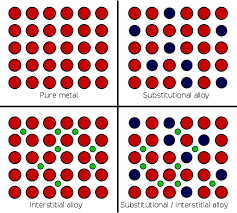
How are metals made harder?
Pure metals are softer than alloys because the particles can easily move past each other.
The differently sized particles in alloys interfere with lateral movement