Week 1 Part 1: Homeostasis & Cell Physiology
Homeostasis-
The maintenance of stable internal environment is essential for the normal healthy function of the body's cells, tissues and organs. It involves keeping conditions within tightly regulated physiological ranges.
Variables such as these are regulated by homeostasis:
- Blood glucose
- blood pressure
- ion balance
- water balance
The endocrine and nervous systems are particularly important as they allow communication- enables the body to maintain a stable internal environment and to adapt to changes in circumstances.
Mechanisms for maintaining homeostasis
- restores the normal state of body after its been disturbed
- Maintained through a feedback mechanism- feedback loop
Examples:
- Blood pressure- BP drops; to increase this there is vasoconstriction, increased re-absorption in the kidney (increased blood volume). BP increases; to decrease this there is vasodilation and increased excretion in urine (decreased blood volume)
- Body temperature
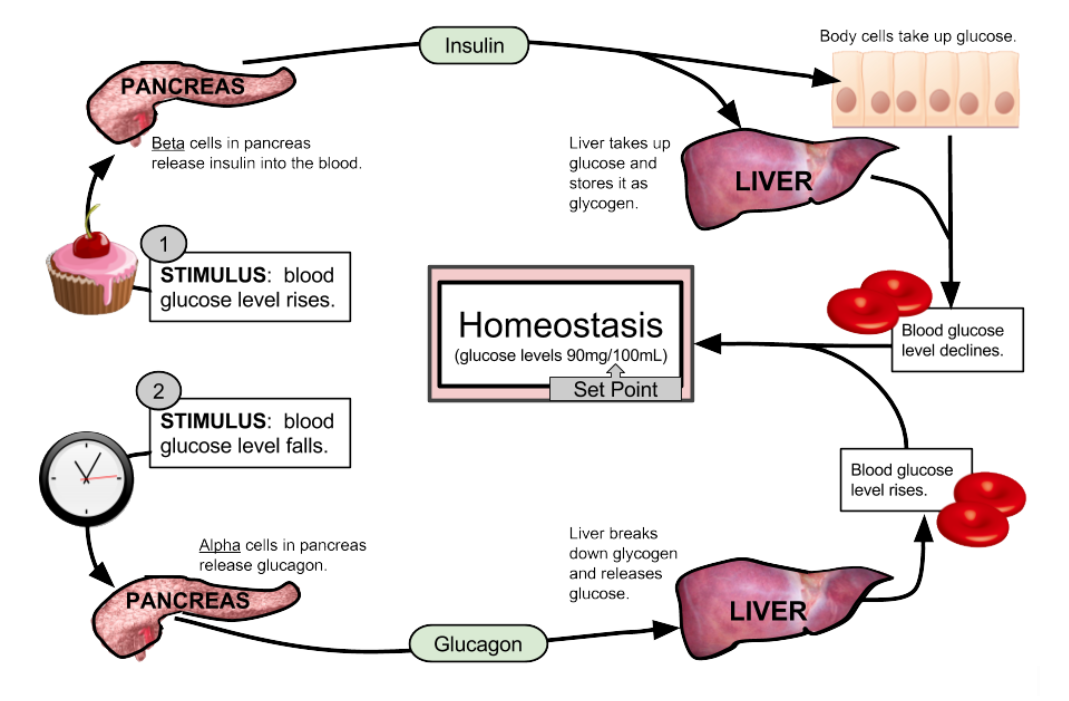
- Blood glucose
- Calcium levels
The components that maintain homeostasis:-
Sensor (receptor)- detects the variable, tells when something is not within the acceptable range.
Control centre- decides what to do with information from the sensor (e.g.brain).
Signal- transmits information from the control centre as to what to do next (also called a signal particle, often hormones are signals).
Effector- target organs where the signal has its effect, carries out the process to adjust the controlled variable.
Feedback loops
When the body is in homeostasis the set levels of all variables are within physiological range (dynamic balance). There is a dynamic balance between the set level and input at the comparator, an output to target organs.
- Stimulus occurs in internal/external environment that shifts the variable actual value and disturbs homeostasis and shifts the variable.
- Sensor obtains current info about a given variable. Monitor the environment and responds to the stimulus by sending info to control centre via afferent pathway.
- Comparator determines a set point (physiological range) and is where a variable is to be maintained. info travels from control centre to effector via efferent pathway. It compares current value from the afferent pathway (input) to a desired value within the physiological range.
- Effector modifies some parameters to restore the variable back to its physiological range.
If there is a difference between the set level and input at the comparator, an output to target organs will modulate the variable.
Negative Feedback
When change occurs in the opposite direction to the original stimulus:
- a feedback that reduces the output of a system
- a decrease in function in response to a stimulus
- the body’s variables are restored back to the steady state
Most homeostatic control mechanisms use negative feedback. Examples include:
- Acute restoration of blood pressure
- return of plasma osmolality to normal
- Temperature regulation
If there is a difference between the set levels and input at the comparator, an output to target organs will restore the variable.
Decreased variable
- The comparator output (efferent arm) will act to increase (⬆) the value of the variable.
- If the variable is decreased (⬇), then the sensor registers a reduced signal (⬆).
- Feedback info (to comparator) is reduced (afferent pathway).
Increased variable
- The comparator output (efferent arm) will act to decrease (⬇) the value of the variable.
- If the variable is increased, then the sensor registers an augmented signal (⬆).
- Feedback info (to comparator) is increased (afferent pathway)
Positive Feedback
- Enhances the stimulus so that the reaction continues at an even faster rate.
- Change occurs in the same direction as original stimulus and causes variable to deviate further from original range and usually controls infrequent events.
Examples of positive feedback:
- Labour –The uterus contracts more frequently and with greater strength after it has begun to contract.
- Micturition (urination) – increases after the flow of urine has started
### The secretion of oxytocin during childbirth - positive feedback:
| 1.Increased excitability of uterus | 2. Uterine contractions | 3. Foetus presses on cervix | 4. Afferent signal to hypothalamus | 5. Oxytocin secretion by posterior pituitary | Birth of baby terminates positive feedback |
|---|---|---|---|---|---|
| ⬆️ | ⬅️ | ⬅️ | ⬇️ |
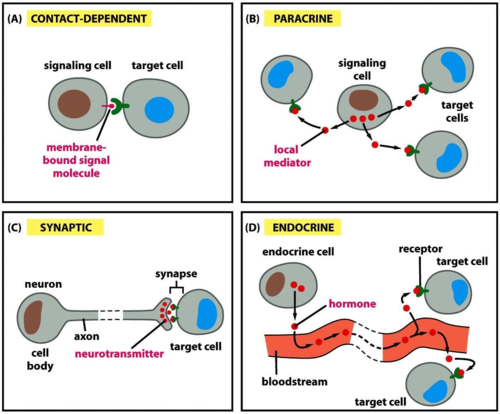
Communication os essential for homeostasis:
- Cell-to-cell communication: electrical and chemical signals e.g. physical touch/contact dependant.
- Long-distance communication: electrical and chemical (neurotransmitters, which use specialised long neurones and hormones, which use endocrine signalling).
- Intracellular signalling pathways: chemical signals activate a receptor, translate chemical signals to cellular signal and create a response.
Pathology (illness or death) can happen when changes are be too great or too rapid to be controlled by feedback mechanisms e.g.
- Sensors fail to detect changes
- Messages may be sent or fail to reach their targets
- Serious injuries can overwhelm the homeostatic mechanisms
- Viruses or bacteria can change the body’s internal chemistry