ATI DOCUMENTATION
Electronic health records (EHRs)
Systemic, digitized documentation system used to improve medical records. A computerized, real-time form of a client's paper chart that can be shared between members of the interprofessional team; includes information such as the medical history, diagnosis, allergies, and diagnostic testing results.
In 1997, the Institute of Medicine (IOM) recommended the adoption of EHRs nationwide in its advocacy for safer health care.
EHRs offer numerous advantages. For example, such electronic records allow providers to follow a client’s care from one facility to another, with information, including a complete medical history, being available instantaneously. EHRs also enhance communication between providers. Moreover, with legible documentation, medical and prescription errors are reduced, and more reliable coding and billing can occur. While EHRs offer convenience and improvements over the paper chart documentation systems of the past, their most important goal is to improve client care and provide for better health outcomes.
Scope of Practice
Documentation is not the sole responsibility of the registered nurse. Licensed practical nurses and assistive personnel (AP) as well as other providers are also responsible for documenting in the EHR. It is essential that nurses follow up on delegated tasks to ensure that everything has been documented appropriately in the client’s record.
A health record is an individualized collection of health information and data about a client’s health. It also identifies the health services that have been provided to the client, such as hospitalization and procedures. Many health records are now stored in digital or electronic formats, collectively referred to as EHRs. Electronic health records (EHRs) are real-time, client records that can be accessed by any authorized user, including the client. Complete client information is readily available and allows providers to make care decisions quickly. Care is improved and safety risks are decreased. Each client’s health record includes numerous components, such as demographics, vital signs, medical history, medications, allergies and immunizations, as well as other information. The client's electronic medical record is a digital compliation of the client's medical information. Included in the record are the client's diagnoses, treatments, medications, laboratory and radiology studies, and other health information. Clients have the ability to access their own health records, and health information can be shared with other providers and institutions.
Problem-Oriented Medical Records
Lawrence L. Weed, a physician, developed the problem-oriented medical record (POMR) as a more comprehensive and organized approach to recording and reading client data. This approach gathers information from all members of the interdisciplinary team. The POMR contains four components:
A database in which assessment data are documented
A problem list that lists the client’s problem chronologically
An initial plan that outlines goals, expected outcomes, and further data needed, if necessary
Progress notes using the SOAP (subjective, objective, assessment, plan) format
SOAP
SOAP documentation, as mentioned earlier, is a component of POMR that includes clinician observations. This type of documentation is widely used and allows clinicians to communicate in a systematic and organized way. The SOAP acronym also serves as a guide for clinicians when using the method.

PIE Model
The PIE model focuses on the client’s:
Problems
Interventions
Evaluations
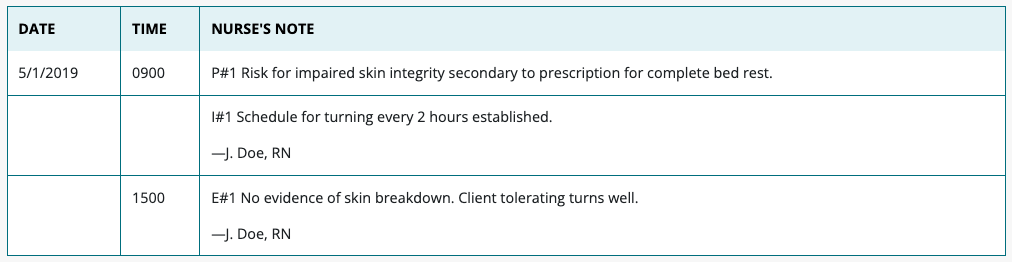
A simplified approach to documentation, this model uses both flowsheets and progress notes. When using the PIE model for a progress note, the problem is defined using a nursing diagnosis. The PIE model focuses on the nursing process and includes an ongoing plan of care instead of the traditional plan of care.
Focus Charting
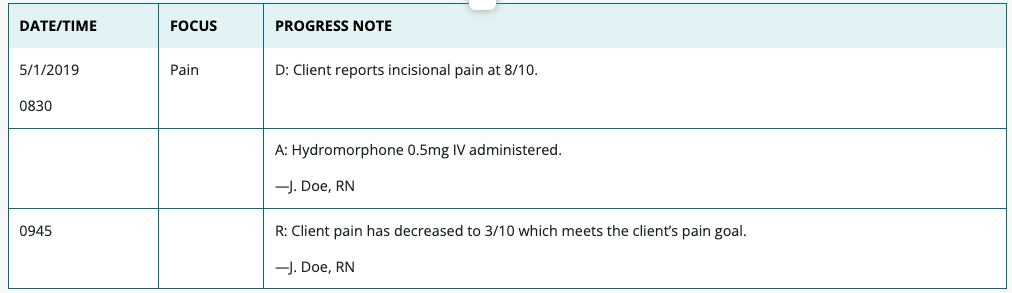
Focus charting documents a client’s specific health care problem by focusing on the nursing diagnosis as well as changes in the client’s condition, events, and concerns. The three items that must be documented when using the focused charting method are data, action, and response (DAR). Focus charting also includes immediate and future nursing actions.
Charting by Exception
The charting by exception (CBE) method focuses on documenting only unexpected or unusual findings based on standardized protocols. CBE involves the use of a physical assessment flowsheet with normal or expected findings. This type of charting can also be done in narrative form. There may be a need for additional documentation if the client’s condition changes from what is expected or the care plan does not match the standard care plan. Be aware that CBE is not the most effective form of documentation, as it creates the assumption that the client’s care was routine and followed all standards.
Documentation within the health record must be clear, accurate, and concise. This helps clinicians provide quality, safe, and evidence-based care as well as reduces medical errors. Information in clients’ charts is utilized by interprofessional team members, as well as for functions outside of client treatment, such as billing and payment, research, accreditation, and legal proceedings. To meet all of these needs, the information recorded must be concise, rather than overwhelming; provide accurate details of the client’s history and care; and include treatments and interventions. Record client data in a systematic method, in the time and sequence that events occur.
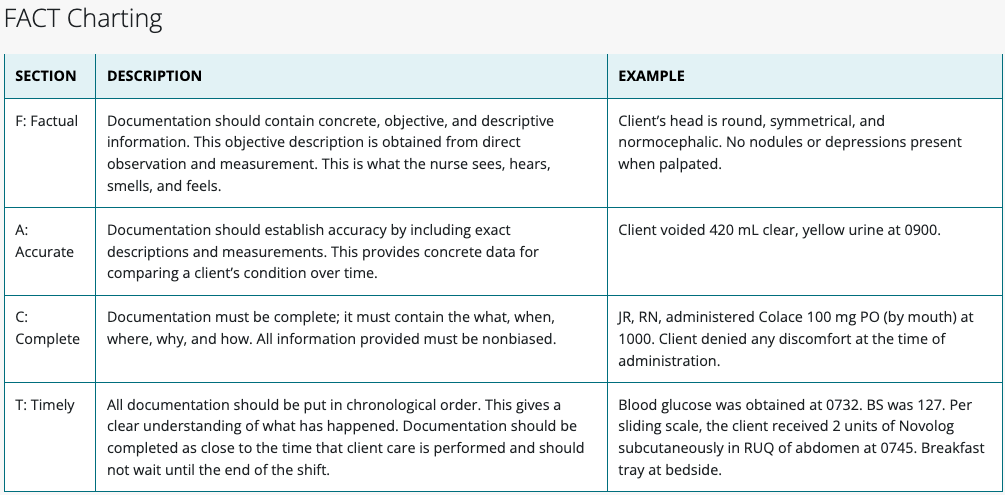
Consistency is an element of high-quality documentation. The FACT acronym provides a guide for accurate documentation including elements that promote consistency and complete documentation. FACT stands for factual, accurate, complete, and timely.
ABD | Abdomen |
a.c. or ac | Before meals |
Ad lib | At liberty (client can move around freely) |
BID or b.i.d. | Twice a day |
BK | Below the knee |
BP | Blood pressure |
cath | Catheter |
CBC | Complete blood count |
c/o | complains of |
CPR | Cardiopulmonary resuscitation |
C & S | Culture and sensitivity |
CXR | Chest x-ray |
DNR | Do not resuscitate |
DX | Diagnosis |
FBS | Fasting blood sugar |
GI | Gastrointestinal |
gtt | Drop |
H&H | Hemoglobin and hematocrit |
HOB | Head of bed |
hr | Hour |
Hx | History |
ICU | Intensive care unit |
I&O | Input and output |
IV | Intravenous |
LLE | Left lower extremity |
LMP | Last menstrual period |
LOC | Level of consciousness |
LUE | Left upper extremity |
MI | Myocardial infarction (heart attack) |
MRSA | Methicillin-resistant Staphylococcus aureus |
NG | Nasogastric |
NKA | No known allergies |
NKDA | No known drug allergies |
NPO | Nothing by mouth |
N&V, N/V | Nausea and vomiting |
O2 | Oxygen |
OOB | Out of bed |
per | Through or by |
PO | By mouth |
PRN | As needed |
q | Every |
r/o | Rule out |
Rx | Prescription |
Stat | At once, immediately |
TID | Three times a day |
Tx | Treatment |
UA | Urinalysis |
Wt | Weight |

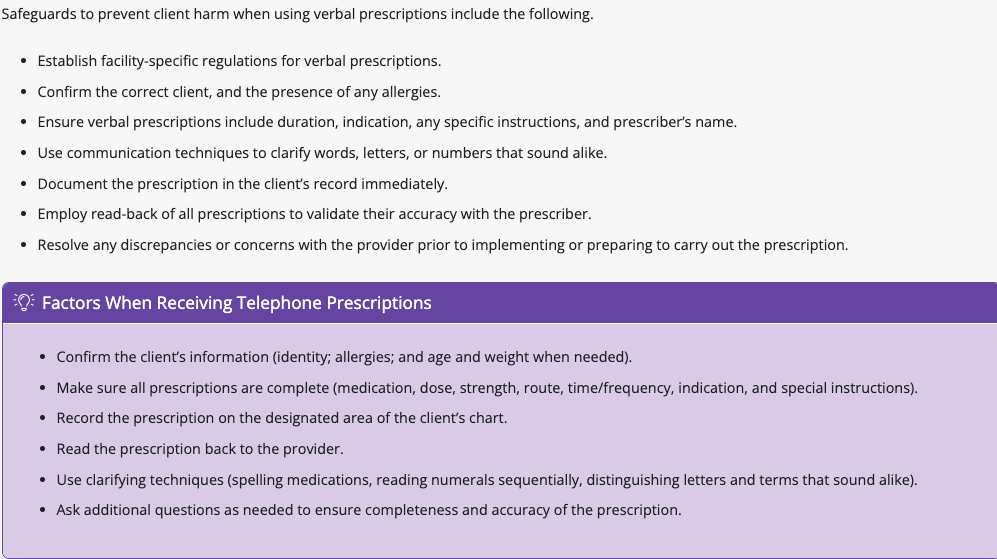
Verbal prescriptions are provided by health care providers who have the authority to prescribe treatments and medications. They can be received either in person or via the telephone (telephone prescription) by licensed personnel whom the facility designates as appropriate to receive the prescription. State regulations may vary regarding the process for verbal prescriptions.
Verbal prescriptions should be reserved for emergency situations due the potential for error in transcription and omission of safety safeguards that are built into computerized provider order entry systems. Vulnerabilities associated with verbal prescriptions may include the potential to misinterpret spoken language due to dialects or pronunciations; the presence of background interference and reception; confusion of clients with similar names and medications with similar-sounding names; and the provider’s lack of familiarity with the client in question. All of these factors can potentially lead to errors when making and taking telephone and verbal prescriptions.
When taking a verbal prescription, write it down in the client’s record as it is received so that it can be read back. The only time a prescription does not need to be written down immediately is when there is an emergency or in a sterile environment. In these situations, the nurse should repeat back the prescription prior to its implementation. Note that you should not accept verbal prescriptions for chemotherapeutic medications, unless the directive is to withhold or stop the medication.
The Health Insurance Portability and Accountability Act (HIPAA) was established in 1996 by the federal government with the goal of making health care more efficient. Part of the act, the HIPAA Privacy Rule, which took effect in 2003, created regulations that govern EHRs and are intended to protect the privacy of health care consumers. The HIPAA Privacy Rule provides clients with the assurance that their personal health information will be safeguarded by all members of the health care system. The rights guaranteed by HIPAA are meant to ensure that clients’ confidentiality is maintained when information is communicated with other members of the health care team or transmitted electronically.
Like other health care practitioners, nurses are bound by HIPAA: They have a legal obligation to protect their clients’ personal health information. The health information that nurses obtain must not be shared with anyone who is not directly involved in the client’s care; to do so is a violation of the HIPAA regulations. Nurses who breach these regulations can be punished by termination from the health care facility, fines, or imprisonment. Violating a client’s rights by allowing unauthorized access to their health care records, or by not protecting the confidentiality of those records, can also put the nurse’s license in jeopardy.
Although EHRs have proven to have great benefits, there can be legal ramifications if documentation is incomplete or inaccurate. Specifically, components of a medical record can be used as evidence in a court of law. Thus, nurses must follow the ANA’s standards, which require documentation to be factual, accurate, complete, timely, organized, and compliant. In using EHRs, nurses must also be aware of state and federal regulations, the health care facility’s policies, and their obligations to their profession to ensure documentation is accurate.
In another effort to improve client safety, in 2009 the federal government enacted the Health Information Technology for Economic and Clinical Health (HITECH) Act, which encouraged health care facilities to install computerized provider order entry (CPOE) systems. Implementation of CPOE has minimized medication errors and adverse drug events and resulted in fewer transcription errors. In addition, CPOE works by activating alert systems to notify the provider of a potential client issue such as a drug reaction.
CPOE systems can eliminate errors caused by illegible handwriting, inconsistent abbreviations, and lack of knowledge, thereby increasing client safety. Most of these systems include a clinical decision support system (CDSS) feature, which offers default factors for prescription orders. When a particular medication is prescribed, the CDSS will recommend doses, routes, frequencies of administration, and other safety features such as allergy checks, interactions, and laboratory warnings. Along with these safety factors, CPOE systems allow for quicker transmittal of provider prescriptions to the appropriate department.