Texas Republic
Extra Credit Ideas!
What is the name of the Comanche tribe who attacked at the council house fight. - Peneteka Comanche
Flags of the Republic
Treaties of Velasco
The Republic is Born!
Treaties of Velasco
Following the Battle of San Jacinto, Interim President David G. Burnet made the new temporary capital, Velasco, TX.
The Texans took Santa Anna to the temporary capital on May 14, 1836, and made him sign two Treaties of Velasco (one public, the other secret)
Public Treaty Terms:
Texas officially independent— war between TX and Mexico over
Santa Anna not to take up arms against TX again.
All Mexican forces withdraw south of Rio Grande.
Any Texan prisoners would be returned home.
Mexicans would return all captured property.
In return, Texas leaders would return Santa Ana to Mexico.
The second treaty, and secret treaty, stated that Santa Anna, in return for his life, would go back to Mexico and lobby for Mexico’s official recognition of the Texas Republic; additionally, was to get Mexico’s agreement of Rio Grande as border.
General Filisola did leave the troops back to Mexico.
Texas did NOT follow the treaty in full; kept Santa Anna as prisoner.
Sent to DC to negotiate peace between Texas and Mexico—nothing came of this attempt.
In return, the Mexican government now considered him a prisoner of war and no longer a president (devoiding him of legitimacy to sign treaties); consequently, they did not acknowledge Texas’s sovereignty for 12 years.
Election of 1836
Next on the list of necessary items was to elect official (non-interim) leadership.
In addition to choosing new leaders, decisions like, should Texas consider being annexed by the US were to be explored.
Three well-known Texans ran:
Sam Houston (5,119 votes)
Henry Smith (743 votes)
Stephen F. Austin (587 votes)
Houston won by a large majority, largely due to his recent success at San Jacinto (He had become known as “Old Sam Jacinto,“) but had only finally accepted to have his name placed on the ballot 11 days prior to the election.
Mirabeau Lamar (celebrated San Jacinto war hero, known as the “Keenest blade on the battlefield“) was elected as his vice president.
Sam Houston Sworn In
On October 22, 1836, just 5 months after the defeat of Santa Anna’s forces on the San Jacinto Battlefield, Sam Houston takes the oath of office, becoming the first President of the Republic of Texas.
Houston laid out his new plans out before the Texas Congress.
Making/sustaining peace with the natives.
Guarding Texas from Mexican takeover.
Eventual annexation into the United States
Houston Selects his Cabinet
An important part of any leader’s success is the people he/she surrounds themselves with. Houston chose many close to him, including those who served under him at San Jacinto.
Postmaster General - John Rice Jones
Secretary of Treasury - Henry Smith
Attorney General - James Pickney Henderson
Vice President - Mirabeau Lamar
Secretary of War - Thomas Jefferson Rusk
Secretary of Navy- Samuel Rhoads Fisher
Secretary of State - Stephen F. Austin
In Memorial of Stephen F Austin
Stephen F. Austin only served on Houston’s cabinet for a short time. Due to his life of ceaseless dedication to the Texas cause, coupled with exposure to the cold, he finally overworked himself — to death. Pneumonia ended the great leader’s life on December 27, 1836.
November 3, 1793 - December 27, 1836
“Texas is recognized… did you see it in the papers?“ - last words of SFA.
Houston declared 30 days of mourning in honor of the late leader of Texas.
In a statement mourning the loss of Austin, Houston remorsefully declared…
“The Father of Texas is no more…“
-Sam Houston
First Flags of the Republic
First flag of the Republic (The Burnet Flag), was adopted by the Texas Congress on December 10, 1836.
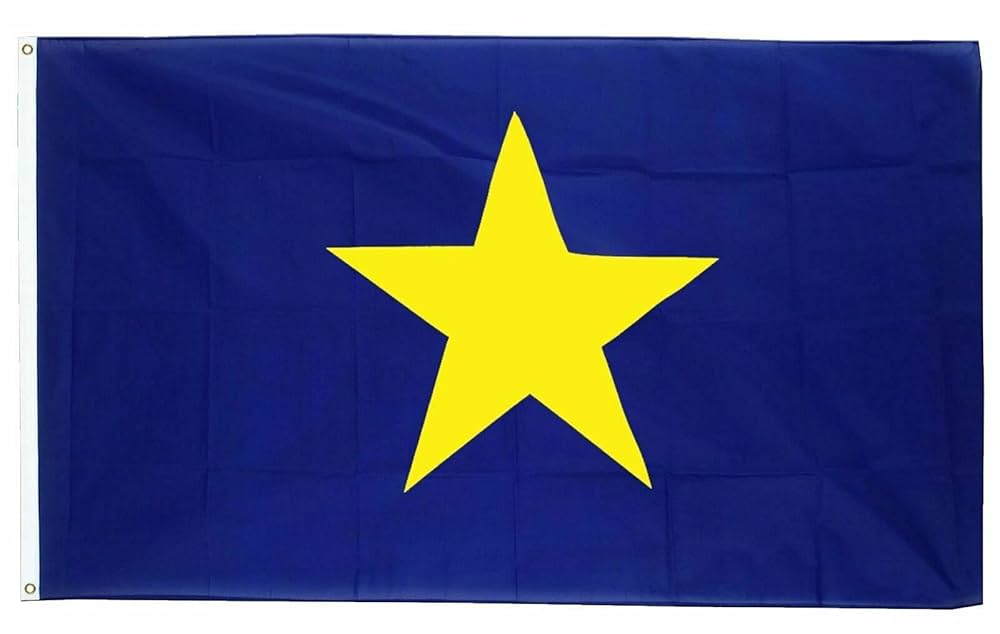
Our current flag (the Lone Star) was adopted three years later 1839; however, the original designer is not known to this day.

Border and Early Capital Disputes of the New Republic
When Houston took over as president, the Texas congress considered the Rio Grande (Rio Bravo), the southern border.
Of course, Mexico did not recognize this )Mexico claimed up the Nueces River.
Initially, there was no permanent capital. Velasco had been capital at end of revolution, and then moved to Columbia after war.
Town proved too small, so Congress moved it to the new town of Houston.
Grew from 12 residents in 1837 to 1500 four months later!
Houston and His Civil and Military Forces
Many Americans had come to help fight the revolution — only to find out they were late by the time they arrived in Texas.
Many brawls broke out as many Americans despised the Mexicans and wanted action.
Army commander, Felix Huston, was one of those eager to fight, and desired to invade Mexico.
Houston replaced Huston with Albert Sidney Johnston, who became injured in a duel with Huston.
With Johnston now unable to command, pressure mounted from other commanders to storm the capital and “chastise the president,“ kick congress of of doors, and give laws to Texas.
Houston solved the problem by “furloughing“ all but about 600 troops and never recalled them. Furloughing means like bye, you’re on summer vacation, but don’t come back until we tell you to, but Houston never tells them to come back.
Instead turns to militia and the Texas Rangers.
The Rangers had been formed by SFA in 1823 to protect from Karankawa Indian attacks.
Served (and still do) as an elite specialized defensive force.
Rough, tough, rugged, and deadly; provided their own horse and weapons (used the Colt .45 6-shooter revolver)
The Texas Navy had been formally commissioned in January of 1836; however, Houston found it difficult to fund/maintain.
One ship (the Liberty) was seized in New Orleans
Two more were almost seized in New York
The Independence was captured by the Mexican Navy
Houston ordered the Secretary of Navy, Samuel Rhoads Fisher to bring the remaining two ships into port (The Invincible and The Brutus)
Fisher decided to keep them out at bay and go on a sea raid of Mexican towns.
The Invincible was ultimately destroyed by two Mexican Navy vessels and the Brutus was lost in a storm.
Houston’s First Term
Economic Difficulties of the New Republic
The new republic found itself spending much more than it was generated in revenue. When Houston took office, the debt of the nation was $1.25 million.
Government attempted to pay debt via taxes, customs/duties on imports, selling some public lands, and attempting to get loans from the US.
U.S. was experiencing a financial crisis in 1837— The Panic of 1837 (a depression lasting through the Republic’s life)
Few manufactured items came from Texas so money left the Republic, but failed to come in.
More money (called “Star Money“) was printed, but there was no gold/silver to back it, so it was just paper.
Land Policy
Though Texas had little money, that had more than plenty of land—roughly 200 million acres of public land!
The Constitution of 1836 laid out requirements for acquiring:
Heads of families living in Texas (except African or Native Americans) got 4,606 acres for free (~3,500 foot ball fields!)
Single men over 17 got 1,476 acres.
Veterans of the war got an extra 640 acres.
Texas gave away 37 million acres under this policy.
Was intended to encourage settlement.
Established an immigration colonization policy based on the Empresario system in the 1840’s.
Houston’s Native American Policy
As Texas began “giving away“ large amounts of land, conflicts soon arose, as much of it was already inhabited by the Indians. Many were for the forcible removal of them from the lands— Houston opposed.
Houston wanted peaceful resolution with the Natives, and in addition, he sympathized with their cause.
Before Houston’s presidency, he had negotiated permanent land for his adopted tribe, the Cherokees, in east Texas
The Texas Senate refused to ratify this treaty now.
Houston urged his Cherokee brethren to be patient and know that they had his support.
He wrote to his friend Chief Bowels, the leader of the Texas Cherokees and offered reassurances, as well as setting specific land aside for the tribe.
In doing so, he angered many Texans who wanted the land to themselves.
Chief Bowles agreed to help his friend Houston work on establishing peace with the hostile plains tribes.
Fort Parker Massacre
Before Houston had sworn in earlier in 1836, the Fort Parker massacre had occurred in Groesbeck, Texas. 500 Kiowa and Comanche Indians killed 5 family members and captured several children, including Cynthia Anne Parker.
Basically, a family of Americans moved to Texas and ignoring the Texian’s warnings, they settled in Comancheria. Of course, this was not a good idea.
Houston and Congress put together a plan to try to quell the growing tensions between the Texans and the Indians.
Established a line of defensive forts across the frontier
Promoted trading with the natives to foster good relations
Deployed the Rangers to the frontier to “keep the peace“
Houston’s program was not popular; though he believed in the cause of white/native peace and coexistence, most just wanted them gone.
Texas Under Lamar
Lamar Elected to Office
Under Republic’s constitution, a president could not serve two consecutive terms. Mirabeau Lamar is elected after Houston’s first term ended in Sept 1838.
David G. Burnet elected Vice President.
Both Lamar and Burnet were deeply opposed to Houston and his policies.
Lamar was a poet and staunch advocate for education. Known by some as the “Father of Texas Education“
Passed Education acts in 1839/1840
- Each county received 17,712 acres of land for public schools
231,400 acres for future establishments of universities
Private college (first in state), Rutersville College in La Grange was established in 1840.
Lamar and His New Texas Capitol
Lamar, being adverse to anything Houston stood for, decided he did not like the current location of the Texas Republic’s capital…
To Lamar, Houston was too far to the east.
Wanted a capital more central as his ultimate ambition was to expand the republic’s territory westward.
Site chosen in 1839 was the small village of Waterloo on the Colorado river; renamed to honor the Late Father of Texas— AUSTIN!!!!!
Judge Edwin Waller was chosen to arrange the layout of the new city.
A temporary capitol building was soon built.
Many, including Houston, were against this new location — deemed dangerous and vulnerable to Mexican and Indian attacks.
Judge Edwin Waller was the first Mayor of Austin.
Lamar, Land, and Economy
Under Lamar, Congress passed a Homestead Law in 1839 designed to protect a family’s home and 50 acres from forfeiture due to debts.
As the administration’s financial situation worsened over time, this was very helpful to the citizens.
High debt accumulated under Lamar
Military spending (Texas Navy re-established)
Government spending
Currency continued to fall in value.
Lamar’s response was to produce “Redbacks“
Value almost worthless after only 3 years of use due to rampant inflation.
Lamar and the Indians
Lamar hated the Natives and wanted them gone at all costs. He did not sympathize for them as Houston did, and cared not for their previous claim to land.
Battle of the Neches
Chief Bowles and 100+ Cherokee Indians murdered after Kelsey Douglass, Thomas Jefferson Rusk, and Colonel Edward Burleson, were sent by Lamar to forcibly remove them from Texas near the Neches River in 1839.
Remaining Cherokees were pushed north into Indian Territory
Council House Fight
March 19, 1840. 65 Peneteka Comanches showed up the Council House in San Antonio. Was supposed to be a prisoner exchange/for peace. Only brought one prisoner — 16 year old Matilda Lockhart — brutally abused, her nose cut off. By time “Negotiations“ were over, 35 Comanches killed including 12 chiefs, 3 women, 2 children. 7 Texans killed and 10 seriously wounded.
Battle of Plum Creek
In retaliation for the massacre on their people at the Council House Fight, a large Comanche raiding force attacked and destroyed the towns of Linnville and Victoria, Texas.
20 settlers murdered, houses burned, livestock stolen.
Natives are literally cutting apart mattresses and began to shoot Texan Rangers in top hats and silk suits. 🤦
In retaliation, an attack party made up of Rangers, settlers, and soldiers found the Comanche party near present day Lockhart, Texas and killed more than 130. 1 Texan was killed and 7 were wounded.
Lamar’s Land Quest and the Santa Fe Expedition
Lamar’s ultimate desire was to expand the Republic’s territorial boundary westward, all the way to the Pacific Ocean. In 1836, Texas claimed the southern border of the state as the Rio Grande — including the New Mexican portion.
This meant half of New Mexico (controlled by Mexico) was included in the land claim of the Republic’s boundary.
In 1840, Lamar moves forward on an expedition to expand westward and capture the city of Santa Fe for trading purposes.
Sends 320 people and $200,000 worth of trading goods on the “Santa Fe Expedition“
Led by Col Hugh McLeod (from the Council House Fight)
Jose Antonio Navarro — well-known Tejano from the revolution was also a leader sent by Lamar.
The expedition is plagued with failure from the beginning!
Expedition takes off in June of 1841 from Brushy Creek (20 miles north of here) and heads on an aimless, wandering course north and westward.
Indian attacks, hostile and hot terrain, food and water shortage all contribute to a miserable march.
The terrain absolutely whips the men of the expedition. Eventually Mexicans capture the expedition members once it reaches New Mexico.
Marched back as Prisoners and placed in Mexico city jail for a year until their release is negotiated.
Expedition is a failure, but it promotes Mexican interest again in Texas.
Houston’s 2nd Term
Houston’s 2nd Term
Houston was up against David G. Burnet for president following Lamar’s term. Even though Houston was unpopular at the end of his first term, Lamar left the state in such a mess, people’s confidence returned to Houston to lead them out of the chaos. Col. Edward Burleson was chosen as the V.P.
In order to attempt to fix things leftover from Lamar’s presidency, Houston takes some of the following actions.
Tried to achieve a balanced budget.
Cut government jobs/spending
Cut size of Texas Army/Ranger force
Persuaded Congress to sell the Navy (tho it never happened)
As a result, spending dropped from $4.8 million/yr during Lamar’s rule to $500,00! Unfortunately, budget never balanced and debt was in $12 million by 1845.