Germanic-languages
Proto-Germanic (1500-500 BC): This period marks the emergence of the Proto-Germanic language, which is the common ancestor of all Germanic languages. It was spoken by the early Germanic tribes in what is now Scandinavia and northern Germany.
Settlements before 750 BC: The initial settlements of Germanic tribes before significant expansion. These early settlements were likely small and scattered, with the tribes living in relative isolation.
New settlements after 750 BC until 1 AD: Expansion of Germanic tribes into new areas. This expansion was likely driven by population growth, climatic changes, and the search for new resources. The spread of settlements would have facilitated the spread of the Proto-Germanic language.
New settlements until 100 AD: By this time, the Germanic tribes had expanded further, possibly reaching into areas that are now part of modern-day Germany, the Netherlands, and Poland. This period might also coincide with increased contact with the Roman Empire, influencing the Germanic languages.
New settlements after 100 AD: Continued expansion and migration of Germanic tribes. This period includes the beginning of the Migration Period (around 400 AD), where significant movements of Germanic tribes occurred, leading to the further spread and diversification of the Germanic languages.
Language Shift
The Anglo-Saxon invasions led to a significant language shift in Britain. The indigenous Celtic languages were largely replaced by Old English, a Germanic language brought by the invaders.
Dialectal Variation: The establishment of different kingdoms (like Mercia, East Anglia, and Wessex) led to the development of distinct dialects of Old English. These dialects would later influence the regional varieties of Middle and Modern English.
Cultural and Linguistic Integration: The interaction between the Anglo-Saxons and the remaining Celtic-speaking populations, as well as later Viking and Norman invaders, contributed to the rich tapestry of the English language, incorporating elements from multiple linguistic traditions.
Foundation of English: The Anglo-Saxon period laid the foundational grammar and vocabulary for the English language. Many core elements of Modern English can be traced back to this period.
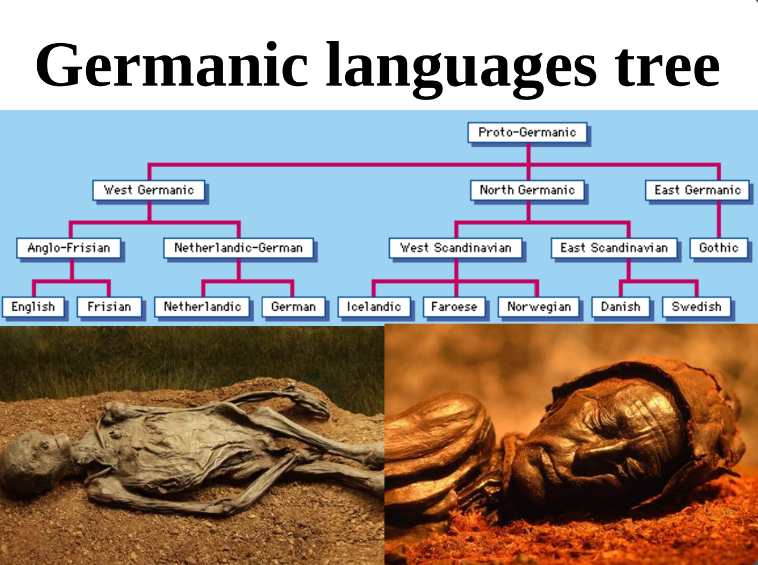
East Germanic Languages:
East Germanic tribes, believed to have migrated from Scandinavia to the Vistula River's mouth, include the Gepids, Rugians, Burgundians, Vandals, Visigoths, and Ostrogoths. Limited information exists on most of these languages, except for Gothic, particularly Visigothic, spoken near the Black Sea in the 4th century AD. Our knowledge of Gothic comes mainly from a Bible translation by Ulfilas/Wulfila, a Visigothic Arian bishop, for the Visigoths along the lower Danube.
Crimean Goths:
Crimean Goths were Gothic tribes that remained near the Black Sea, particularly in Crimea. They were the least powerful and least known but surprisingly the longest-lasting Gothic community. Medieval European legends spoke of a Gothic state in Crimea. In the 16th century, Ogier Ghiselin de Busbecq documented a conversation with two Goths in Constantinople and compiled a Gothic-Latin dictionary, revealing words similar to ancient Gothic.
Scandinavian Languages and Inflection:
Mutual intelligibility among Continental Scandinavian languages is asymmetrical, with Norwegian speakers being the most adept at understanding other languages in the group. While most Western European languages have significantly reduced inflection, especially in noun declension, Icelandic maintains a complex inflectional grammar similar to Latin and medieval Germanic languages like Old Norse and Old English.
Indo-European (IE) to Germanic (Gmc):
Vocabulary: Gmc includes many words without known cognates in other IE languages, likely borrowed from non-IE languages spoken in the Gmc region (e.g., broad, drink, drive, fowl, hold, meat, rain, wife).
Verb Simplification: Gmc lost all IE tense and aspect distinctions except for present and preterit (past) tenses. Verbs are categorized into:
Strong verbs: Form past tenses through internal vowel change (ablaut), e.g., drink/drank/drunk (7 classes based on vowel patterns).
Weak verbs: Form past tenses with a dental suffix (d/t), e.g., opened, learnt (3 classes).
Adjectival Declensions: Gmc features two types:
Strong (indefinite): e.g., ein guter König (a good king).
Weak (definite): e.g., der gute König (the good king).
Germanic Stress (Accent):
Shift from IE System: The Indo-European (IE) "free" accentual system, where stress shifted between syllables, was replaced in Germanic (Gmc) by a fixed stress on the first syllable.
Strong, Dynamic Stress: The first syllable is heavily stressed, causing unstressed syllables to weaken or disappear over time.
Word Shortening: This stress pattern led to the shortening of words, e.g., catte > cat, dogga > dog, lufu > love, openian > open, hadde > had.
Impact on Inflection: The reduction or loss of unstressed syllables contributed to the weakening and eventual loss of inflectional endings in Gmc languages.
Grimm’s Law (Jakob Grimm, 1822)
Grimm's Law describes a set of systematic sound changes that occurred in the transition from Proto-Indo-European (PIE) to Proto-Germanic (PGmc). These changes affected the stop consonants and are summarized as follows:
Voiceless Stops (p, t, k) → Voiceless Fricatives (f, θ, h/x):
PIE p → PGmc f (e.g., Latin pater → English father)
PIE t → PGmc θ (e.g., Latin tres → English three)
PIE k → PGmc h/x (e.g., Latin centum → English hundred)
Voiced Stops (b, d, g) → Voiceless Stops (p, t, k):
PIE b → PGmc p (e.g., Latin labium → English lip)
PIE d → PGmc t (e.g., Latin decem → English ten)
PIE g → PGmc k (e.g., Latin genu → English knee)
Voiced Aspirated Stops (bʰ, dʰ, gʰ) → Voiced Stops (b, d, g):
PIE bʰ → PGmc b (e.g., Sanskrit bhrātar → English brother)
PIE dʰ → PGmc d (e.g., Sanskrit madhya → English middle)
PIE gʰ → PGmc g (e.g., Sanskrit stighnoti → English sting)
Verner's Law explains a key exception to Grimm's Law in Proto-Germanic (PGmc). It states that voiceless fricatives (*f, þ, s, *h) became voiced ([v, ð, z, ɣ]) when they followed an unstressed syllable in the same word. Examples include:
IE pətér → PGmc fadēr (English father; contrast Latin pater)
IE upér → PGmc uber (English over; contrast Greek hyper, Latin super)
Verner discovered this while studying why Gothic fadar and broþar had different consonants after the root vowel. He linked the change to stress patterns, resolving a major inconsistency in Grimm's Law.
This law was celebrated by the Junggrammatiker (Neogrammarians) as it supported their principle that sound laws are exceptionless (die Ausnahmslosigkeit der Lautgesetze). It significantly advanced the understanding of sound changes in historical linguistics.
Old High German Consonant Shift (Second Consonant Shift):
The Old High German Consonant Shift, also known as the Second Consonant Shift, occurred between the 5th and 9th centuries AD. It further differentiated High German dialects from other West Germanic languages. This shift involved the following changes:
Voiceless Stops (p, t, k) → Affricates (pf, ts, kx):
p → pf (e.g., English apple → German Apfel)
t → ts (e.g., English tongue → German Zunge)
k → kx (e.g., English make → German machen)
Voiced Stops (b, d, g) → Voiceless Stops (p, t, k):
b → p (e.g., English lamb → German Lamm)
d → t (e.g., English day → German Tag)
g → k (e.g., English go → German gehen)
Voiced Aspirated Stops (bʰ, dʰ, gʰ) → Voiced Fricatives (b, d, g):
bʰ → b (e.g., English brother → German Bruder)
dʰ → d (e.g., English door → German Tür)
gʰ → g (e.g., English ghost → German Geist)
This shift is a key feature distinguishing High German from other Germanic languages and played a crucial role in the development of modern Standard German.
Old English Palatalization of Velars (k, g) near Front Vowels (i, e, æ) - 6th Century AD:
In the 6th century AD, Old English underwent a process called palatalization, where velar consonants (k and g) were softened when they appeared before front vowels (i, e, æ). This change led to the development of new sounds:
Velar k → Palatal č (ch):
Example: cild (child) → pronounced with a ch sound, as in modern "child."
Velar g → Palatal j (y):
Example: gēar (year) → pronounced with a y sound, as in modern "year."