Week 6: Succession, Climate, Biomes, and Ecosystems
Succession
The orderly replacement of populations of plants and animals in an area following a disturbance, until a stable community is established.
Climax Community: The stable community at the end of succession, determined by local climate, which has the largest population and species diversity.
Transition from r-selected to K-selected species indicates a shift from species that produce many offspring with less investment in each to those that produce fewer offspring but invest more resources in their care.
Reasons for Succession
Causes:
Succession is largely driven by the organisms themselves, modifying their environment to make it less favorable for current species and more suitable for others.
Consequences of Succession
Changes in community structure:
Increase in community diversity
Increase in abundance of species
Shift from r-selected to K-selected species
Types of Succession
Primary Succession:
Occurs in an area with no soil (e.g., newly formed volcanic islands or glacial moraines).
Progression: autotrophic prokaryotes → lichens and mosses → grasses → shrubs → trees.
Secondary Succession:
Begins in an area where soil remains after a disturbance (e.g., after a forest fire).
Role of Lichens
Pioneers: Lichens are vital in early stages on new rock and soil surfaces due to their ability to:
Break down rock through physical penetration and chemical attack.
Trap windblown soil.
Add nitrogen to soil, facilitating succession.
Indicator Species: Sensitivity to pollution means lichens can signal air quality issues.
Plant Life Succession
Succession on Bare Rock: The process from bare rock to climax community is driven by the changes induced by the vegetation itself.
Example in Alaska: After glacial retreat in Glacier Bay, pioneer species like alder are succeeded by Sitka spruce, western hemlock, and mountain hemlock.
Climate and Biomes
Climate Concepts
Climate: Long-term prevailing weather conditions in a region that significantly influence the distribution of organisms.
Determinants: The four major abiotic components are:
Temperature
Precipitation
Sunlight
Wind
Global Climate Patterns
Variations in heat and light from the sun affect climate zones; the tropics receive more direct sunlight than polar regions.
Seasonal changes in light and temperature correlate with Earth's tilt and orbit around the sun.
Latitudinal Influence
At the equator: warm temperatures and high precipitation
Deserts form at the Tropics of Cancer and Capricorn due to subsiding dry air.
Definition of Biome
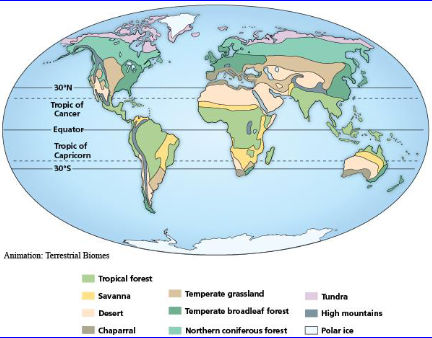
Biomes: Major types of ecosystems occupying broad geographic areas, characterized primarily by vegetation type and climate.
Terrestrial Biomes
Grassland Biome: Dominated by grasses.
Temperate Deciduous Forest: Dominated by deciduous trees.
Biomes are named after the mature plant community prevalent in the area and include adaptations specific to local climates.
Aquatic Biomes
Classified by physical and chemical characteristics, not by dominant vegetation.
For freshwater: water movement, depth, temperature, and salinity are key features.
Examples of Major Biomes
Terrestrial:
Tropical rain forest
Coniferous forest
spans northern NA and Eurasia
Temperate deciduous forest
Spans eastern NA and Asia, Europe, eastern AU, NZ, and southern Chile
Temperate grassland
Spans Great Prairies and Central Asia/ Mongolia
Desert
Tundra
North Pole and neighbouring region
Aquatic:
Freshwater:
Oligotrophic lakes
nutrient-poor, oxygen-rich, deep, cold, low productivity (most lakes in Canada
Eutrophic lakes
nutrient-rich, oxygen-poor, shallow, warm, high productivity
Rivers
Wetlands
inundated by water for some time
Marine: Estuaries (transition area between river and sea, e.g. where the Fraser River empties), Intertidal zones, Coral reefs, Open ocean
Ecosystems, Nutrient Cycling, and Climate Change
Characteristics Limiting Production
Terrestrial Ecosystems
Major Factors:
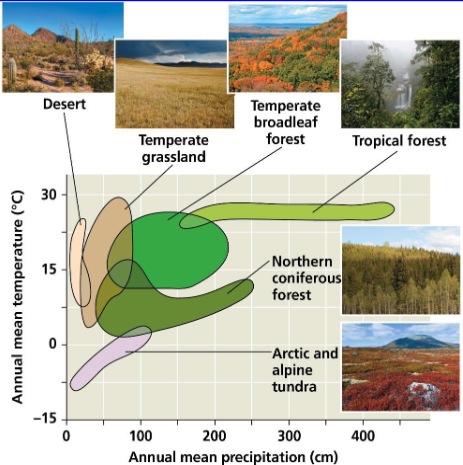
Temperature: Influences both growth and metabolism.
Precipitation: Affects water availability for organisms.
Climograph
plots annual mean temperature and precipitation in a region
Ecotone
transition from one type of habitat/ ecosystem to another (e.g. grassland to forest)
Aquatic Ecosystems
Limiting Factors:
Light: Limits photosynthesis, especially at depths.
Nutrients: Essential for growth but can limit productivity.
Primary Production Dynamics
Gross Primary Productivity (GPP): Total primary production in an ecosystem.
Net Primary Productivity (NPP): GPP minus the energy used for respiration by primary producers (availability to consumers).
NPP measurements reveal variations in ecosystem productivity:
High NPP: Tropical rainforests, estuaries, and coral reefs.
Low NPP: Marine ecosystems are unproductive per unit area but contribute significantly due to their vast surface area.
Nutrient Limitation
Limiting Nutrients: Elements required for production that are found in short supply; nitrogen and phosphorus are commonly limiting in marine contexts.
Eutrophication: Occurs when excessive nutrients lead to algal blooms, causing significant ecological impacts (e.g. loss of most fish species)
Key Chemical Elements Required by Organisms
Carbon and Hydrogen: Found in carbohydrates, lipids, proteins, and nucleic acids.
Oxygen: Found in organic molecules, essential for cellular respiration, which produces ATP.
Nitrogen: Essential for amino acids and nucleic acids.
Phosphorus: Important for nucleic acids and ATP.
Nutrient Cycling
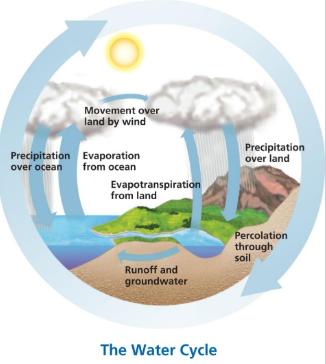
Water Cycle
Movement through evaporation, transpiration, condensation, precipitation, and through surface and groundwater driven by solar energy.
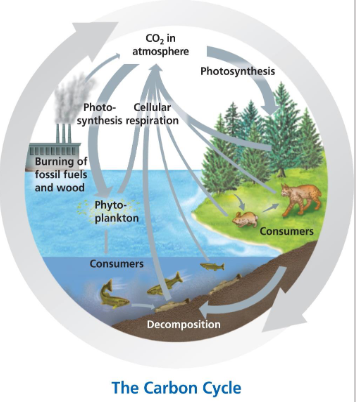
Carbon Cycle
Essential for organic molecules; involves processes like photosynthesis, respiration, and decomposition, with CO2 released from natural and anthropogenic sources.
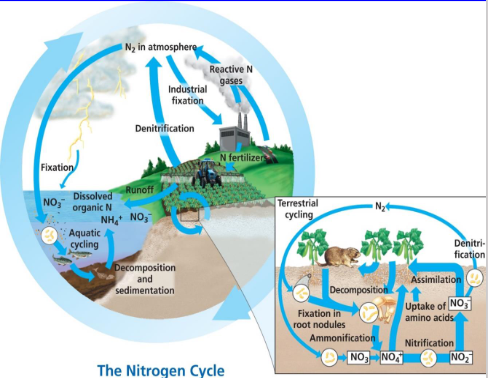
Nitrogen Cycle
Nitrogen must be converted by bacteria to forms available to plants (NH4+ or NO3–); atmospheric nitrogen is the principal reservoir.
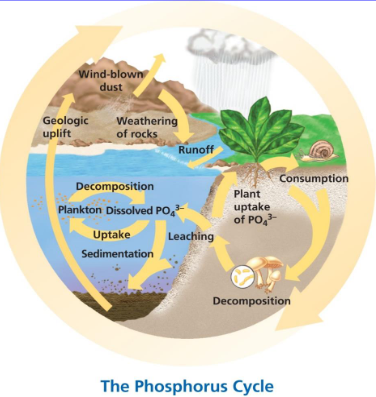
Phosphorus Cycle
Involves phosphate (PO4^3−) as the primary inorganic form; major reservoirs include marine sedimentary rocks and oceans
Human Impact on Nutrient Cycling
Activities disrupt ecosystems, affecting trophic structures and nutrient cycles.
Nutrient Enrichment: Includes the addition of fertilizers leading to environmental pollution and altered ecosystems.
e.g. DDT and CFC (chlorofluorocarbons)
Greenhouse Gas Effects: Rising CO2 levels due to human activities contribute to climate change, reflected by phenomena such as the Greenhouse Effect, which regulates Earth's temperature.
Greenhouse gases include
methane, water vapour, nitrous oxide, CFCs
Climate Change Implications
Effects include rising global temperatures, changing species distributions, and increased productivity in some plants, limited by nutrient availability.
Human-induced changes complicate existing ecological balances and biodiversity.