3. Data Collection
How will data be collected
Observational research - gather info about smth that little is know about by looking, listening, judging - study people/phen. in natural setting (answers how/why questions)
Existing info/ big data
Surveys - study behav/opinions - can be on paper/ online/ phone
(+) multiple Qs can be asked about same topic —> different aspect of same theoretical concept can be measure
Likert scales

Scale score = combination/mean of all different answers (e.g. answers to dif question on IQ test) —> is a construct (IQ is a constructed variable bc it is the result of lots of dif Qs)
Sampling options
A. Nonrandom samples
chance of bias/ distortion
generalising is NOT possible
low ext. val.
still often used in qualitative studies
Convenience sampling - researchers use participants who are easy to reach (e.g. UU psychologists recruiting UU students for small experiments)
Purposive sampling - researchers look for specific individuals who can provide important info (e.g. study about coping mechanisms in refugees will look for refugees who had it tough)
Quota sampling - convenience sample with requirement for no. within the groups
Snowball sampling - targeted sampling where participants are asked to recommend other ppl for the study
B. Random sample
sample is representative of the entire pop.
generalising to pop. is possible
high ext. val.
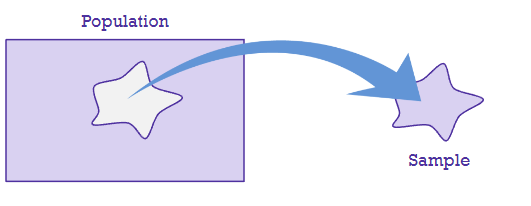
Simple random sample - requires list of all members of pop. and uses computer to select random participants (all participants have same chance of being selected)
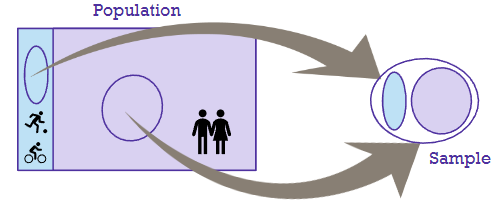
Stratified sample - combo of multiple random samples drawn from subgroup of pop. (to compentate for groups varying in size or having systematically dif experiences)
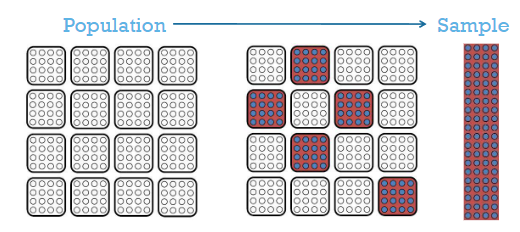
Cluster sample - divide pop. into clusters and randomly select some of them
Multistage sample - from prev random cluster select random individuals
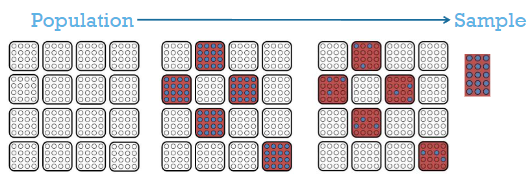
Systematic sample - assuming pop. is ordered in some way, you pick every n-th individual
Potential errors:
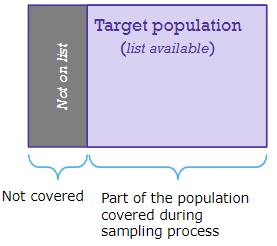
Coverage error - not everyone is included in the list we draw from —> biased results
Non-response errors - some people refuse to participate or answer Qs —> biased results