MODULE 4: Logic
Inverse
Converse
The converse of the proposition “p —→ q” is the proposition “q —→p”
Contrapositive
DEFINITIONS
Logic: Study of valid reasoning
Statement: Declarative sentence that is either TRUE or FALSE, but not both.
A statement is the basic building block of logic.
Logical Statements = Propositions
A statement cannot be true & false as the same time, nor can there be any uncertainty about the truth of a statement
Examples of Logical Statements (Propositions)
Washington, D.C., is the capital of the United States of America. —> True
Toronto is the capital of Canada. —> False
1 + 1 = 2. —> True
2 + 2 = 4. —> False
Examples of sentences that are NOT logical statements:
What times is it? —> This is a declaration, not a statement
Read this carefully —> This is a declaration, not a statement
x + 1 = 2 —> Neither true nor positive
x + y = z —> Neither true nor positive
Compound Statement
Def: Statement created by connecting/joining two or more simple statements together using one or more connectives (e.g. AND)
Example:
Statement A —> 2 is an even number
Statement B —> 2 is a prime number
Compound Statement (A + B) —> If 2 is an even number then 2 is a prime number
Propositional Variables
Def: Lower case letter used to represent a simple statement
Can be combined using connectives to form/represent a compound statement
Examples:
Let p represent the statement “She is rich”
Let q represent the statement “She is famous”
p AND q —→ “She is rich AND famous”
p OR q —→ “She is rich OR famous”
NOT p —→ “She is NOT rich”
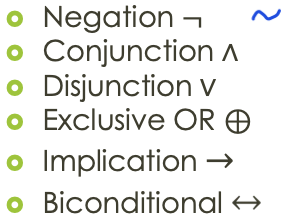
Connectives/Operators
Several connectives are used to combine simple statements (to form compound statements)

Truth Tables
Def: Tool used to identify all the possible true & false combinations for a statement.
Number of Combinations
In general, there are 2n possible truth value combinations where ‘n’ is the number of simple statements involved
A simple statement has 2 possible combinations
A compound statement formed from two simple statements has 4 possible combinations
Converse, Contrapositive, and Inverse
Converse
Def: Creating a new proposition from a pre-existing proposition, by switching the positions of the condition and outcome.
Examples
The converse of the proposition q → p is the proposition p → q
The converse of “If you receive a grade above 95 in the final exam, then you will pass this course” is “If you pass this course, then you received a grade above 95”
Contrapositive
Def: The proposition related to a pre-existing proposition that has the same logical meaning.
Examples:
The contrapositive p —> q is ¬q → ¬ p
The contrapositive of “If you receive a grade above 95 in the final exam, then you will pass this course” is “If you don’t receive a grade above 95 in the final exam, then you won’t pass this course.
Inverse
Def: Creating a new proposition from a pre-existing por
From p → q we can form new conditional statements…
q → p is the converse of p → q
¬q → ¬ p is the contrapositive of p → q
¬p → ¬ q is the inverse of p → q
From the following compound statement, we can form new conditional statements…
“If it rains, then I will not go to town.”
Let a = “It rains”
Let b = “I will not go to town”