Evaluate the effects of a decrease in trade union membership on the UK labour market
Chain of reasoning Point 1
One effect of falling trade union membership is that the reduced collective bargaining power of workers may lead to lower real wages
This is because trade unions lobby on behalf of their members with employers for better real pay and conditions.
If unions are less powerful, an employer with monopsony power might be able to take people on by offering reduced terms.
They may pay workers a going wage rate less than would be the case if wages were set in competitive labour markets
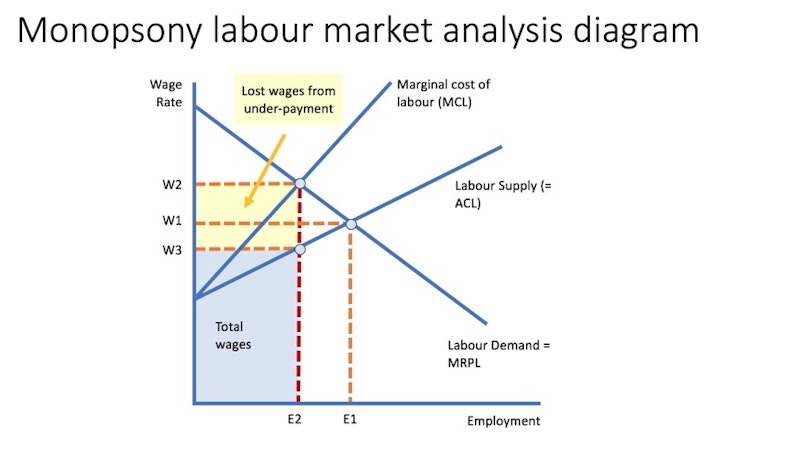
This is shown in my monopsony diagram where profit maximising employment level is E2 & MRPL = W2 but the wage on offer is only W3
Wage W3 is below the value of marginal revenue product of labour and suggests workers without trade union protection might be exploited
However, despite the reduction in trade union power workers wages may be protected by legislation such as the national minimum wage that has recently increased to £12.21
Because of this, monopsony’s will not be able to exploit workers as substantially whether they are apart of a trade union or not due to the wage floor
Furthermore, especially in the instance of public sector monoposony’s - this reduces worker exploitation - connected to government - image
Nonetheless, this still remains a poor argument as despite the arguably more ethical practices in the public sector we have seen on recent Jr Doctor strikes as well as bin men strikes despite the rise in National Living Wage - which implies that this may simply not be enough is regards to MRP generated
Therefore a reduction in trade union power will reduce the power of workers to essentially correct the government failure perhaps due to info failure which has resulted in the National Living Wage set too low - yet workers now do not have the choice
Conversley, via a reduction in trade union power 22.4 % in 2023 and 50% relatively in the 1970’s - which arguably resulted in the Winter of Discontent - resulted in higher wages. Therefore, the government may not feel as much intense pressure regarding barriers for employment such as minimum wage or the wage demanded by trade unions
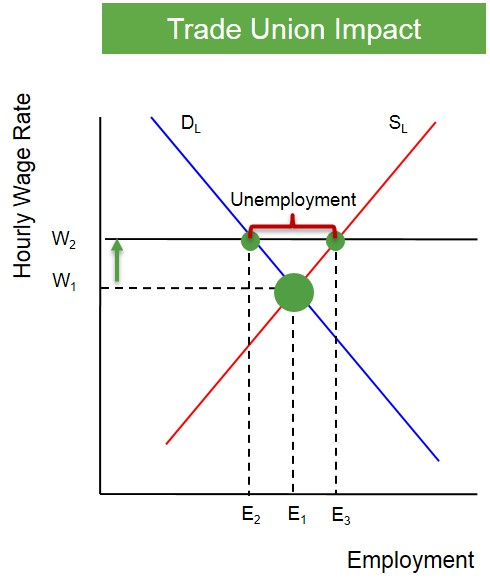
As shown by the diagram, as a result of trade union power, the competitive equilibrium wage is increased to W2 and therefore resulted in unemployment from E2 to E3
Therefore, As the AD for labour and the AS of
labour both depend on the level of real wages, if money wages are low in relation to prices,
firms will demand more labour. Businesses would have more capacity as a result of lower
wages as they can employ more people, allowing them to produce more. As firms produce
more and increase their revenue, they are able invest into more technology which would
increase productivity and allow them to make more profit in the long run.
Therefore
Less unemployment
Higher price or lower quality: higher wages means higher cost of production, in
markets that have inelastic demands, firms might pass on the higher costs to
consumers in term of higher prices or lower quality goods
Competitiveness
Fewer day of work loss - reduction of adstenteenism
However, in evaluation the reduction of trade unions may have a negative effect on the labour market via productivity and this is because trade unions can work with employers and give invaluable advice on how to improve working conditions as well as fair wages.
Therefore, via an improvement to working conditions, this will improve worker morale as well as this an increase in wage rate encourages the supply of labour to increase - backwards demand curve - and this may in turn reduce spare capacity - increase unemployment and improve MRP if wages are used as an incentive to improve productivity. Furthermore, a decrease in protection from workers who are not generating sufficient revenue will provide firms more power to act efficiently - removing workers who do not add to revenue.
Moreover, It is true that we saw labour productivity increase when unions were weakened after Prime Minister Thatcher successfully attacked the unions.
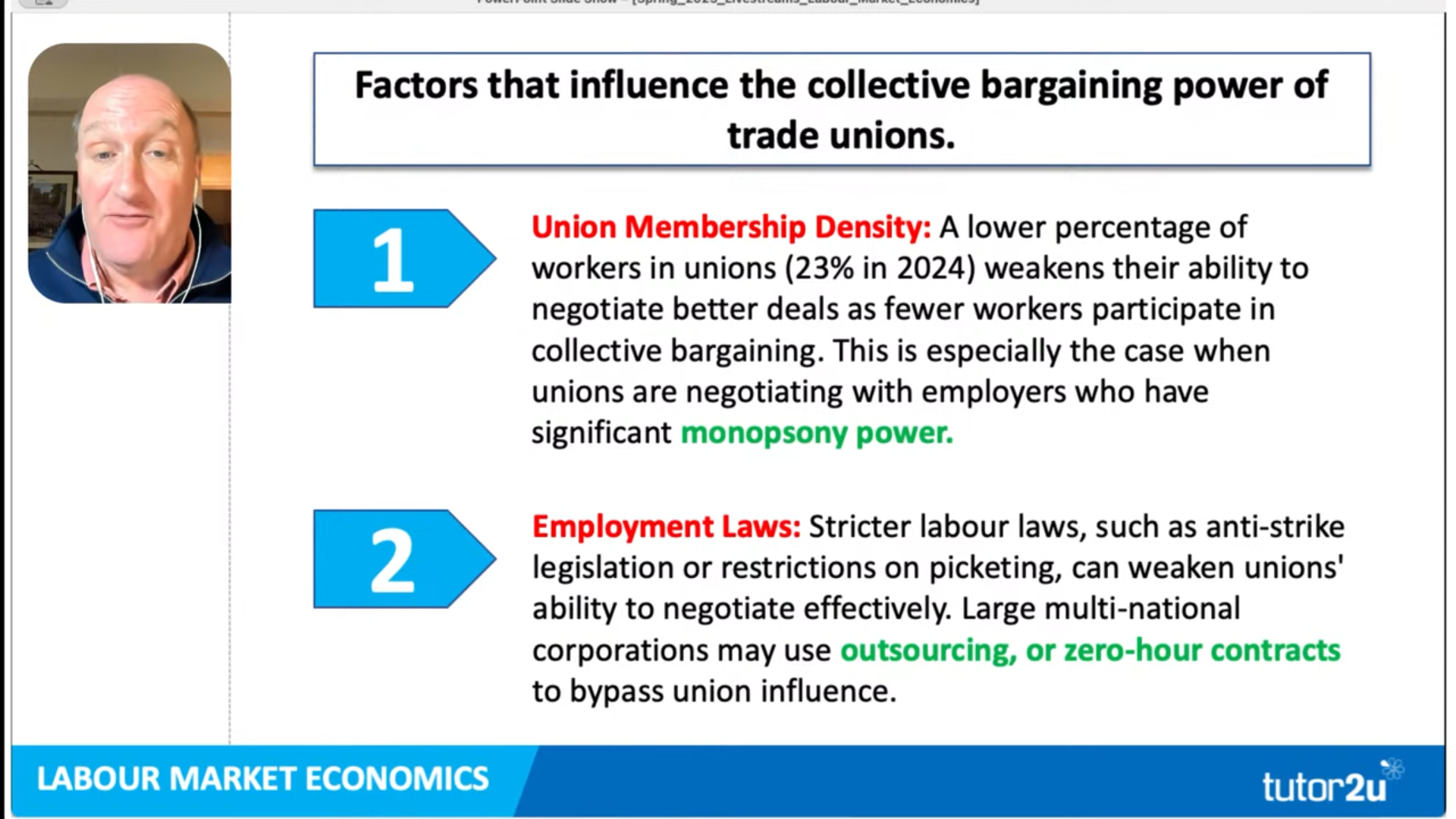
On average 1 in 4 workers are not apart of a trade union
In order to reduce labour immobility - the UK economy can provide Work Visas