Theory
Intervals:
- The combinations of intervals gives music different shapes. It can be:
- Conjunct
- Disjunct
- Chromatic
- An arpeggio is the rising and falling melody using the notes of a chord
- Broken chords are alterations of the first, third, and fifth degrees of a scale
- Scales are sets of notes ordered by increasing or decreasing pitch
Melodies:
- There are three ways to describe a melody:
- Diatonic melodies are based on major and minor scales
- Chromatic melodies are notes outside the music key
- Atonal melodies aren’t based on a key or tonal centre
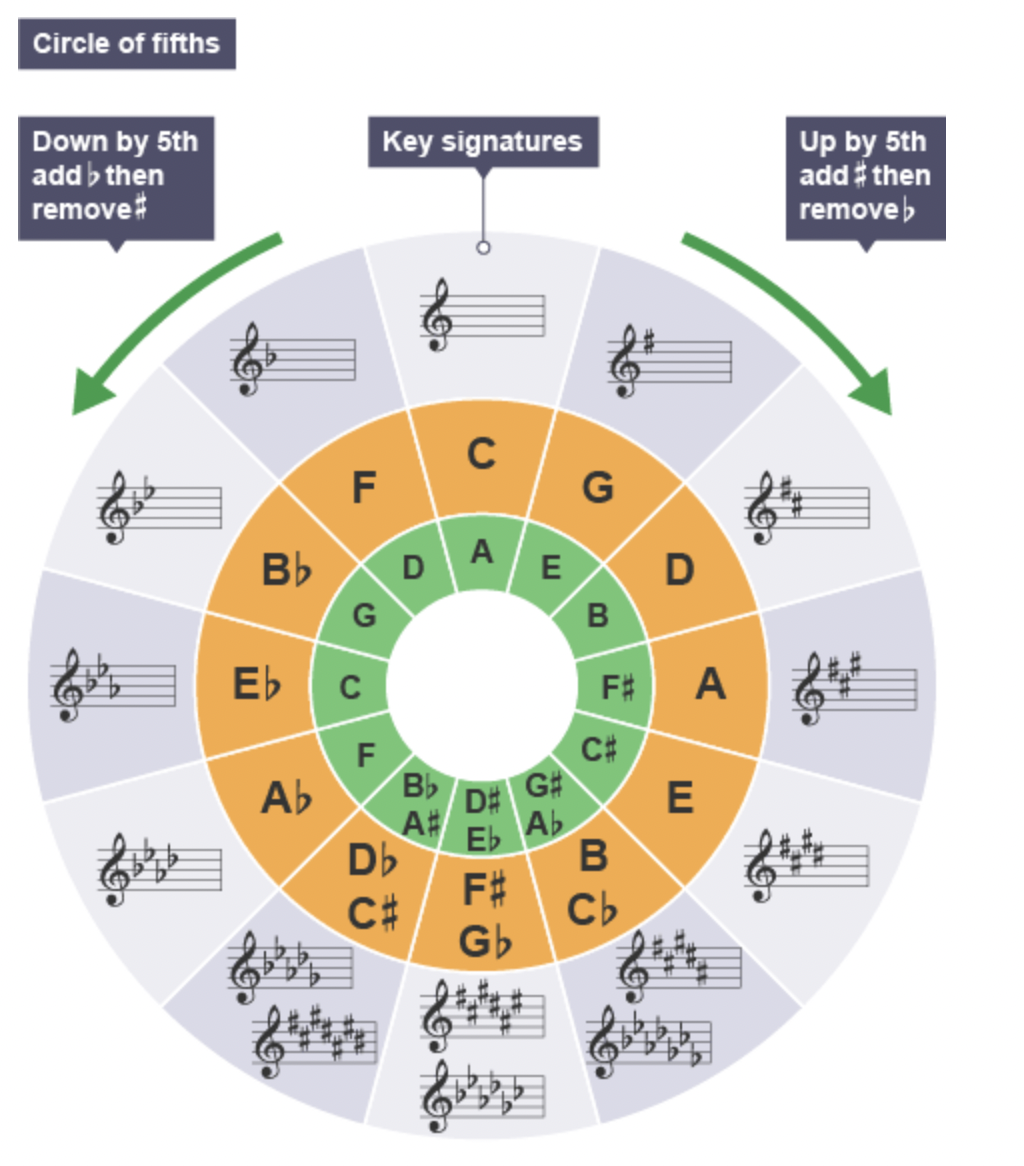
Phrases:
- End with cadences
- Musical sentences
Types of Chord:
- Triad
- 3 notes
- Root, third and fifth
- Dominant and subdominant
- I - tonic
- IV - subdominant
- V - dominant
- Sevenths
- The dominant seventh of a V chord is shown as V7
- Concord
- All notes agree with each other
- Complete
- Discord
- Notes clash
- Unsettling
- Diatonic
- Notes belonging to a key
- Chromatic
- Notes outside a key
Cadences:
- Perfect cadences are V - I
- Interrupted cadences are minor and surprising
- Imperfect cadences end on V. They sound unfinished
- Plagal cadences sound finished. They are IV - I
Sometimes cadences end in major chord instead of an expected minor chord. This is a Tierce de Picardie
Tonality:
- The character of music related to its key is tonality
- Tonal music - major or minor key
- Atonal music - not related to tonic, no sense of key
- Modal music - in a mode
- Dorian mode
- Mixolydian mode
Modulation:
- When music changes key, it modulates
- This generally happens to a closely related key
- The keys which are closest to the tonic are the dominant, subdominant or relative minor/major keys
Bass:
- Drones are held or repeated chords through a piece of music
- Usually a bare fifth
- Pedals are single notes which are held on or repeated in bass parts
- Inverted pedal notes sustained or repeated in a higher register
- Ground bass is used in baroque music. The bass part is repeated throughout the piece. They can last for many bars
- Ostinatos are repeating patterns/motifs
Structure:
- Repetition
- Some sections are repeated
- Double bars
- Double bar lines (sometimes with repeats) happen at the end of sections
- Keys, cadences
- Some structures modulate to specific keys at certain points
- There are clear cadences at the end of sections, which indicate key changes
- Melodies
- Some sections have distinctive melodies
- Textures
- Some music has specific textures in specific sections
- Words
- Any repeated text will help identify structures
Musical terms (stolen from BBC Bitesize):
| Music Term | Meaning |
|---|---|
| Largo | Slowly and broadly |
| Andante | Fairly slow - at walking pace |
| Moderato | At moderate speed |
| Allegro | Fast |
| Vivace | Lively |
| Presto | Very quick |
| Accelerando | Gradually speeding up |
| Rallentando | Gradually slowing down |
| Ritenuto | Immediately slower |
| Allargando | Getting slower and broadening |
| Rubato | Literally 'robbed time', where rhythms are played freely for expressive effect |
- Compound time is where each beat is a dotted note, for example, 6/8, 9/8 and 12/8
Rhythmic Techniques:
- Syncopation - notes held over beats, instead of only offbeats
- Cross rhythm - two conflicting rhythms heard together
- Polyrhythm - two or more rhythms with different pulses are heard together
- Triplets - three notes played in the time of two
- Hemiola - Gives the impression of music speeding up, but instead, they are the changing of time signature
- Diminuition - musical idea repeated with note values halved
- Augmentation - musical idea repeated with note values doubled
- Offbeats - the weaker beats of the bar
- Anacrusis - Musical phrase starting just before the bar line
- Rubato - performer has the freedom to relax the tempo
Simple dynamics (courtesy of BBC bite-size):
| Dynamic marking | Meaning |
|---|---|
| < | Crescendo: getting louder |
| > | Diminuendo: getting quieter |
| pp | Pianissimo: very quiet |
| p | Piano: quiet |
| ff | Fortissimo: very loud |
| f | Forte: loud |
| mf | Mezzo forte: fairly loud |
| mp | Mezzo piano: fairly quiet |
| sf | Sforzando: sudden accent |
| > (marked near note head) | Accent: emphasis on a particular note |
Simple articulation (BBC Bite-size):
| Term | Meaning |
|---|---|
| Legato | Notes should be played smoothly |
| Staccato | Notes are shortened |
| Tenuto | A note to be played for its duration |
| Sforzando | A note should be given sudden emphasis, similar to an accent |
| Marcato | This is a type of accent associated with string playing. Pressure needs to be placed on the bow and then released quickly and explosively. |
Vocal range examples:
| Voice | Description | Famous examples |
|---|---|---|
| Treble | A boy’s high unbroken voice - sometimes refers to a boy soprano | Ernest Lough singing Hear My Prayer |
| Soprano | A high female voice | Renee Fleming, Maria Callas, Björk |
| Mezzo-soprano | A medium high female voice | Cecilia Bartoli, Katherine Jenkins, Beyoncé |
| Counter-tenor | Male alto or soprano, sometimes described as falsetto | Andreas Scholl, Justin Hawkins of The Darkness |
| Alto (contralto) | A high male or low female voice | Janet Baker, Kathleen Ferrier |
| Tenor | A high male voice | Pavarotti, Placido Domingo, Jeff Buckley |
| Baritone | A medium male voice | Bryn Terfel, Elvis Presley |
| Bass | The lowest male voice | Willard White, Paul Robeson, Barry White |
Texture:
- Unison
- No chordal accompaniment
- Monophonic
- One line of music
- One instrument
- No accompaniment
- No secondary melody
- Can be done in unison
- Homophonic
- Block chords / choral music
- Polyphonic
- Aka contrapuntal music
- May have imitation
- Add ornaments
- Change in octabe
- Same melody in notes of different duration
- Fugues
- The specific type of polyphonic texture
- Begin with the melody played on a solo instrument, voice, or in unison
- Then it is played by all of the other instruments in turn, but not at the same pitch
- Heterophonic
- Simultaneous variation of a single melody line
- Variations played over the original melody
- ie gamelan
- Antiphonal
- More than one group of instruments/voices
- Played in different parts of the concert venue
- Melody passed between the groups
- Melody and accompaniment
- You can clearly distinguish between the two
- Countermelody
- Secondary melody played in counterpoint with original melody
- Common in fugues
- Descant
- Additional melody played on top of existing texture
- Last verse of carols when sopranos sing higher
Notes: 1 Tonic 2 Supertonic 3 Median 4 Subdominant 5 Dominant 6 Submediant 7 Leading note
8 Octave
Tonality:
- F major scale has one flat
- C major scale has no sharps or flats
- Enharmonic notes - when a note can be called two different things (for example Eb and D#)
- Relative minors
- Count down three semitones
- The pattern of melodic minor keys is:
- Tone - semitone - tone - tone - tone - tone - semitone ascending and tone - tone - semitone - tone - tone - semitone - tone descending
- Harmonic minors use the relative major and raise the seventh note
- Minor scales
- Melodic minor
- The sixth and seventh degrees are raised on the way up and flattened on the way down
- Harmonic minor
- Augmented second between the sixth and seventh degree of the scale
- Triads of a key are shown using roman numerals
- Modal - This means that the music is in a mode
- Atonal - This means that the music is not related to a tonic - no sense of key
- Tonal - In a major or minor key
- Pentatonic scale - a five-note scale. Usually, it will be I, II, III, V, VI (especially common in Chinese and Japanese music)
- Whole Tone scale - scale where there are ONLY whole tones between the notes used (6 notes total, especially common in impressionism)
- Working out sharp keys (major) - look at the last sharp, and go up one step
- Working out flat keys (major) - look at the second to last flat
Tempo key terms (courtesy of bitesize):
| Music Term | Meaning |
|---|---|
| Largo | Slowly and broadly |
| Andante | Fairly slow - at a walking pace |
| Moderato | At moderate speed |
| Allegro | Fast |
| Vivace | Lively |
| Presto | Very quick |
| Accelerando | Gradually speeding up |
| Rallentando | Gradually slowing down |
| Ritenuto | Immediately slower |
| Allargando | Getting slower and broadening |
| Rubato | Literally 'robbed time', where rhythms are played freely for expressive effect |