The Lost Cause
The Civil War and Reconstruction were painful subjects for many Virginians and other Southerners. Their terrible defeat had transformed the Southern way of life, and many believed that the South had become the victim of Northern aggression. Though the South lost the war, they did not stop fighting the war of words that continued afterward. Throughout the second half of the nineteenth century, Southerners developed their own interpretation of the Civil War, one that cast the Confederates in the best possible light and remembered the South before the Civil War as a peaceful, happy society. This dominant interpretation of the history of the Civil War and Reconstruction is known as the "Lost Cause." It is important to understand this concept, which has become part of the culture of the South and has been under debate for generations.
Six Tenets
Historians have identified six basic ideas that define the Lost Cause interpretation. First, the Lost Cause holds that slavery was not the cause of the Civil War. The war was about preserving the Union and the issue of states' rights. Second, Lost Cause advocates believed that enslaved Africans were loyal to their masters, believed in the Confederate cause, and did not want the responsibility that came with freedom. They frame the antebellum South as a happy, peaceful society where blacks and whites lived in harmony where, after the war, freed blacks were confused and frightened at their newfound freedom. Third, the Confederates fought with honor and were not defeated on the battlefield itself. They lost the war only because of the North's incredible advantages in manpower and industry.
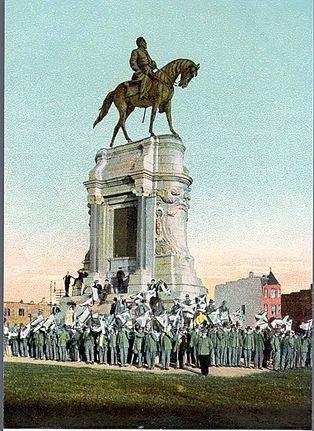
Lee statue on Monument Avenue in Richmond, Virginia
Fourth, the Lost Cause emphasizes the honor and chivalry of Confederate soldiers. They were men of integrity who lost to a superior foe not because of their weakness, but because of circumstance. Fifth, above all, Confederate General Robert E. Lee is deified. The Lost Cause elevates him to an almost Christ-like level. Lastly, the Lost Cause romanticizes the role of Southern women who remained loyal and self-sacrificial throughout the war.
Origins of the Lost Cause
The Lost Cause interpretation has its origins very soon after the end of the war. The term itself, most historians believe, was coined by a journalist in the Richmond Examiner as early as 1866. It arose as a concerted effort among journalists and former Confederate leaders, who were shocked over their loss and concerned that only the Union version of the war would be preserved in the historical record. They intentionally began to record their interpretation of the war. In 1869, for example, former Confederate officers met and established a historical society devoted to defining how future generations would view this time in history. They defined their message and began writing histories, articles, poems, and journals that expressed their shared vision. Beginning in 1876, the institution that came out of this meeting even began publication of the Southern Historical Society Papers, with the express purpose of espousing the Lost Cause interpretation. Jubal Early of Lynchburg, Virginia, was among the most influential, especially in glorifying and defending Robert E. Lee and establishing the Virginia Theater as the most important of the war.
When Lee died in 1870, there was an enormous outpouring of grief in the South, which led to the formation of two institutions most important in preserving and growing the influence of the Lost Cause, the United Sons of Confederate Veterans and the United Daughters of the Confederacy. These two institutions established and preserved Confederate monuments and landmarks and controlled how future generations understood the Civil War.
Legacy of the Lost Cause
One big question historians have tried to answer is why the North accepted and even internalized the Lost Cause as well. After all, the Lost Cause did not paint the North in a pleasant light. While some did protest the cultural movement to glorify the Confederate cause, many Northerners accepted it. Though most of its tenets are demonstrably false, the interpretation was attractive to Northerners, especially in the decades after Reconstruction, because it facilitated a peaceful reunification of the country. It allowed the South to keep its perceived honor while Northerners joined in a shared nostalgia for a lost social order.
However, while the Lost Cause mended the wounds among white Northerners and Southerners by turning the vilification away from the North, it also portrayed emancipated African Americans as a threat to democracy in the South. Nothing solidified these ideas in white Americans' minds more than D. W. Griffith's landmark 1915 film The Birth of a Nation, which glorified the KKK as heroes of the South who broke the tyranny of African American influence. Though the film certainly caused controversy in some quarters, American culture absorbed and internalized its images and message.
Only during the Civil Rights Movements of the 1950s and 1960s did a few textbooks begin to admit that slavery was the main catalyst of the Civil War. The Lost Cause view became a justification for racist policies and presuppositions for well over a century.