Pastoral System - Sheep Farming in Australia
Characteristics and Location of Sheep Farming
Land Use and Scale: Sheep farming in Australia occupies approximately . This makes it one of the major land uses in the country.
Farming Classification: It is a classic example of an extensive farming system.
Physical Inputs: The primary physical input is the extensive use of natural open ranges. These ranges are often fragile in nature.
Location: Australia's sheep farms are located predominantly in inland and semi-arid areas.
Human Inputs: Compared to other types of agriculture, human inputs are low. There is a very low use of labour and capital per hectare.
Core Processes: The main farming processes include:
Grazing
Lambing
Dipping
Shearing
Outputs: The system produces lambs, sheep, wool, and sheep skins.
Global and Economic Importance
Global Standing: Australia is the world's leading sheep-producing country, with a total population of approximately .
Global Trade Roles:
Largest wool producer and exporter.
Largest exporter of live sheep.
Major exporter of lamb and mutton.
Economic Impact: The sheep and wool industry represents a vital sector of the Australian economy.
Sheep Breeds and Distribution
Regional Distribution: Sheep are raised throughout southern Australia in areas with moderate to high rainfall, as well as the drier regions of New South Wales and Queensland.
Breed Composition:
Merinos (): These produce very high-quality wool for clothing. They are characterized by their ability to survive in harsh environments while still producing heavy fleeces.
Meat Breeds (): These are a mixture of breeds, specifically named as Border Leicester and Dorset, bred primarily for meat production.
Mixed Breeds (): A mixture of Merino and cross-bred sheep utilized for both wool and meat production.
Farm Statistics: There are roughly in the country. Farm sizes vary significantly, carrying anywhere from a few hundred sheep to over .
Geographical Zones of Production
Sheep and wool production is organized into three distinct geographical zones:
High Rainfall Coastal Zone: Areas typically closer to the coast with higher precipitation.
Wheat/Sheep Intermediate Zone: A middle zone where sheep farming is combined with wheat cultivation.
Pastoral Interior Zone: This is the arid and semi-arid inland area where farming is at its most extensive.
Environment: Characterized by high summer temperatures, low rainfall, and a high prone to drought.
Vegetation: Due to the lack of grass in this inhospitable environment, sheep often consume saltbush and bluebush.
Density and Inputs: Approximately of all sheep are farmed here. Sheep density per hectare is extremely low due to poor forage quality. Labor, capital, energy, and other inputs per hectare are the lowest in the country. Farms in this zone are typically extremely large.
Land Use Competition and Marginal Areas
Land Selection: In the coastal and intermediate zones, the highest quality land is reserved for:
Arable farming
Dairy and beef cattle
Market gardening
Marginal Lands: Sheep are often relegated to marginal areas, such as the higher and colder highlands of New South Wales, where more profitable farming types are not viable.
Farm Scale: Approximately of Australia's sheep are located on farms supporting more than . Smaller farms are usually found on better-quality land where higher stocking densities are possible compared to the pastoral zone.
Current Farming Issues
Weed Infestation: Difficult to control on very large extensive farms because profits per hectare are relatively small.
Habitat Destruction: Sheep grazing has led to the destruction of wildlife habitats, particularly in marginal areas.
Drought: Periodic droughts increase the difficulty of farming in low-rainfall regions.
Soil Degradation: Issues include soil loss from wind erosion and the loss of soil structure. This process is transforming traditional mainstream farming areas into marginal lands.
Animal Welfare: Concerns exist in inhospitable environments where low human input means individual animals may not be monitored for long periods.
Labour Shortage: There is an increasing shortage of experienced sheep shearers.
Many shearers have left the industry due to poor working conditions and higher-paying opportunities in the mining industry.
The number of experienced shearers decreased by approximately between .
Productivity Note: A good shearer is capable of shearing up to .
Landscape Fragility: The industry operates in a generally fragile landscape. Changes in farming systems are required to prevent a progressive decline in the utility of the resource base.
Case Study: An Arable System - Intensive Rice Production in the Lower Ganges Valley
Location and Context
Region: The Lower Ganges valley in India and Bangladesh.
Productivity: The Ganges basin is the most extensive and productive agricultural area in India and is also its most densely populated region.
Bangladesh Delta: The delta region occupies a large part of Bangladesh, one of the world's most densely populated countries.
Dietary Importance: Rice contributes over of the diet in many parts of this region.
Physical Requirements for Rice Cultivation
Temperature: Temperatures of and above throughout the year. This allows for two crops to be grown annually. Rice requires a growing season of only .
Rainfall: Monsoon rainfall exceeding provides the water necessary to flood fields for wet rice cultivation.
Soil: Rich alluvial soils created through regular monsoon flooding over long periods.
Harvesting Conditions: A seasonal dry period is essential for harvesting the rice.
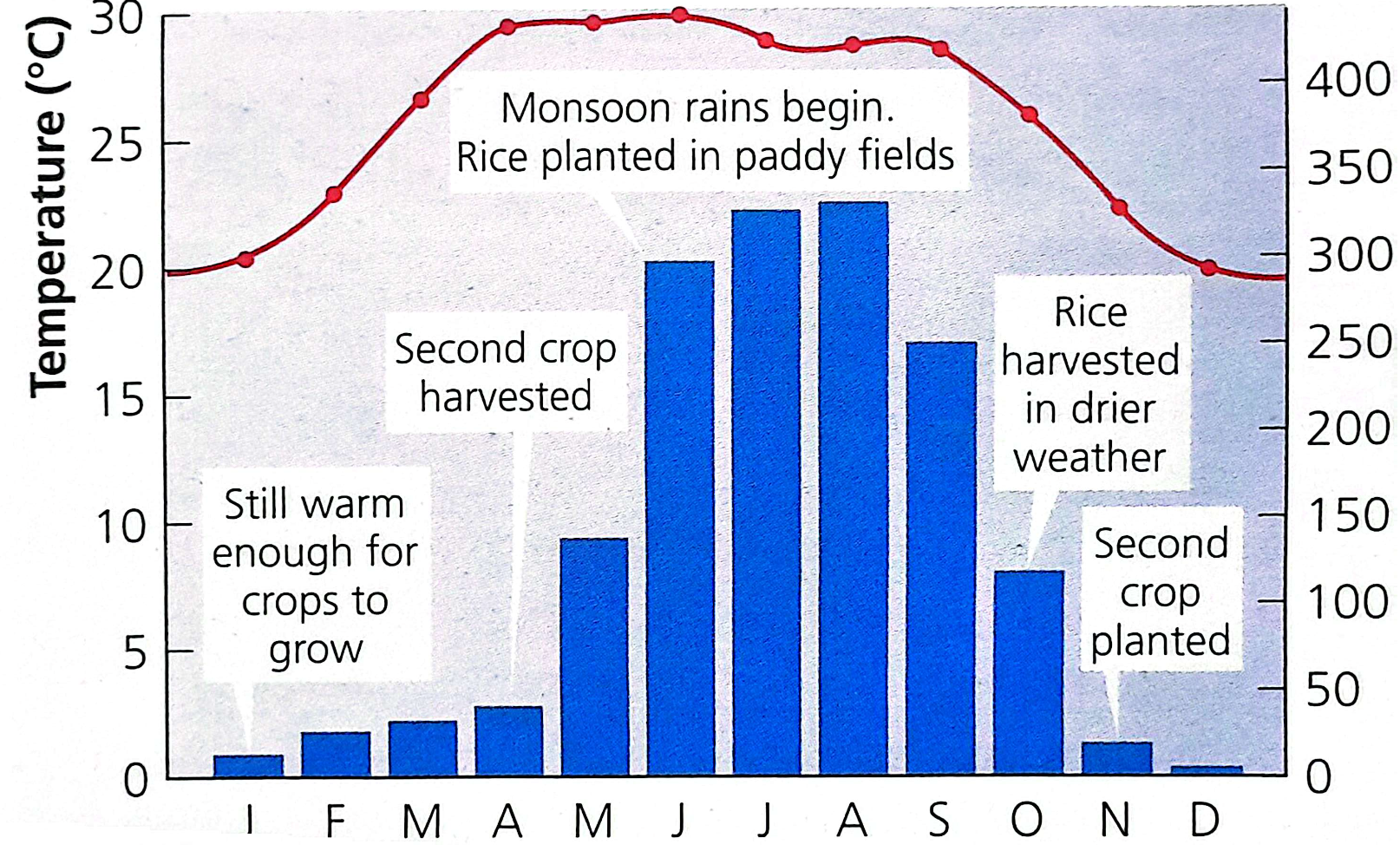
Resource Intensity and Farm Characteristics
Water Intensity: Rice is extremely water-intensive. of agricultural water in Asia is used for rice production.
Water Requirement: The International Rice Research Institute estimates it takes to produce .
Farming Classification: Much of the production is classified as intensive subsistence cultivation.
Pre-modern Intensive Farming: Characterized by very small plots of land and very high labor input using traditional techniques, unlike capital-intensive systems in High-Income Countries (HICs).
Wet vs. Dry Rice:
Wet Rice: Grown in fertile silt and flooded lowlands.
Dry Rice: Cultivated on hillside terraces (levelled sections of hilly areas). Terracing aids in soil conservation and prevents rapid runoff of irrigation water. Dry rice is easier to grow but yields are lower than wet rice.
The Farming System and Processes
Paddy Fields: Characteristics of lowland production involve flooded parcels of land called paddy fields. Water is supplied via the Ganges flooding or gravity canals.
Cultivation Cycle:
Nursery: Rice is first grown in nurseries.
Transplanting: Seedlings are moved to paddy fields when monsoon rains flood them.
Harvesting: The main crop is harvested when the drier season begins in late October. High yields per hectare are common.
Second Crop: A second crop can be planted in November, though water supply can be an issue.
Animal Assistance: Water buffalo are used as draft animals. They are uniquely adapted to wetlands and provide manure for the fields, although manure is also used as domestic fuel.
Labour Requirements: Rice cultivation is extremely labour-intensive, providing jobs in densely populated areas with few other employment options. It takes an average of to farm of land.
Specific Labour Tasks:
Building and stabilizing embankments (bunds) with tree crops like coconut and banana.
Constructing irrigation canals.
Nursery planting, ploughing, transplanting, weeding, and harvesting.
Tending livestock (chickens) or other crops in the dry season.
Farm Economics:
Farms are generally small ( or less).
Seeds are stored from the previous year's crop.
Tenant Farming: Many farmers pay for land use by giving a share of their crop to a landlord.
During dry seasons with insufficient water for rice, farmers grow cereals and vegetables.