1d. Terms of trade
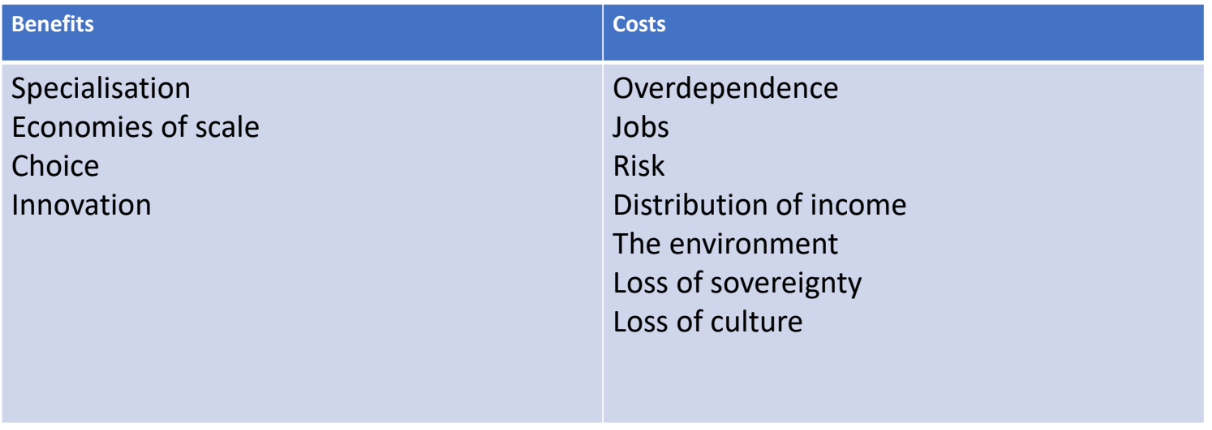
Benefits and costs of trade
Terms of trade

This gives an index figure and tells us the quantity level of exports that need to be sold in order to purchase a given level of imports. It is the ratio of export prices to import prices.
An improvement means the price of the exports can buy more imports than it could previously. For this to happen either export prices increase or import prices decrease (or both)
If it has deteriorated it means the prices of the exports can buy less imports than it could have done before. This means either the price of exports has decreased or the price of imports has increased
Assuming comparative advantage of country 1 is 2 for Product A to Product B and country 2 is 3. The ToT would be in between these two numbers
if it was greater than 3 country 2 wouldn’t benefit
if it was lower than 2 country 1 wouldn’t benefit
if the ToT is in exactly in between the 2 numbers both have an equal advantage however if it isn’t there is a disparity in between the benefits they get from trading
Changing Terms of Trade
If export prices are rising faster than import prices, then the terms of trade index will improve. This means that fewer exports have to be given up in exchange for a given volume of imports.
If import prices rise faster than export prices, then the terms of trade have deteriorated. A greater volume of exports has to be sold to finance a given amount of imported goods and services.
Changes in terms of trade
If export prices are rising faster than import prices, then the terms of trade index will improve. This means that fewer exports have to be given up in exchange for a given volume of imports.
If import prices rise faster than export prices, then the terms of trade have deteriorated. A greater volume of exports has to be sold to finance a given amount of imported goods and services.
Changes in terms of trade
Short run
Demand/supply of imports/exports
Relative inflation rates
Exchange rate movements
Long run
Incomes
Productivity
Technology
Terms of trade and the current account
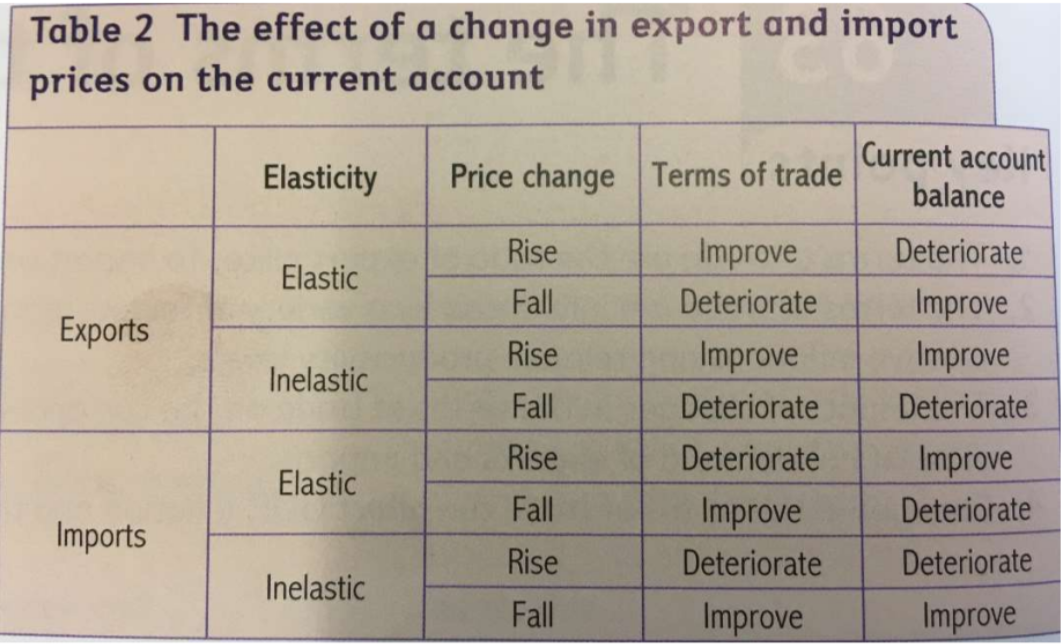
Elastic Exports Falling → when elastic goods have a fall in price the ToT would fall aka deteriorate as the export to import fraction becomes smaller and the current account (exports-imports) would increase / improve as export amount increases as demand increases due to elastic fall in price
Terms of trade and the domestic economy
If the terms of trade improve due to an increase in export prices this might mean (depending on elasticity) that less exports are demanded.
This would have negative impact on the export sector which could lead to a fall in GDP and an increase in unemployment.
Impact of improving terms of trade
Living Standards
Improving terms of trade mean you can buy more imports for your exports, meaning a higher standard of living
Inflation
Cheaper import prices can lower cost-push inflationary pressures. Furthermore higher export prices can lead to less demand-pull inflation
Current Account of the Balance of Payments
Cheaper imports should lead to more imports, whereas more expensive exports will lead to less exports, leading to a deterioration in the current account...
• ...as long as the Marshall-Lerner condition is met. If demand for exports and imports is in fact price inelastic then the current account will improve before it gets worse
Developing countries and the terms of trade
As developing countries tend to specialise in agricultural goods their terms of trade have been deteriorating.
This is because agricultural goods are income inelastic (necessities) which means demand for them stays constant as income increase (leading to stable prices) whereas imports of manufactured goods are more income elastic (leading to higher prices from more demand as incomes increase)
Additionally productivity in agriculture has tended to rise faster than productivity in manufacturing meaning higher supply and hence lower export prices.
This decline in terms of trade of developing countries is called the Prebisch-Singer hypothesis
Developing countries and the terms of trade
Prices for agricultural goods can also be volatile (due to supply changes) as can the price of commodities (due to demand changes)- this leads to problems as without consistent export earnings it makes it hard for countries to invest and diversify their output and avoid deteriorating terms of trade
Would an improvement in the terms of trade be preferable for the UK?
This depends on what caused the improvement in the terms of trade. If it is factors such as low productivity and high inflation these will have a negative impact on the domestic economy. However, if it is due to factors such as higher quality exports then this will be positive.
It should be noted that an improvement in the terms of trade is likely to lead to an improvement in the current account as UK demand for exports and imports is inelastic.