Section 8h: Laser Hair Removal And IPL (Pg. 315-332)
History of Laser (Pg. 315)
In 1900 Max Planck discovered the relationship between energy and frequency of radiation, saying that energy could be emitted or absorbed only in discrete chunks known as quanta. Think of a lamp; instead of smoothly dimming or brightening, imagine it can only change brightness in set jumps—like clicking up a notch at a time. That’s how energy behaves at a tiny scale, like with atoms and light.
In 1817, the Theodor Grotthuss law (the Principle of Photochemical Activation) states that only that light which is absorbed by a system can bring about a photochemical change. Light can only cause a change if the material "catches" or absorbs it; for example in LHR, only light absorbed by the melanin in the hair will result in the heating and subsequent destruction of hair follicles. Or sunscreen, absorbs UVA/UVB rays, not indoor artificial light.
In 1917, Einstein theorized stimulated emission, which stated that the photon released by the second atom would be identical in frequency, energy, direction, and phase with the triggering photon, and the triggering photon would continue on its way, unchanged. This idea is the foundation of lasers! Lasers work by causing many atoms to release identical photons, creating a powerful and focused beam of light, all moving in sync—just like perfectly timed claps in a crowd!
In 1951, Charles Hard Townes conceives his MASER Idea: Microwave Amplification by Stimulated Emission of Radiation.
Gordon Gould was the first person to use the word “laser”. Gould made the first light laser as a doctoral student at Columbia University under Charles Townes.
In 1960, Theodore Maiman invented the ruby laser, considered to be the first successful optical or light laser!
In 1996, Rox Anderson M.D. discovered that it was possible to selectively target a specific chromophore with laser to destroy hair follicles. In 1997 hair removal lasers were approved for “permanent reductions” in the United States by the FDA.
LASER - Light Amplification by the Stimulated Emission of Radiation; if enough amplification occurs a LASER beam is created.
Bringing It All Together with an Example: Think of a row of dominoes. If you push one, it knocks over the next, and so on. But imagine instead of falling randomly, each domino perfectly copies the speed, direction, and timing of the first one. That’s what happens inside a LASER—light photons trigger more identical photons, amplifying the light into a strong, focused beam.
What is LASER? (Pg. 317)
Light
Amplification by the
Stimulated
Emission of
Radiation
The Atom: Basic unit of a chemical element; source of energy (basic building block of all things)
The Electron: Electrons are usually in a “resting” stage; when they absorb a photon, they are raised to an “excited” stage. (Tiny particles inside an atom that move around. They can absorb and release energy; Imagine electrons like kids on a swing. Normally, they sit still (resting stage), but if they get pushed (absorb energy), they go higher (excited stage). Eventually, they lose that energy and come back down.)
Laser is a form of Electromagnetic Radiation
Spontaneous Emission: Once raised to an “excited” stage, the electron naturally tend to return to its “resting stage”, and does so by emitting a photon (similar to the one absorbed).
All photons leave the atom in a wave form based on the medium (i.e. solid, gas, liquid). The medium is what determines the the wavelength which defines the attraction to the intended target. The type of material inside the laser (solid, gas, or liquid) controls the color and energy of the laser beam.
When an excited electron loses energy, it releases a tiny packet of light (called a photon).💡 Example: Think of a bouncing ball. When you throw it up (excited stage), it eventually falls back down (resting stage), releasing energy.
Stimulated Emission (How a Laser Works): A phenomenon that is produced inside a laser. When electrons are stimulated repeatedly by energy, they will force a photon to jump off in a wave form and return to their resting state. Process whereby a newly created photon of light acquires energy equal to that photon that is created. (If an excited electron is hit by another photon, it releases another identical photon. This starts a chain reaction where more and more photons are created, all moving in the same direction.👏 Example: Imagine you're at a concert. One person starts clapping, then another joins in, and soon the whole crowd is clapping together in rhythm. That’s how a laser beam is formed—many photons moving in sync.)
Amplification: A laser beam is generated by amplification, which is stimulated emission repeated innumerable times resulting in a laser beam.
Summary
Electrons absorb energy and get excited.
They release energy as photons when they return to normal.
Stimulated emission makes more and more photons join in.
This process is amplified, creating a strong, focused laser beam.
Components of Laser (Pg. 318)
Laser Diagram: Optical cavity provides energy to stimulate the electrons in the active media and the optical cavity
Stimulated Emission: what creates a laser beam. The wavelength is determined by the medium (solid, liquid, gas). Stimulated emission is a process by which a molecule emits two photons of light after absorbing one
Lasing Medium: the lasing medium determines the wavelength of the laser. Gas (CO2 or Argon Laser); Solid (Nd-YAG or Alexandrite Laser); Liquid (Tunable Dye Laser)
Power Source: what is used to excite or stimulate the lasing medium to produce the laser beam. I.e. Electricity, Flash lamps, other lasers
Delivery system: what is used to carry the laser beam from the unit to the handpiece and ultimately to the target. I.e. articulated arms, optical fibers, lenses, etc
Electromagnetic Spectrum: light, visible and invisible, ionizing and non-ionizing is energy measured by wavelengths along a scale called the electromagnetic spectrum (non-ionizing = weaker)
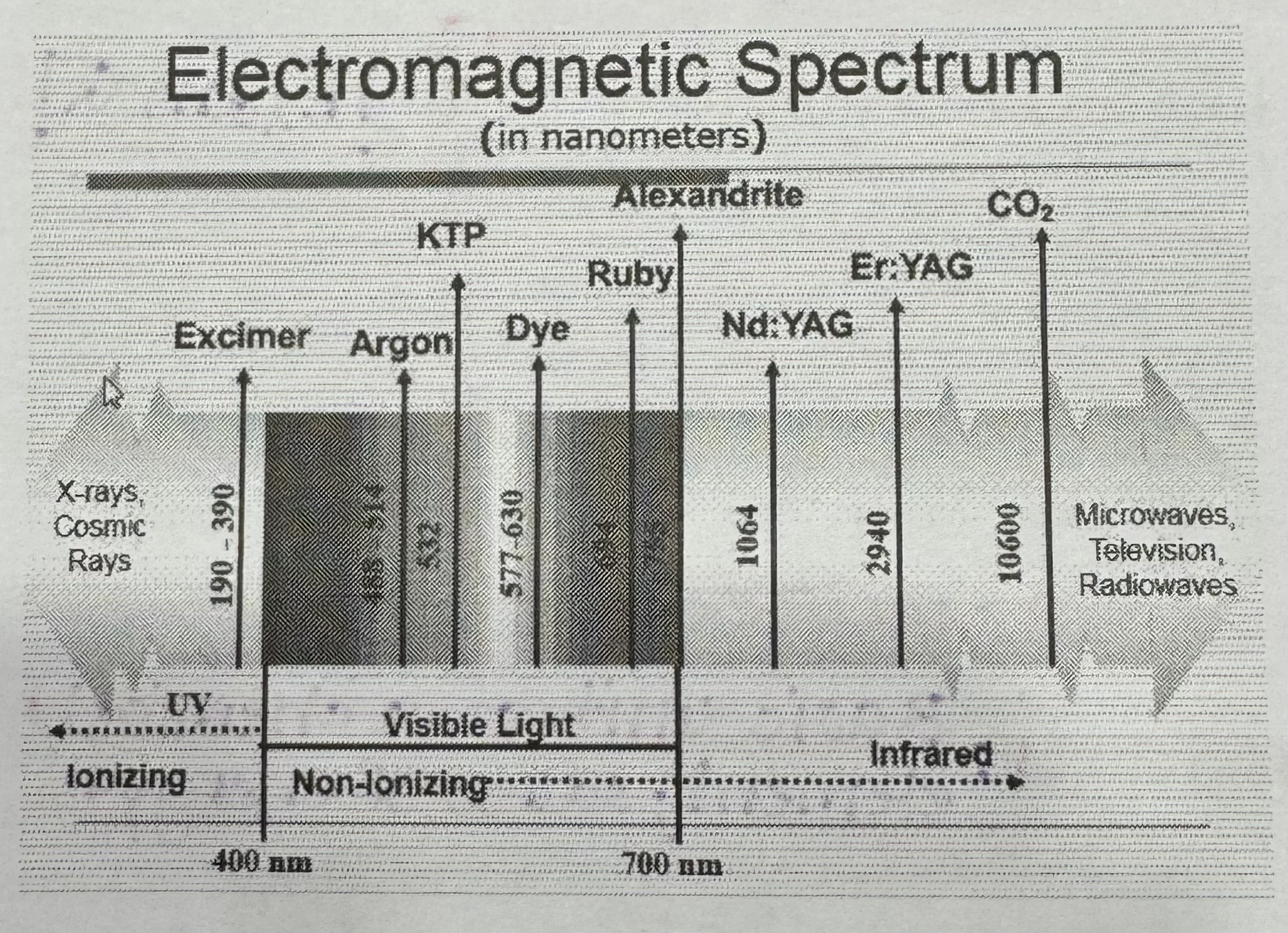
Wavelength is measured in nanometers when dealing with lasers or IPLs. One nanometer is 1/1 millionth of a millimeter. This is relevant because of what different wavelengths do to tissue. Chromophores (different colored structures in tissue) respond to different wavelengths of light.
Ionizing radiation (390nm or less): changes DNA, causing cell mutation and or cell death. Examples include: Nuclear, Gamma, X-Ray (to bones, used in airport security)
Non-ionizing radiation (400nm and up): does not change DNA. Examples include: sunlight, heat, incandescent light (lightbulbs), radio waves, microwaves, infrared
Nanometers of lasers:
Alexandrite - 755nm
YAG - 1064 nm
Diode - 810nm
Ruby - 694nm
IPL - 400-1200nm OR 400-1400nm
Visible light = 380-400nm OR 380-700nm
Retinal Hazard = 400-1400nm
Laser and IPL Characteristics (Pg.319)
Lasers are defined by the specific wavelength of light or energy that they produce. A laser is an instrument that generates a beam of light of a single wavelength or color that is monochromatic, collimated (parallel) and coherent.
Intense Pulsed Light (IPL): Rather than using a specific wavelength of light, IPL applies a broad range of light (400-1400nm). Filters are used to determine the wavelength. IPL is polychromatic, divergent (incoherent), and non-collimated.
Basic Laser and IPL Parameters
Laser: Wavelength, Pulse Width, Spot Size, Fluence
IPL: Filter (Wavelength Cutoff), Pulse Width, Fluence
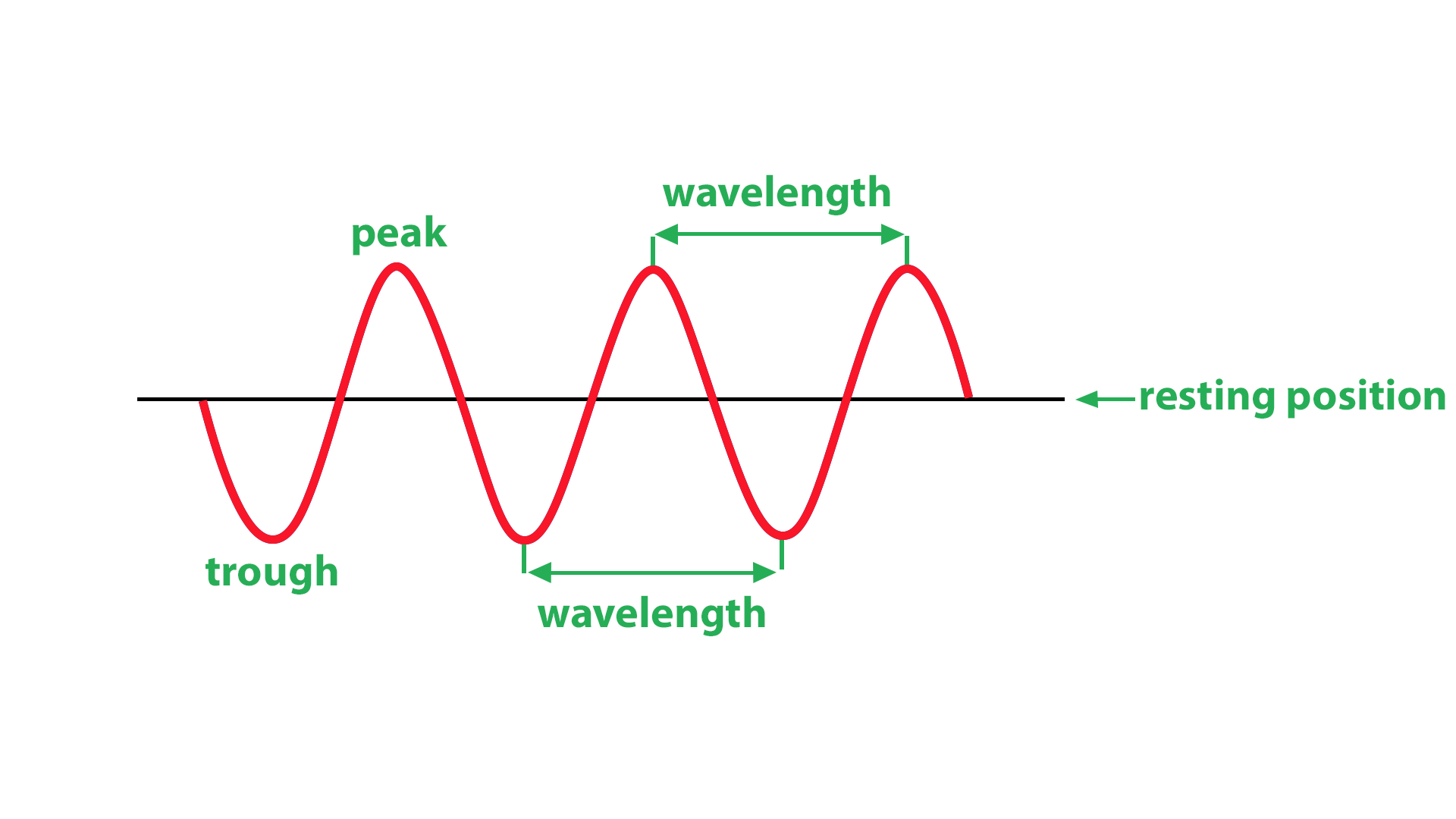
Wavelength: Wavelength is determined by the distance between two peaks and is measured in nanometers (nm). Wavelength dictates appropriate treatment for various chromophores based on depth of penetration.
Wavelength Properties
Chromophore/Target:
The lower on the spectrum of light the higher the attraction to melanin and oxyhemoglobin. (i.e. Alex Laser 755nm)
The higher on the spectrum the more attraction to water and less attraction to melanin and oxyhemoglobin. (i.e. IPL)
Depth of Penetration is dependent on wavelength and spot size:
The lower (smaller) on the spectrum, the shallower the penetration
The higher (larger) on the spectrum, the deeper the penetration
Larger spot size = deeper penetration
Absorption of Wavelength
Pulse Width = Time or duration. The amount of time energy directed to a target. Pulse Width is measured in milliseconds (ms) or nanoseconds (ns). Pulse width is time on target. I.e. A longer pulse delivers more gentle heating to the target, a shorter pulse is more destructive to the target
Spot Size Characteristics: maximum energy output is determined by spot size. Energy is limited by the size of the spot size on all devices for added safety.
Large spot size allows for deeper penetration and less scatter. Smaller spot size results in a shallower penetration and more scatter.
Fluence – measures the rate of energy per unit area. Fluence is measured in joules (J/cm2). As the fluence increases, so does the thermal injury to the target chromophore and surrounding tissue. Maximum fluence is determined by pulse width, spot size, and wavelength. The relationship between fluence and spot size is important.
Theory of Selective Photothermolysis
Selective photothermolysis states that laser light of a specific wavelength can destroy a target containing the adequate chromophore without damaging the surrounding tissue.
Pulse Width (Exposure) is limited to less than the thermal relaxation time of the chromophore.
Sufficient Fluence (Energy) reaches the chromophore to cause the desired effect.
Thermal relaxation time (TRT)
Selective destruction is possible, if the TRT of the target is longer than the duration of the laser pulse.
TRT, which is the time necessary for a target tissue to cool down by 50% (or 60%) through transfer of heat to surrounding tissue via thermal diffusion.
Laser Tissue Interaction
Absorption is necessary for effect on tissue
Reflection from the skin has a little practical importance, except as a safety concern. For example, some deodorants, body creams, and make up contain metal particles glitter that reflect the laser.
Scattering is a process that reduces the amount of laser energy that can be directed at the target tissue. More structures in the epidermis contain one or more of the chromophores that would absorb laser light. Most in insufficient amounts, resulting and energy deflecting
Transmission travels through tissue. The passage of laser energy through a biological tissue without producing any change of light to heat.
Absorption of laser/light energy is the key interaction between laser/light and tissue. It is what makes laser Treatments effective. I.e Grotthus Law - If there is not absorption, there’s no reaction.
Epidermal Cooling
Epidermal cooling allows, higher, fluence, and reduces discomfort and side effects. There are four types of epidermal cooling:
Clear gel used chilled
Contact cooling through a window cooled by circulating water
Cryogen spray applied immediately before and sometimes after the laser pulse
Air cooling such as a Zimmer cooler
Application = Hair removal; Target = Melanin
LASER HAIR REMOVAL (Pg. 322)
What is Laser?
Traditional/incandescent/flashlights = IPL
Exam Q: A laser is a device that produces a narrow and powerful beam of light that has many special uses in medicine, industry, etc. the letters in the word, laser stand for light amplification by stimulated emission of radiation.
How does a laser work? A laser works by light traveling in waves, and the distance between the peaks of a wave is called the wavelength.
Lasers produce a narrow beam of light in which all the light waves travel together with their peaks lined up in what is referred to as a phase. This is why laser beams are very narrow and bright with the ability to be focused into a very tiny spot.
Fundamentals
Lasers are distinguished from other light sources by their coherence. Spatial coherence (consistency) is typically expressed through the output being a narrow beam. Laser beams can be focused to very tiny spots achieving very high irradiance or they can have very low divergence in order to concentrate their power at a great distance.
Lasers are characterized according to their wavelength.
Exam Q: Lasers are employed in applications, where light of the required spatial or temporal coherence could not be produced using simpler technologies.
Lasers in hair removal
The primary principal behind laser hair removal is selective photothermolysis (SPTL), the matching of a specific wavelength of light and pulse duration to obtain optimal effect on a targeted tissue with minimal effect on surrounding tissue. Lasers can cause localized damage by selectively heating dark target matter, melanin, in the area that causes hair growth, the follicle, while not heating the rest of the skin.
Melanin is considered the primary chromophore for all hair removal lasers currently on the market. Melanin occurs naturally in the skin and give skin and hair their color. There are two types of melanin in hair. Eumelanin Gives hair brown or black color while pheomelanin gives hair blonde or red color. Eumelanin is dark brown or black, while pheomelanin is reddish or yellow.
Because of the selective absorption of photons of laser light, only black or brown hair can be removed. Laser works best with dark course hair. Light skin and dark hair are the ideal combination being most effective and producing the best results, but new lasers are now able to target black hair and patients with dark skin with some success.
Chromophore: Visible light that hits the chromophore can thus be absorbed by exciting and electron from its ground state (resting) into an excited state
Eumelanin: There are two types of eumelanin, brown and black
Pheomelanin: Pheomelanin impart a pink to red hue, depending upon the concentration.
Hair removal lasers
Under the FDA definition, permanent hair reduction is the long-term stable reduction in the number of hairs growing after a treatment regimen.
Alexandrite Laser:
Wavelength = 755nm
Light source = Near-infrared
Types of Skin = Fitz 1-4
Types of laser hair removal
Pulse duration(width) measured in nanosecond or millisecond is the timing of the light energy and one of the most important considerations.
Germ Cells = bulge/stem cells
The longer the laser stays on the tissue, the deeper the penetration and more thermal effects are produced.
Exam Q: Hair removal lasers have a spot size about the size of a fingertip 3 to 18 mm.
Power density or energy density/fluence is another important consideration. Energy or fluence is measured in joules per square centimeter (j/cm2)
Epidermal cooling has been determined to allow higher fluences and reduce pain and side effects, especially in darker skin.
Contact cooling
Cryogen spray
Air cooling
Gel
Power density is the combination of energy, spot diameter, and pulse duration.
Exam Q: Light energy is absorbed by the tissue chromophore - melanin, hemoglobin or water.
Energy fluence
Used in pulsed lasers, energy fluence is measured in joules. The larger the e spot size the more fluence that is necessary to produce the same effect.
Joule
Joule is the unit of energy in the international system of units. It is equal to the energy transferred to or work done on an object when the force of one newton acts on the object in the direction of its motion through a distance of 1m.
Laser Fundamentals (Pg. 327)
Tissue Optics
When laser light reaches the skin, it can interact with the tissue in four different ways: it can be absorbed, reflected, scattered, or transmitted. Most times, a combination of various interactions, each at different degrees, takes place at the same time.
Absorption
Absorption is the physical process in which light energy is converted by the target tissue into heat. When using lasers for therapeutic purposes, the goal is for the laser light to be absorbed by a specific target. The Grothus-Draper law of photobiology states that: In order to have a biological effect on the tissue light must be absorbed by the target tissue.
The three main chromophores in the skin are: melanin, hemoglobin/blood, and water. The amount of light that gets absorbed by the specific chromophore depends on the wavelength used and whether it corresponds to the specific absorption spectrum of the respective chromophore.
Reflection
Reflection of light can be minimized by applying the incident Laser beam perpendicularly to the tissue surface. It is crucial to try to keep the amount of reflection at the surface at its minimum as increased reflection means decreased fluence, absorbed by the tissue
Scattering
Exam Q: The amount of scattering of laser energy is inversely proportional to the wavelength of incident light (Laser energy scattering decreases as wavelength increases), with shorter wavelengths scattered more and longer wavelengths scattered less.
With larger laser beam diameters (spot size) less scattering occurs well at the same time there is deeper penetration and less loss of energy with depth of penetration.
Light- Tissue Effects
The biological effect of laser light in the tissue can only be achieved if the light is absorbed and converted into thermal energy. Tissue effects also depends on the conduction of the heat from the target to the surrounding tissue.
Exam Q: This means the damage achieved in the tissue depends on the energy density, the pulse width/pulse duration, and the heat conduction.
Photothermal
Photothermal effects occur when the absorbed light energy within the chromophore is converted into thermal energy.
Selective Photothermolysis
They described the selective absorption of a specific light by targeted chromophore is one of the most important concepts to explain laser principles.
Laser Principles
It states that laser energy can be absorbed by a defined target chromophore, leading to its controlled destruction without significant damage to the surrounding tissue.
Wavelength
The wavelength of the laser light needs to correspond to the absorption maximum or lie within the absorption spectrum of the respective target chromophore.
Pulse Duration
The pulse duration also called pulse width of the laser beam must be equal to or shorter than the thermal relaxation time of the target chromophore. The TRT is defined as the time needed for the target chromophore to dissipate 63% (or 50%) of its peak temperature. This time is directly proportional to the square size of the chromophore. Small objects, cool faster than larger ones well large chromophores have a longer TRT than smaller chromophores. The pulse width is this determined by the size of the target chromophore.
Energy Density
The energy density delivered by the laser beam, also referred to as fluence, must be high enough to actually destroy the target chromophore within the defined pulse duration. Energy densities are measured in joules per centimeter squared. Based on these concepts, the wavelength, pulse duration and fluence must all be tailored to the properties of the target chromophore and clinical indication in order to produce a desirable clinical outcome and avoid complications.
Consider, for example, in laser hair removal, where the target and the chromophore are not the same. The target chromophore in hair removal is melanin; however, the clinical targets seem to be the Hair matrix and stem cells. The hair matrix contains melanin and hence can be destroyed by direct heating. However, the stem cells do not contain pigment and are found at a distance from the pigment containing target chromophore, namely, the melanosomes within the hair shaft. If we heat only long enough to destroy the hair itself (nanosecond pulse width), the hair itself will fragment, but no permanent removal will result. In order to destroy the non-pigmented stem cells and achieve semi permanent hair removal , the heat must diffuse from the pigmented area (hair) to the target. Thus the clinical target will be destroyed by heat diffusion rather than by direct heat. This can only be achieved if the TRT is longer than the TRT of the chromophore. This mechanism has been proposed as the concept of thermal damage time as an extended theory of selective photothermolysis for non-uniformly pigmented targets. It basically states that thermal destruction of a clinical target at a distance from the chromophore can be achieved by heat diffusion.
Principles of Selective Photothermolysis:
Wavelength: preferentially absorbed by target chromophore
Pulse width: Shorter than TRT of target chromophore
Fluence: high enough to destroy target chromophore without damaging surrounding tissue
Parameters to adjust according to target: Wavelength, pulse width, fluence
Choosing the optimum wavelength for the absorption of the respective target chromophore is one important thing. However, for clinical results one has to bear in mind that within the visible range, penetration depth increases within increasing wavelengths.
Exam Q: Hence, although the highest melanin absorption is at short wavelengths within the visible range, those wavelengths will not penetrate deeply enough to, for example, reach melanin located in the dermis, and consequently treat a dermal pigmented lesion.
What Are Examples of Lasers That Are Used in Health Care Facilities? (Pg. 332)
Exam Q: Nd-YAG: Neodymium-doped Yttrium Aluminum Garnet
What are the types of hazards found when using lasers?
There are two types of laser hazards: the laser beam hazards, and the non-beam hazards. Laser beam hazards include eye and skin burns, which are due to laser beam shining on a person’s body. Non-beam hazards Are associated with the laser equipment or the hazardous substances released from the laser equipment, and fumes emitted from materials exposed to laser beams, including laser plumes produced during surgical procedures.
Sources of laser hazards include:
Lack of eye protection, equipment, malfunction, improper handling of high voltage systems
What standards can be used to develop a safe work practice program?
The American National Standards Institute (ANSI) standard Z136.3-2011
What are the eye hazards when using lasers?
Exam Q: Lasers in the visible light and near infrared range focus on retina. Therefore, the injuries produced our retinal burns. The infrared radiation is absorbed in the cornea and may cause corneal damage and loss of vision.
What kind of eye protection should be used?
The ability of eyewear to filter the laser beam is expressed in terms of optical density. Optical density, type of laser, and visibility required are all important factors in the selection of protective eyewear. Protective eyewear may not provide the same degree of protection for infrared as for visible light and ultraviolet laser beams. Goggles with side shields are preferred because they provide protection against back reflection and side entrance of stray laser beams.
Selection of protective eyewear
Consult appropriate standards, such as American National Standards Institute (ANSI) Standard Z87.1 For guidance on selecting protective eyewear for your specific application.
What are the skin hazards and what protective clothing is needed?
The potential for skin damage depends on the type of laser, power of the laserbeam, and the duration of exposure. The type of damage may range from localized reddening to charring and deep incision. Protective clothing, such as gown, cap or mask, Gloves, and safety eyewear may be required for working near a laser.
What are sources of fire hazards from lasers?
A fire can be started when laser beam or reflection of the beam strikes, a combustible material such as rubber, plastic, human tissue, paper products, skin treated with acetone and alcohol based preparations, human hair, and intestinal gases.
What are preventative measures for the fire hazard?
Train personnel to develop awareness about fire, hazards, and response procedures in case of laser fires.
Make sure that hot tip of the laser does not touch combustible items
Eliminate surfaces, which can reflect laser beams, such as mirrors
Make sure that preparation solutions are fully vaporized before covering the area with surgical drapes.
What are non-beam hazards?
Electrical hazards
Many lasers use high voltage and high current electrical power. The danger of electrical shock or electrocution arises when an untrained or unauthorized person tries to perform maintenance work without following the proper safety procedures. The American National Standards Institute Standard Z136.3 Outlines electrical safety procedures, applicable to laser equipment. Electrical safety requirements include the following:
Use proper grounding for metal parts of the of Laser equipment
Label laser equipment with electrical rating, frequency and watts.
Avoid contact with electrical components, including capacitors, which can contain an electrical charge even after the power is turned off.
Make sure that there is no electromagnetic interference between the laser equipment and other electrical equipment.
Administrative: A written laser safety policy.
Engineering controls: Local exhaust ventilation
Personal protection: appropriate eye protection
What are some of the duties of a laser safety officer?
In workplaces where a class 3b or class 4 laser is used, a laser safety officer or LSO must be on staff. The laser safety officer must do the following to ensure safe use of lasers; Confirm classification of laser.
What are some elements in a laser safety training program? Laser beam hazards (eye and skin hazards)
What is an example of a laser safety checklist?
Room:
Warning sign
Window and door covers ( non-transparent, non-reflective material)
Fire extinguishers
Secure, locked designated place for the laser key
Personal protection: training for use and maintenance of personal protection equipment, such as goggles and gloves (PPE)
Laser equipment: electrical power cords, should not be frayed
Smoke Evacuator:
Filter change date record
Responsibility for filter change assigned
Written operating procedures