postural control
postural control: ability to control orientation of body position in space to create stability
postural orientation: to be able to orient relationship between body parts & segments as they are related to a specific environment or task
postural stability: ability to control COM in relationship to BOS
COM: point at the center of total body mass
COG: vertical projection to the support surface of COM and space of BOS
BOS: area of body that is in contact with support surface
COP: area where force is directed onto support surface, moves continuously like COM but they are not the same
COM vs COP: COM is where center of mass is, COP is related to support surface/on support surface
all tasks require us to control these elements ^ to generate control of our posture, to create stability to perform a task w/ skill and effectiveness
related to dynamic systems theory from 1st module: any time we’re performing movement, it’s influenced by individual systems AND task demands & environmental context
balance=postural tasks, individual, environment
postural tasks=reactive, proactive, steady state
individual=motor, sensory cognitive
environment=support surfaces, sensory context, cognitive load
individual constraints=postural control system, neural components
postural control results from a complex interaction among many body systems that work to control both orientation and stability of the body
postural systems of individual=musculoskeletal, muscle synergies, sensory systems, cognitive strategies, cognitive resources, sensory organization
task constraints=balance control: feedback control, feed-forward control
most fxl tasks require all three aspects of balance control at some point
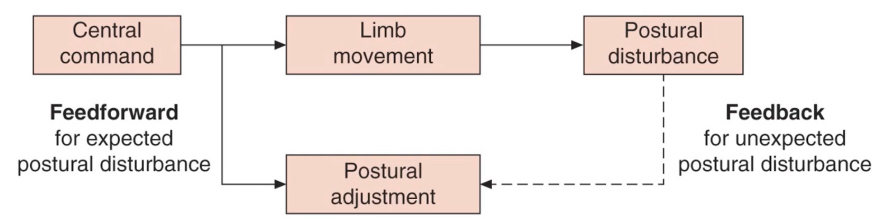
feedforward: when we’re expecting a disturbance so we engage postural control systems in order to maintain stability (proactive), predominantly via visual system (motor planning+visual inspection)
feedback: a postural adjustment in response to a postural disturbance (reactive), predominantly via proprioceptive system/vestibular system (not rly visual!)
environmental constraints= support surfaces, sensory context, cognitive load
steady state (NOT static) balance: body alignment can minimize effect of gravitational forces; muscle tone keeps body from collapsing in response to pull of gravity in different positions, not absent of movement (so not static)
certain muscles need to have tone in order to maintain upright standing in a controlled environment (solid surface): spinal extensors, glutes, ankle PFs* and DFs, abdominals, quads/knee extensors
postural tone: increase in activity in antigravity muscles to maintain upright position that are active during quiet activity (not active movement)
movement strategies: learned
limits of stability: bounds in which we can maintain control as COP moves within/around/near BOS
not just based on biomechanical constraints & limitations, but also affected by perceptual & cognitive factors.
ankle strategy, hip strategy
as we move and adjust posture, first adjustment is @ ankle, then hip
reactive balance control: unanticipated change in postural alignment & orientation requiring immediate postural realignment in order to maintain stability—quick, automatic response, stereotyped & very consistent
motor patterns: ankle, hip, step, reach-to-grasp (in order of normal recruitment)
in this order b/c speed of response is easier as we work more proximal to the sensory info being received/energy conservation
also more fxl: ex, hip response in upright stability may compromise stability to complete a task, less likely w/ ankle strategy
change in support strategies: step & reach to grasp
if balance is lost beyond ankle & hip, first response is to take a step then return to ankle & hip strategies to maintain stability: new BOS allows u to control momentum
reach to grasp is last resort by leaning against a surface to change BOS using UEs
AP stability: ankle strategy, hip strategy, then change-in-support
ML & multidirectional stability: ankle minimally involved (b/c inv/ev weaker than PF/DF)—hip and trunk strategies, then change in support strategies
refining & tuning muscle synergies: stereotyped reactions that are modified in response to changing demands of task & environment: ADAPTATION
still abnormal: responding w/ a large step every time (even when situation doesn’t call for one) b/c it’s not an efficient mechanism to use in every situation—lack adaptation
reactive balance in sitting: controlled similarly to that in stance; individual muscles change relative activation depending on direction of instability
BOS is limited at pelvis, so responses start from pelvis up
in order: trunk response, reach/change-in-support
proactive/anticipatory balance control: CNS uses anticipatory processes to control action which is critical in LE activities where the posture anticipates a voluntary movement
based on how we understand environment & task being performed
using predominantly visual system to gauge response
ex. when going from DL support to SLS, activation is at RF first on stance limb, then CL RF to prevent hamstrings from rotating the pelvis when they are activated (to bend the knee) and to stabilize the knee to control the motion in a predictable fashion
sensory inputs for steady-state balance
visual: position, motion of head w/ respect to surrounding objects, reference for verticality, self motion (eyes being tricked by the environment moving in a way we didnt expect)
somatosensory: provides CNS w/ position & motion info abt body w/ reference to supporting surfaces, report info about relationship of body segments to one another, integrates for steady state balance
fastest system, detects very fine movement changes/position changes
dependent on ability to sense changes (internal disruption or dampened by environment)
even light touch can reduce movement of COP w/ eyes closed
vestibular: provides CNS info about position and movement of head w/ respect to gravity & inertial forces
can help detect if we’re on a flat or incline surface
reactive control needed if we act like we’re on a flat surface when we’re on an incline
reweighting sensory info: ability to change what portion of sensory triad each sensory modality takes up effectively (adapting to sensory input), allows us to be effective & fxl across different environments & tasks
proprioception is most helpful w/ steady state control: rely more on somatosensation than visual or vestibular (when perfectly healthy) because it’s more useful
sensory inputs for reactive balance
visual input minimal, not as sensitive
takes a lot more time to react to a postural disturbance if relying on only visual input b/c there is a lot to interpret before you can react
somatosensory: very fast very sensitive; dominant system
vestibular: can recognize unanticipated change in orientation to gravity if head position changes
smaller than somatosensory
all integrate together to generate control
sensory inputs for proactive balance
visual: MOST critical depending on individual & task, guides postural control when we make movement
somatosensory & vestibular lay the groundwork based on initial conditions: body position and how it’s oriented to gravity BEFORE we move
cognitive systems in postural control
attentional resources: can be small in healthy ppl, but elevate with pathology/impairment
dual-task interference
should be considered w/ impairments: do they not have the resources to plan & execute effectively w/in a time frame?
reaction time frame is small (milliseconds)→more off balance, more momentum, more force to control, have to extend BOS further if they have to change it; none are fxlly safe or efficient
neural subsystems controlling postural orientation & stability
spinal: orientation component of postural control via tonic activation of extensors for weight support & directionally specific responses to perturbations present at SC level
a lot of steady state control occurs at spinal cord levels
reflexive control helps maintain tone & upright posture
UMN lesions: can see tone emerge abnormally (spasticity), often in patterns of tone against gravity that help maintain proper alignment and function
brainstem: regulate postural tone and automatic postural synergies
stereotypic, consistent
ability to adapt responses consistently occurs at higher levels (brainstem)
basal ganglia & cerebellum
bg controls postural set: combining postural movements through a motor program (rather than individual joint responses)
cerebellum controls adaptation of postural responses—error correction, trial and error learning
cortical: high level integration and adaptation
ability to decide to allow self to go off balance to a certain degree b/c it’s fxl for the task being done (ex. football, falling towards end zone on purpose)
falls: one of the main reason why ppl (esp geriatrics) come to therapy w/w/o pathology w/o secondary complications that come from falls
factors that contribute to falls/loss of balance
age: biological changes occur but don’t dictate flx changes that come with them; often b/c pathology becomes more prevalent
muscle weakness
hx of falls
gait deficits
balance deficits
AD use
visual deficits
arthritis
impaired ADLs
depression
cognitive impairment
stairs
throw rugs
slippery surfaces
poor lighting
4+ medications
etc
are usually multifactorial
age related changes to postural control: musculoskeletal, ROM, visual
somatosensory: due to age related pathology (ex. neuropathy); lag in sensory info→lag in response to postural disturbance
vestibular: hair cells lost over time→loss of vestibular sensitivity due to loss of receptors
can’t be manipulated
even tho it isn’t the dominant system in postural control, it is THE reference system to almost all other postural control related sensory info
usually at least vision/vestibular or somatosensation/vestibular give the same info, vestibular deficit BAD b/c loss of reference system→more challenging to interpret sensory info
vision: degrades over time
effects of dual tasking w/ age
diminished attention, cognition
more postural sway when dual tasking, more eradicate, more reactive than steady-state
don’t respond as efficiently, recruit muscles more strongly
falls w/ neuro pathology: prevalence varies by diagnosis & setting; associated w/ mobility (walking, transfers, stairs); impaired balance is most consistent RF for individuals who have neuro pathology who fall
certain components of postural control are limited depending on pathology
pathologic steady-state control
think about relationship of body segments to one another and to position of body w/ reference to gravity and BOS
alignment
determine movement strategies effective in controlling posture
influences how muscles recruited and coordinated for recovery of stability
examination: verticality & symmetry—can they orient to vertical, are they symmetrical when they do?
hemiparesis: more dramatic changes in postural orientation, BOS changes
postural sway: assessing stability during quiet stance
cerebellum pathology causes directionally specific increased postural sway (depending on area of lesion)
PD/levodopa replacement therapy: keep in mind med effects when seeing pt vs when pt is off meds (less sway vs more erratic)
fxl stability limits
determined by biomechanics of body, postural control abilities, environmental factors
examination: COP excursion during voluntary leaning—reduced in MS and PD
pathologic reactive balance
sequencing problems, problems w/ timely activation of postural responses, problems adapting postural activity to changing task & environmental
impaired in-place strategies (ankle, hip strategies)
sequencing problems: spastic limb will take longer to activate and order of recruitment is different
co-activation: muscles that would usually activate at different times/in a certain sequence activate all at the same time instead (ex. PD)→greater instability b/c available motion is reduced→more body body motion occurs in response to perturbation b/c too many components are ‘freezing’
delayed onset of postural responses: even a few milliseconds of a delay leaves room for a lot of postural excursion, causing a greater demand to correct it
problems modifying postural strategies (postural adaptation): in healthy ppl, response to fwd perturbation occurs only on one side of a joint (ex. hamstrings active, quads off); cerebellar pathology response to fwd perturbation occurs on both sides of a joint, agonist then antagonist activity (ex. hams then quads on)
impaired central set (motor plan)
norm flat surface fwd perturbation: ankle, then hip, then trunk activation
beam surface fwd perturbation: different pattern—little to no ankle, some quad & hip
sitting: trunk only
impaired central set (PD): similar recruitment pattern REGARDLESS of task/environment: gastroc, ham, paraspinal activation WITH antagonist activation very consistently in different situations
impaired change in support strategies: organization and timing of automatic stepping or reach for support strategies to recover from unexpected perturbation
pathologic anticipatory/proactive balance
loss of anticipatory processes that activate postural adjustments in advance of potentially destabilizing voluntary movements
dependent on previous experience and learning
normal arm pull: biceps activated as agonist, but first gastroc and hams activate in anticipation of pull
spastic arm pull: initial activation is biceps, then gastroc & hamstrings→leverage changes because position has changed, stability can’t be generated before the motion
sensory problems affecting steady-state
disrupt ability to adapt sensory inputs to changes in task & environment demands
we receive less or more sensory input and interpret the environment/task differently
disrupt development of accurate internal models and perceptions of body
leads to poor planning and responding to postural demands of the task, esp in a short timeframe
detecting position of body in space
accurate orientation cues in environment
sensory weighting
sensory problems affecting reactive balance
TIMING
somatosensory inputs from LEs have a major role—remember it’s the fastest sensory input
trigger centrally organized postural synergies
provide direct sensory feedback
sensory problems affecting proactive balance
loss of input results in profound changes in motor adaptation leads to earlier activation of anticipatory postural adjustments as a compensatory strategy→inefficiency, inappropriate stability→fatigue
perceptual problems affecting postural control
verticality
subjective visual vertical: orienting self to vertical based on orientation of surroundings
haptic or kinesthetic vertical: manipulating an object to be vertical (ex. handing pt a stick horizontally and asking them to hold it so that it’s vertical w/ their eyes closed)
subjective postural vertical: move pt out of postural alignment and ask them to adjust their body so that they are oriented vertically
balance and falls self-efficacy
confidence/fear
avoidance
major factor predicting participation in community mobility
activity & participation limited not only by pt actual balance abilities but also by perceived balance abilities
goal isn’t to improve balance, but to use their balance abilities in a more efficient & meaningful way; must address secondary concerns like fear
dual-task interference (again i guess)
attentional capacity: limited capacity in dual task conditions is exceeded & compromises stability
pathology may produce deficits in executive attention
influences allocation of attention under dual-task conditions impairing balance
maintaining stability requires more attentional resources in ppl w/ neuro path
may contribute to instability in DT conditions
people who fall have a larger COP tracing only in situations that demand divided attention